
NHS vs private ear care: making the right choice
- 24 hours ago
- 7 min read
TL;DR:
NHS waits for earwax removal in Scotland can extend from two to eight weeks or longer.
Private clinics offer faster, same-day appointments with transparent pricing and regulated safety.
Microsuction is the preferred, safest method for complex cases and individuals with ear health issues.
Many people in Scotland assume that getting earwax removed on the NHS is straightforward. Book an appointment, see your GP, and the problem is solved within days. The reality, however, is quite different. NHS waiting times for ear wax removal can stretch from two to eight weeks or considerably longer, and since 2025, routine wax removal has been deprioritised across many health boards. This article breaks down exactly how NHS and private ear care compare in Scotland, covering access, techniques, costs, and suitability, so you can make a confident, informed decision about your ear health.
Key Takeaways
Point | Details |
NHS waiting times | Routine wax removal via NHS often involves waits of several weeks or more, especially for non-urgent cases. |
Private care speed | Private clinics offer same or next-day appointments, transforming access and comfort for patients. |
Safety and methods | Both NHS and private clinics use safe, effective methods, with microsuction being the gold standard. |
Who benefits most | Private care is ideal for families, busy professionals, or anyone seeking quick, regulated relief in Scotland. |
How NHS ear care works for wax removal in Scotland
Understanding the NHS pathway for wax removal helps set realistic expectations. Treatment is free at the point of use, but access depends on clinical need, and the journey from symptom to treatment involves several steps.
The typical process looks like this:
Contact your GP to describe your symptoms, such as muffled hearing, a feeling of fullness, or tinnitus.
Assessment by the GP or a practice nurse to confirm wax build-up is the cause.
Referral to an audiology or ear, nose, and throat (ENT) department if the GP cannot treat you directly.
Prioritisation based on clinical urgency, which often places routine wax removal at the bottom of the list.
Since changes introduced in 2025, many Scottish GP practices have moved away from offering in-house ear irrigation, directing patients instead towards self-care using olive oil drops or signposting them to private providers. For those who do receive a referral, NHS waiting times for routine wax removal typically run from two to eight weeks, with ENT appointments for more complex cases sometimes stretching to six months or beyond.
“Routine wax removal is no longer considered a clinical priority in many NHS settings, meaning patients with significant but non-urgent symptoms may wait months for relief.”
This shift has left many people frustrated, particularly those whose hearing loss or discomfort is affecting their work, social life, or wellbeing. It is worth understanding what NHS ear treatments in Glasgow and Edinburgh currently look like in practice, and how this compares to the NHS versus private ear treatment landscape more broadly. The NHS remains an essential service, but for wax removal specifically, the pathway has become less predictable.
What private ear care offers: speed, choice, and expertise
With NHS waits posing a genuine challenge, private ear care has grown significantly as a practical alternative for people across Scotland. The advantages go beyond simply being seen more quickly.
Key benefits of choosing private ear care include:
Same-day or next-day appointments at regulated ear clinics for wax removal across Scotland.
No GP referral required. You can self-refer and book directly online or by phone.
Transparent pricing. At EARS Clinics, appointments cost £60 for adults and £75 for under-18s, with home visits available at £180.
Children accepted from age 2, making private care accessible for families who cannot wait for NHS paediatric audiology slots.
Flexible appointment options, including home visits for those with mobility difficulties or complex needs.
Regulation by Healthcare Improvement Scotland (HIS), ensuring clinical standards are maintained.
Private clinics can offer same-day appointments with transparent costs, and are regulated to the same clinical standards expected in NHS settings. This is a crucial point. Choosing private does not mean compromising on safety or expertise. It means accessing the same quality of care without the wait.
Pro Tip: When choosing a private clinic, always confirm it is registered with Healthcare Improvement Scotland. HIS registration means the clinic is inspected and held to strict clinical governance standards, protecting you as a patient.
For those in Edinburgh and the surrounding area, private ear wax removal in Edinburgh is available with straightforward online booking and no lengthy administrative process to navigate.
Treatment methods: comparing techniques and safety
Knowing what you get with private care, it is worth comparing the actual techniques used by both NHS and private providers, and understanding their respective strengths.
The three main methods used for ear wax removal are:
Microsuction: A fine suction device removes wax under direct visualisation using a microscope or loupe. No water is used, making it the safest option for people with perforated eardrums, narrow canals, or a history of ear surgery.
Irrigation (ear syringing): Warm water is gently flushed into the ear canal to dislodge wax. Effective for straightforward cases but unsuitable for certain medical histories.
Instrumentation (manual removal): Specialist tools such as a Jobson Horne probe are used to remove wax directly. Often combined with microsuction for best results.
Method | Best for | Pros | Cons | Typical provider |
Microsuction | Complex cases, children, perforations | Safest, precise, no water | Requires specialist training | Private clinics, some NHS ENT |
Irrigation | Straightforward wax build-up | Comfortable, effective | Not suitable for all patients | NHS and private |
Instrumentation | Stubborn or impacted wax | Highly targeted | Requires skilled practitioner | Private clinics, ENT |
Microsuction is considered the gold standard for wax removal, with a success rate above 90% and a complication rate below 1%. It is particularly valued in medically complex cases where irrigation carries risk. You can read more about the full range of ear wax removal procedures to understand which method suits your situation.
Pro Tip: If you have ever had a perforated eardrum, grommets, or ear surgery, always inform your clinician before treatment. Microsuction is almost always the safest choice in these cases, and a good private clinic will assess your history before proceeding.
For a detailed look at microsuction safety compared to traditional syringing, the evidence is clear: modern techniques used by trained specialists carry far lower risk than older methods.
Which is best for your needs? Key differences at a glance
After exploring methods and safety, here is a direct side-by-side comparison to help you decide quickly.
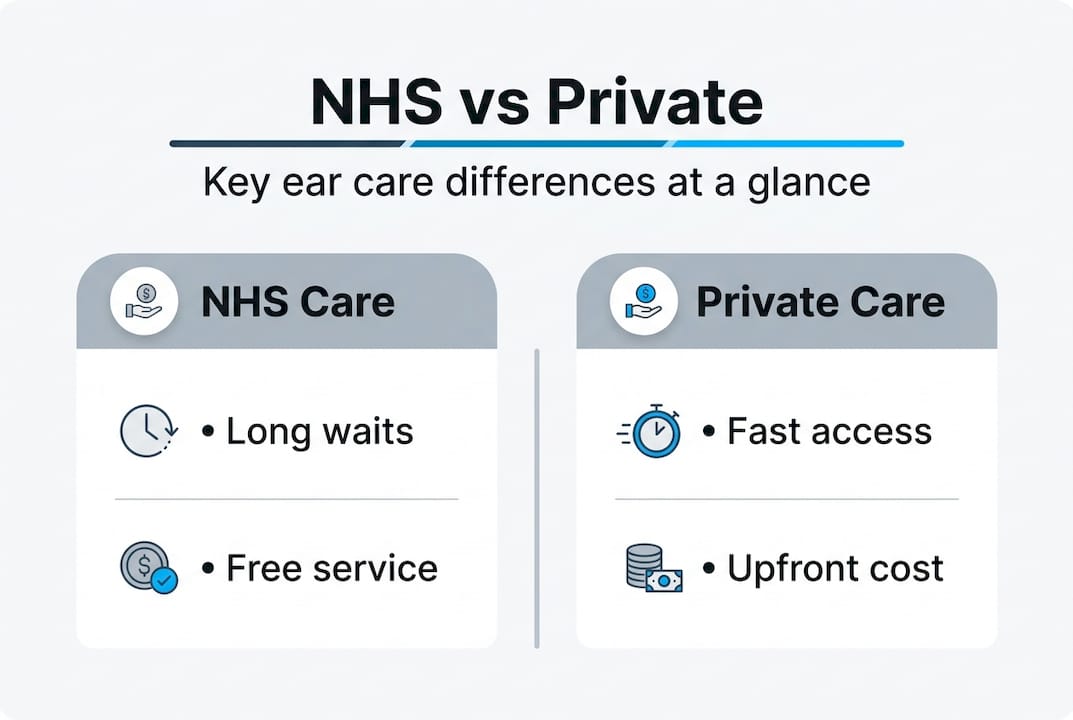
Factor | NHS | Private |
Cost | Free | £60 (adult), £75 (child), £180 (home visit) |
Waiting time | 2 to 8+ weeks | Same day or next day |
Referral needed | Usually yes | No |
Methods available | Irrigation, some microsuction | Microsuction, irrigation, instrumentation |
Children accepted | Limited | From age 2 |
HIS regulated | Yes | Yes (check before booking) |
Home visits | Rarely | Available |
Private clinics offer significantly faster access and fill important gaps where NHS provision is limited or slow. For many patients, this speed translates directly into restored hearing, reduced discomfort, and a faster return to normal daily life.
Who should seriously consider private ear care?
Anyone who has been waiting more than two weeks and is experiencing significant hearing loss or discomfort.
Parents of children with wax build-up who cannot access NHS paediatric services quickly.
People with complex ear histories, such as previous surgery, perforations, or recurring infections.
Individuals who need a home visit due to mobility or health challenges.
Those who simply prefer the convenience of booking on their own schedule.
For a full breakdown of the types of ear wax procedures available and how to choose the right one, it is worth reviewing your options before booking.
A fresh perspective: why immediate, specialised ear care matters
Here is an honest observation drawn from working in ear healthcare: most people wait far longer than they should before seeking help. There is a tendency to assume that blocked ears will resolve on their own, or that the NHS will see you quickly enough. In many cases, neither assumption holds true in 2026.
Delays in treating wax build-up are not merely inconvenient. They can affect concentration at work, a child’s performance at school, and the general quality of daily life in ways that quietly accumulate. Attempting home remedies, such as cotton buds or ear candles, often makes the situation worse, pushing wax deeper or irritating the canal.
Regulated private clinics meet high clinical standards and fill an essential gap when NHS care is delayed. What they also offer, and this is often underestimated, is reassurance. Knowing that a trained, HIS-regulated specialist has examined your ears and confirmed the situation is under control has real value. It removes anxiety, provides clarity, and allows you to get on with your life. Immediate, regulated ear clinic access is not a luxury. For many people, it is simply the most sensible choice.
Find your solution: fast, regulated ear care near you
If you have been waiting on NHS care or are unsure where to turn, EARS Clinics offers a straightforward path to relief. We are registered with Healthcare Improvement Scotland, NHS-accredited, and our Aural Care Specialists are trained in all major techniques including microsuction, irrigation, and instrumentation.
Whether you need a routine appointment or something more complex, our clinics in Glasgow and Edinburgh are ready to help. We offer a full range of ear wax removal procedures and flexible booking, including same-day appointments and home visits. Adults are seen from £60, children from £75, and home visits are available at £180. No referral, no unnecessary wait. Just professional, compassionate ear care when you need it.
Frequently asked questions
Is private ear wax removal safer than NHS care?
Both NHS and private clinics follow strict safety standards, and microsuction carries less than 1% complications with over 90% success, making it the gold standard method used in both settings.
Why is NHS ear wax removal so slow in Scotland?
The NHS has deprioritised routine wax removal since 2025, meaning non-urgent cases can face waits of two to eight weeks or longer, with some patients directed to self-care or private providers instead.
How much does private wax removal cost and is it covered by insurance?
Private appointments cost £60 for adults and £75 for children at EARS Clinics, and these costs are not typically covered by NHS provision or standard health insurance policies.
Can children and people with complex ear problems use private clinics?
Yes. Private clinics treat children from age 2 and are well equipped to manage complex or recurring ear problems, particularly when NHS services have long waits or limited paediatric capacity.
Will I need a GP referral for private ear wax removal?
No. You can self-refer and book directly with a HIS-regulated private clinic, often securing a same-day or next-day appointment without any GP involvement.
Recommended