
Muffled hearing after a cold: causes, timing and what helps

Muffled hearing after a cold is usually caused by swelling or mucus in the Eustachian tube, the narrow channel that links your middle ear to the back of your nose. It often clears within a week or so, but sometimes the cause is earwax, or a cold has simply made an existing wax problem obvious. This guide explains how to tell the difference, what is safe to try at home, and when to get your ears looked at.
TL;DR
A cold can swell the Eustachian tube and stop pressure equalising behind the eardrum, which dulls sound and makes the ear feel full.
In many cases the symptoms settle within a week or so, though they can last longer.
Yawning, swallowing, chewing and a gentle Valsalva manoeuvre are safe first steps. Cotton buds and ear candles are not.
If the blockage persists once the cold has gone, earwax may be involved, and a trained clinician can check and remove it safely.
Sudden hearing loss, hearing that worsens over days, earache, discharge or dizziness need prompt medical advice.
Why a cold muffles your hearing
Your middle ear is an air-filled space behind the eardrum. For the eardrum to move freely, the air pressure on both sides has to match. The Eustachian tube opens briefly when you swallow or yawn to let air in and keep that balance.
During a cold, the lining of your nose and throat swells and produces thicker mucus. According to NHS guidance on Eustachian tube dysfunction, this swelling or mucus can block the tube so pressure cannot equalise, and the common cold is the most frequent cause. The result is the familiar picture: sounds seem dulled, your own voice may echo, and the ear feels full, as if you were on a plane.

This is a problem with ventilation, not damage to the hearing system itself. That is why the hearing loss is usually described as temporary and why it tends to follow the cold rather than the other way round.
Other things that can do the same
Colds are not the only trigger. Sinus, throat, nose and ear conditions, including allergies as well as colds, can lead to poor ventilation of the middle ear. If you get blocked ears every spring or whenever your hay fever flares, allergy may be the pattern to look at, and a pharmacist or GP can advise on treating the nose.
Some people are more prone to longer-lasting problems. NHS guidance from Devon lists smoking, a significantly raised BMI, acid reflux and a blockage at the back of the nose, such as enlarged adenoids, as risk factors for long-term Eustachian tube dysfunction.
How long does it last?
The reassuring answer is that symptoms are likely to go within a week or so, although they can sometimes last longer. Many people notice the ear “pop” and sound return suddenly, often with a yawn or a blown nose.
A sensible rule of thumb:
While you have the cold: expect muffled hearing and fullness to come and go.
A few days after the cold ends: most people are back to normal or close to it.
Beyond a couple of weeks: it is worth asking whether something else, such as earwax, is contributing.
Beyond 12 weeks: the Devon guidance advises seeing a GP if symptoms persist for more than 12 weeks and have not responded to conservative measures, or sooner if other concerning symptoms appear.
What is safe to try at home
The aim is to help the Eustachian tube open, not to force anything into the ear canal.
Yawn, swallow and chew. Sipping water or chewing gum encourages the tube to open. These are the first measures listed in NHS Eustachian tube guidance.
Try a gentle Valsalva manoeuvre. Pinch your nostrils, close your mouth and blow very gently, as if inflating a balloon slowly. Gentle is the key word: blowing hard when you are congested is not wise, particularly if you have earache or suspect an infection.
Treat the cold itself. Rest, fluids and steam can ease nasal congestion. A pharmacist can advise on decongestants appropriate for your age and health conditions.
Leave the ear canal alone. Cotton buds, hairgrips and fingers can push wax deeper and scratch the skin. The NHS advises against putting objects in the ear, a point repeated in an NHS earwax management policy.
If you have ever had a perforated eardrum, ear surgery, or an ear that discharges, speak to a clinician before trying anything in or near the ear.
Is it the cold or is it earwax?
This is where many people get stuck, because the symptoms overlap. The NHS is clear that you should not self-diagnose hearing loss and should see a GP for advice, although the pattern of your symptoms can give an idea of the cause. The table below shows the usual patterns, as a guide rather than a diagnosis.
Clue | More likely cold or Eustachian tube | More likely earwax |
Timing | Started with or just after the cold | Was building up before, or lingers well after the cold |
Sides | Often both ears | Often one ear, though both can be blocked |
Changes | Ear pops, hearing comes and goes | Steady, constant dullness |
Other signs | Stuffy nose, sore throat, pressure on swallowing | Itching, a plugged feeling, tinnitus, sometimes a cough |
After a shower or swimming | Little change | Can suddenly worsen as wax swells |
The two problems can also happen together. A cold may make you notice a partial wax blockage that you had ignored, because you are paying closer attention to your ears. And if you have a cold while wax is already narrowing the canal, the combined effect can feel much worse than either alone.
Why a cold can make wax worse
Earwax is a normal, protective substance. Most ears clear it themselves. But wax can build up or be pushed deeper into the canal, especially when cotton buds, earbuds or hearing aids are used. When you are already muffled from congestion, it is tempting to poke around to “clear” the ear, and that is when a small amount of wax turns into a blockage.
If you think wax is involved, the NHS policy on earwax management recommends self-care first: 2 to 3 drops of olive or almond oil, twice a day for up to 2 weeks. Do not use drops if you have a perforated eardrum, a current infection or have had ear surgery, unless a clinician has said it is fine. If drops have made no difference, our guide to why ear drops sometimes do not work explains the next step, and our overview of safe remedies for an ear wax blockage covers what is and is not worth trying.

Children and muffled hearing after a cold
Children are especially prone to this. Their Eustachian tubes are narrower and less angled than an adult’s, so pressure can take longer to return to normal after a cold. A child may not say their ear feels blocked. Instead you might notice the television getting louder, “what?” becoming a habit, or a drop in attention at school.
Keep ears free of cotton buds, and see a GP if hearing difficulty continues after the cold has gone or your child has ear pain or a temperature. If the cause turns out to be wax, we can help: we are licensed and regulated to treat patients from 2 years of age, and you can read more on our page for children’s ear wax removal.
When muffled hearing needs prompt attention
Most post-cold muffling is harmless, but some patterns should not be waited out. The NHS advises seeking urgent GP advice or contacting NHS 111 for sudden hearing loss in one or both ears, hearing that worsens over days or weeks, or hearing loss with earache or discharge.
Two conditions are worth knowing about:
Perforated eardrum. It can follow an ear infection, an injury or a sudden change in air pressure. The NHS says it typically heals by itself within about 2 months, but it still needs assessing, and ears with a perforation should not be irrigated.
Labyrinthitis. Usually caused by a viral infection such as a cold or flu, it can bring vertigo and hearing loss, and usually improves on its own within a few weeks. If you feel dizzy or the room spins, speak to a GP or call NHS 111 rather than assuming it is simple congestion.
If your ear is painful, itchy and the canal looks swollen, you may have an outer ear infection. In that case irrigation can be unsafe, as we explain in our article on otitis externa and ear wax removal. For a broader view of warning signs, see why urgent ear care matters.
Our view: check the ear before you assume
We see this pattern often at EARS Clinics. Someone has a cold, their hearing dulls, and they wait. The cold passes, the ear stays blocked, and a few weeks later they are still waiting, or trying a cotton bud, or reaching for something from a pharmacy shelf that was never designed for their ear.
Our advice is simple. Give a cold-related blockage about a week or two, use the safe steps above, and then have the ear looked at rather than guessing. A short examination can tell whether the canal is clear and the eardrum looks healthy, or whether wax is sitting in front of it. That matters, because the right treatment is entirely different in each case: wax can be removed, whereas congestion needs time and care for the nose.
When wax is the problem, the method matters as much as the decision to treat. Microsuction is the method we favour and the one recommended in current NICE guidance, but irrigation and manual instrumentation remain safe and clinically valid when they are suitable. Our practitioners choose the safest approach for each patient based on their medical history and what they see in the ear. That is why ear care should only ever be carried out by trained, competent clinicians following best-practice standards, in a service regulated by Healthcare Improvement Scotland (HIS) or the Care Quality Commission (CQC). EARS Clinics are HIS registered, and our aural care specialists are NHS accredited. You can meet them on our team page.
— EARS
How earwax is removed safely
If an examination shows wax is the cause, there are three established methods.
Method | What it involves | Often suitable when |
Microsuction | A fine suction device removes wax under magnification, with no water in the ear | The wax is dry or hard, or irrigation is not advised |
Irrigation | Warm water is gently directed into the canal to flush wax out | The ear is healthy, the eardrum intact and the wax suited to flushing |
Manual instrumentation | Small, specialised instruments lift wax out directly | The wax is visible and accessible, or other methods are not appropriate |
None of these is right for everyone. A history of ear surgery, a perforated eardrum, an infection or a narrow canal can change which one is safest, and that is why a proper assessment comes first. For a fuller walk-through, read how ear wax is removed safely.
What about the NHS?
NHS access to earwax removal varies by area. Under one integrated care board policy, removal in primary or community care is available only after self-care has been exhausted and specific criteria are met. Your GP practice can tell you what applies where you live. Our article on NHS ear wax removal explains the usual routes in more detail, and why ear pressure from wax matters covers the NHS self-care steps.
Book ear wax removal with EARS Clinics
If your hearing is still muffled after the cold has gone and you suspect wax, or you simply want the ear checked, you can book directly with us in Glasgow or Edinburgh. There is no pre-treatment requirement, and we can often see you the same day.
Our published prices are:
Ear wax removal, 18 and over: £60
Ear wax removal, under 18: £75
Home visit within 20 miles of Glasgow: £180
Out of hours: £90
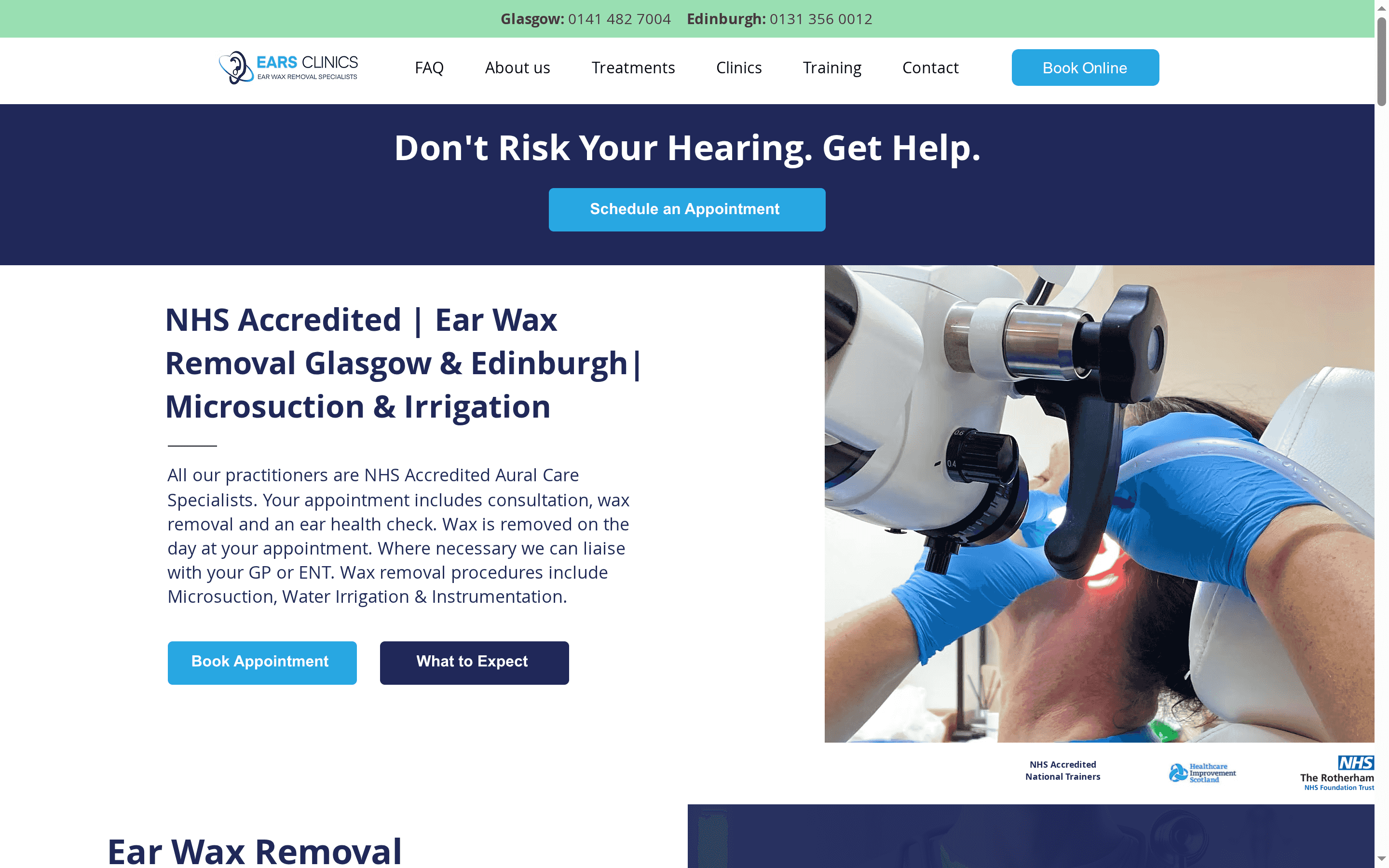
You can book online, look at our same-day ear wax removal option, or read what to expect at an appointment. If getting to a clinic is difficult, we also offer home visits. Where it is relevant, we can write to your GP or ENT specialist after the appointment.
FAQ
Why can’t I hear properly after a cold?
A cold swells the lining of the nose and throat and thickens mucus, which can block the Eustachian tube. Pressure behind the eardrum then cannot balance, so sound is dulled and the ear feels full. It usually settles within a week or so, but if it does not, ask for the ear to be examined.
Can earwax cause a blocked ear after a cold?
Yes. A cold does not create wax, but it can make a partial wax blockage more noticeable, and poking at the ear can push wax deeper. If symptoms linger after the cold has cleared, wax is a common reason. An examination can confirm it, and removal by a trained clinician can then restore hearing.
Can allergies or COVID make hearing muffled?
Allergies can, because they cause the same nasal and throat swelling that disturbs middle ear ventilation. Any respiratory infection that blocks the nose can do something similar. If your hearing changes suddenly or you feel dizzy, do not put it down to congestion: contact your GP or NHS 111.
Is it safe to pop my ears by blowing hard?
Gentle is the rule. A soft Valsalva manoeuvre is a recognised self-care step, but forceful blowing with a heavily blocked nose or a painful ear is not advisable. If you have earache, discharge or a history of eardrum problems, get advice first.
Why does my hearing still feel muffled after earwax removal?
It can take a little time for the ear to settle, and a lingering cold or Eustachian tube problem may still be affecting the middle ear. If hearing has not returned within a few days, or is worse, contact the clinic that treated you so the ear can be re-checked.
Sources
Recommended