
Why urgent ear care matters: spot risks and get swift help

TL;DR:
Ignoring ear symptoms can lead to serious complications, so urgent help is necessary when signs like discharge, swelling, or hearing loss occur. Professional assessment and treatment are essential, especially for infants, persistent symptoms, or sudden changes, to prevent lasting damage. Delaying care increases the risk of permanent hearing loss and more complex recovery, highlighting the importance of prompt expert intervention.
Ear discomfort is easy to dismiss. Most people assume that a blocked or painful ear is simply a matter of wax build-up that will resolve on its own, or with a quick trip to the chemist. But that assumption can be a costly one. Some ear symptoms point to conditions that genuinely cannot wait, and the NHS recommends seeking urgent help when earache is accompanied by fever, swelling, discharge, hearing change, or something stuck in the ear. Recognising which symptoms are truly urgent, and acting on them promptly, can be the difference between a straightforward recovery and lasting harm.
Key Takeaways
Point | Details |
Know urgent signs | Earache with fever, swelling, discharge, hearing loss, or foreign objects all mean you need prompt medical advice. |
Don’t DIY diagnosis | Symptoms often blamed on wax may actually signal infection, injury, or other issues needing professional attention. |
Act quickly | Getting urgent ear care can prevent long-term damage and improve recovery, especially for children. |
Seek expert help | Professional clinics safely diagnose and treat underlying causes far beyond simple wax removal. |
Recognising when ear symptoms are urgent
Let’s define exactly which symptoms signal that ear discomfort should not be ignored. Many people tolerate ear discomfort for days before seeking help, assuming it will pass. Sometimes it does. But certain symptoms are clear indicators that professional assessment is needed without delay.
The NHS urgent advice on earache is explicit: earache with fever, swelling, discharge, hearing change, or a foreign object in the ear requires urgent attention. These are not minor inconveniences. Each of these signs can point to a condition that worsens rapidly without appropriate treatment.
Here is a quick-reference guide to help you assess the urgency of ear symptoms:
Symptom | Possible cause | Urgency level |
Severe earache | Infection, injury, or foreign body | High |
High fever with ear pain | Middle ear infection (otitis media) | High |
Swelling around the ear | Mastoiditis or abscess | Very high |
Discharge from the ear | Infection or perforated eardrum | High |
Sudden hearing loss | Fluid, perforation, or inner ear issue | Very high |
Foreign object in the ear | Accidental insertion or insect | High |
Ear pain in both ears (infant) | Infection in a child under 12 months | Seek immediate help |
Reviewing this checklist against your own ear wax symptoms is a useful first step. If any of the above applies to you or your child, do not wait to see whether things improve.
Beyond the obvious red flags, there are subtler signs worth taking seriously. A persistent sense of fullness in the ear, muffled hearing that does not resolve after a few days, or ringing (tinnitus) that appears suddenly alongside pain are all reasons to seek a professional opinion. Understanding why immediate ear care matters goes beyond avoiding discomfort. It is about protecting your long-term hearing health.
Children under 12 months with earache in both ears represent a particularly urgent category. At this age, the immune system is still developing, and infections can escalate quickly. Any ear pain in an infant this young warrants same-day medical attention, not a wait-and-see approach.
“The moment you notice swelling around the ear, discharge, or a high fever alongside ear pain, that is the time to act, not the time to wait and see.”
Why self-diagnosis can be risky: not all wax is just wax
Now that we have outlined urgent symptoms, it is important to understand why making assumptions about ear wax can be dangerous. The challenge with ear symptoms is that they overlap. A blocked feeling, muffled hearing, or mild discomfort can all result from simple wax build-up. But they can equally be signs of an ear infection, a perforated eardrum, or even a foreign object lodged in the canal.

The problem with self-diagnosis is that the ear canal is not visible to the naked eye without specialist equipment. What feels like wax may be something else entirely. Wax symptoms are not always wax, and an urgent assessment helps rule out infective or structural problems that require completely different treatment.
Consider how these conditions compare:
Condition | Common symptoms | DIY safe? |
Ear wax build-up | Fullness, muffled hearing, mild discomfort | Softening drops may help |
Middle ear infection | Pain, fever, possible discharge | No, needs medical assessment |
Perforated eardrum | Sharp pain, hearing loss, discharge | No, can worsen with irrigation |
Foreign body in ear | Pain, hearing loss, sometimes discharge | Never attempt removal at home |
Outer ear infection | Itching, pain when touching outer ear | No, requires prescription treatment |
The table above highlights a critical point: even though the symptoms across these conditions can appear similar, the treatments are very different. Irrigation, for instance, is appropriate for certain types of wax removal but could cause serious damage if used on a perforated eardrum. Spotting wax build-up safely is something trained professionals do with the benefit of otoscopic examination (that is, looking into the ear with a lit instrument). It is not something that can be replicated accurately at home.
Pro Tip: Never insert cotton wool buds, hairpins, or any other object into your ear canal, even if you are certain the problem is wax. These items push wax deeper, risk puncturing the eardrum, and can introduce bacteria. If wax is causing problems, seek professional removal instead.
Parents in particular may notice that children struggle to articulate what they are experiencing. A child pulling at their ear, becoming irritable, or showing a reluctance to eat (because chewing can make ear pain worse) may be showing early signs of infection. Understanding ear wax impact on children and how quickly it can mask or be confused with other conditions helps parents make faster, better-informed decisions.
Situations that always demand urgent ear care
It is especially critical to respond fast in a few particular scenarios. These are the ones you should never ignore, regardless of how mild the discomfort may seem at first.
The NHS guidance on perforated eardrums confirms that foreign bodies, sudden hearing change, ear discharge, high fever, and signs of a perforated eardrum are all edge cases that raise urgency significantly. Here is a clear breakdown:
Suspected foreign object in the ear. This is especially common in young children, who may insert small items like beads, food, or toy parts into their ears. Do not attempt to remove these at home. Seek professional help immediately to access safe ear foreign body removal.
Sudden loss of hearing. If you or your child experiences a rapid, unexplained change in hearing, this is always urgent. Causes include sudden sensorineural hearing loss, which can become permanent if not treated within 24 to 48 hours in some cases. Time genuinely matters here.
Ear discharge with pain. Discharge that is bloody, yellow, or foul-smelling alongside pain is a strong indicator of infection or a structural problem. Do not assume it will clear up on its own.
High fever with ear pain. A temperature above 38°C combined with ear pain, particularly in a child, suggests a middle ear infection that may need antibiotic treatment. This is not a situation for over-the-counter pain relief alone.
Visible swelling behind or around the ear. This can indicate mastoiditis, a serious infection of the mastoid bone. It is rare but potentially life-threatening if not treated promptly.
Ear pain following a head injury. Any ear discomfort after a knock to the head needs urgent assessment to rule out a perforated eardrum or other trauma-related injury.
Pro Tip: If you are unsure whether your child’s ear symptoms are urgent, it is always safer to have them assessed than to wait. Professional assessment takes only minutes and can prevent days or weeks of worsening pain or complications. Learn more about ear safety for children and review our children’s ear care guide for practical, age-specific guidance.
What to expect from urgent ear care: the assessment and treatment process
Once you have recognised urgent symptoms, here is how the professional care process unfolds and what you can expect. Many people delay seeking help because they are uncertain what will happen or worry it will be time-consuming. In reality, the process is straightforward and often very quick.
A professional assessment typically includes:
A full symptom history. Your clinician will ask when symptoms started, how they have changed, and whether you have had any recent illness, injury, or travel.
Otoscopic examination. Using a specialist instrument, the clinician examines the ear canal and eardrum directly. This is the step that makes accurate diagnosis possible and distinguishes wax from something more serious.
Assessment of hearing. In some cases, a brief hearing check is performed to understand the extent of any impairment.
Treatment or referral. Depending on the findings, treatment may take place immediately, or you may be referred for specialist care.
The workflow for urgent ear wax treatment at a dedicated clinic is designed to be efficient. Same-day appointments mean you are not left waiting while discomfort worsens. If wax is confirmed as the cause, removal can often take place during the same visit using microsuction (which uses gentle suction to remove wax without water) or irrigation, depending on what is most appropriate.
Urgent assessment by an audiologist also helps rule out causes that need different treatment, such as infection requiring antibiotics or a perforation needing careful monitoring. Getting the right diagnosis quickly is what enables the right treatment to begin. It is not just about clearing wax. It is about making sure the ear is safe and healthy.
Follow-up care is equally important. After treatment, your specialist may recommend a review appointment, particularly if infection was present or if a child was treated. This aftercare step is what ensures the problem has fully resolved and that no underlying issues were missed.
The hidden cost of delay: why waiting risks your hearing
Here is what most people do not realise: the difference between a good outcome and a poor one is often not the severity of the original problem but the speed of response. We have seen this pattern repeatedly at EARS Clinics. A patient tolerates what seems like a minor blocked ear for two weeks. By the time they seek help, a straightforward wax removal has become more complex because of secondary infection. Another patient waits on a child’s persistent ear pain, assuming it is teething, only to discover a significant build-up that has started to affect hearing development.
These are not worst-case scenarios. They are common. Ear infections that are not treated with antibiotics can spread. Perforated eardrums that are aggravated by home remedies take longer to heal. Sudden hearing loss that is not addressed within the critical 48-hour window may not recover fully. The ear is a delicate structure, and why urgent ear care matters goes far beyond comfort. It is about preserving function.
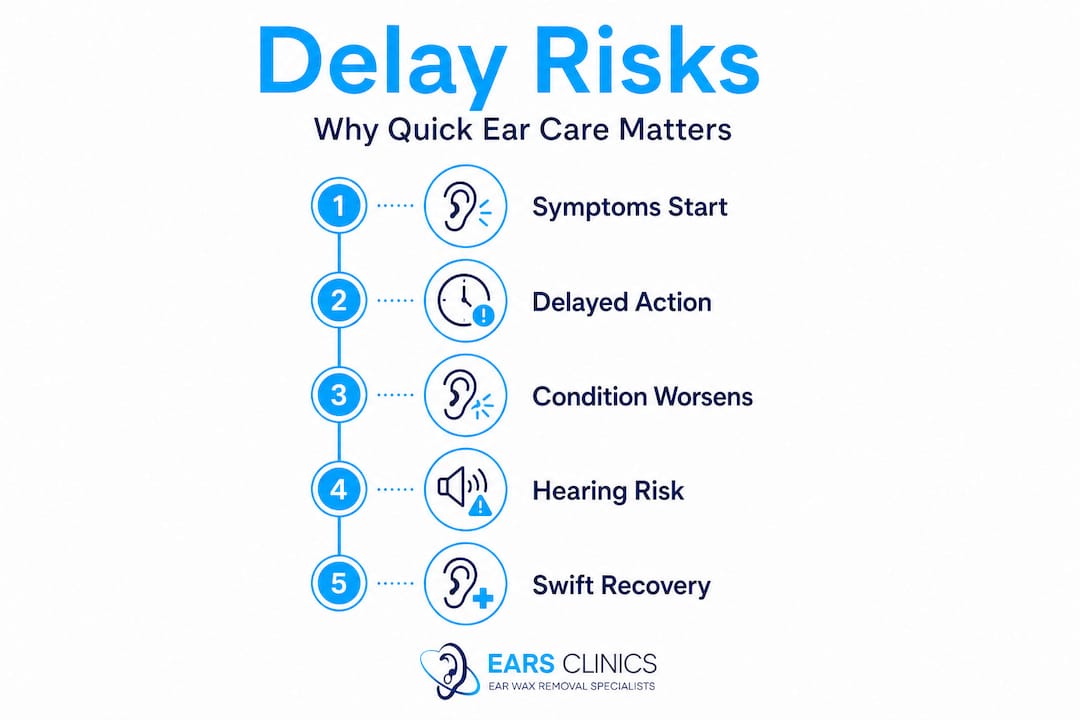
What we find is that patients who act quickly almost always have simpler treatment pathways and faster recoveries. Hesitation rarely pays off when it comes to ear health. If something feels wrong with your ears or your child’s ears, the most sensible course of action is to seek professional advice. The cost of waiting is nearly always higher than the cost of an assessment.
Swift, expert help for ear care in Glasgow and Edinburgh
If you think you or a loved one might need urgent ear care, help is right at your doorstep. At EARS Clinics, we offer same-day appointments and home visits across Glasgow and Edinburgh, delivered by NHS-accredited Aural Care Specialists. We are Healthcare Improvement Scotland (HIS) registered and one of the few fully regulated ear healthcare clinics in Scotland, licensed to treat patients from 2 years of age.

Whether the issue is confirmed wax build-up or a symptom that needs professional investigation, our team uses advanced ear wax removal procedures including microsuction, irrigation, and instrumentation. Every treatment is tailored to the individual, with no pre-treatment preconditions and no lengthy waits. Appointments cost £60 for adults, £75 for under-18s, and £180 for a home visit. If you would prefer to ensure you or your family receive the highest standard of care, our team has undergone rigorous microsuction training. Book today and get the swift, expert care your ears deserve.
Frequently asked questions
What are the main signs I need urgent ear care?
Severe earache, high temperature, swelling, discharge, hearing loss, or a foreign object in the ear all indicate that you should seek urgent help without delay.
Can ear wax cause permanent damage if not treated quickly?
Simple wax build-up rarely causes permanent damage, but if the underlying cause is not wax, other untreated conditions such as infections or perforations can lead to lasting harm.
Is urgent ear care different for children?
Yes. Infants under 12 months with earache in both ears, and any child with a suspected foreign body, should be treated as urgent cases requiring same-day professional assessment.
Are there risks with home ear wax removal?
Definitely. DIY removal methods risk pushing wax deeper, injuring the canal, or masking a more serious condition that needs expert assessment to diagnose correctly.
How quickly should I seek help if my hearing suddenly changes?
Sudden hearing loss is always an urgent matter. Acting within 24 to 48 hours is critical because, as NHS guidance confirms, delayed treatment for certain causes of sudden hearing change may result in permanent loss.
Recommended