
Understand irrigation: How it works and why it matters
- May 5
- 9 min read
TL;DR:
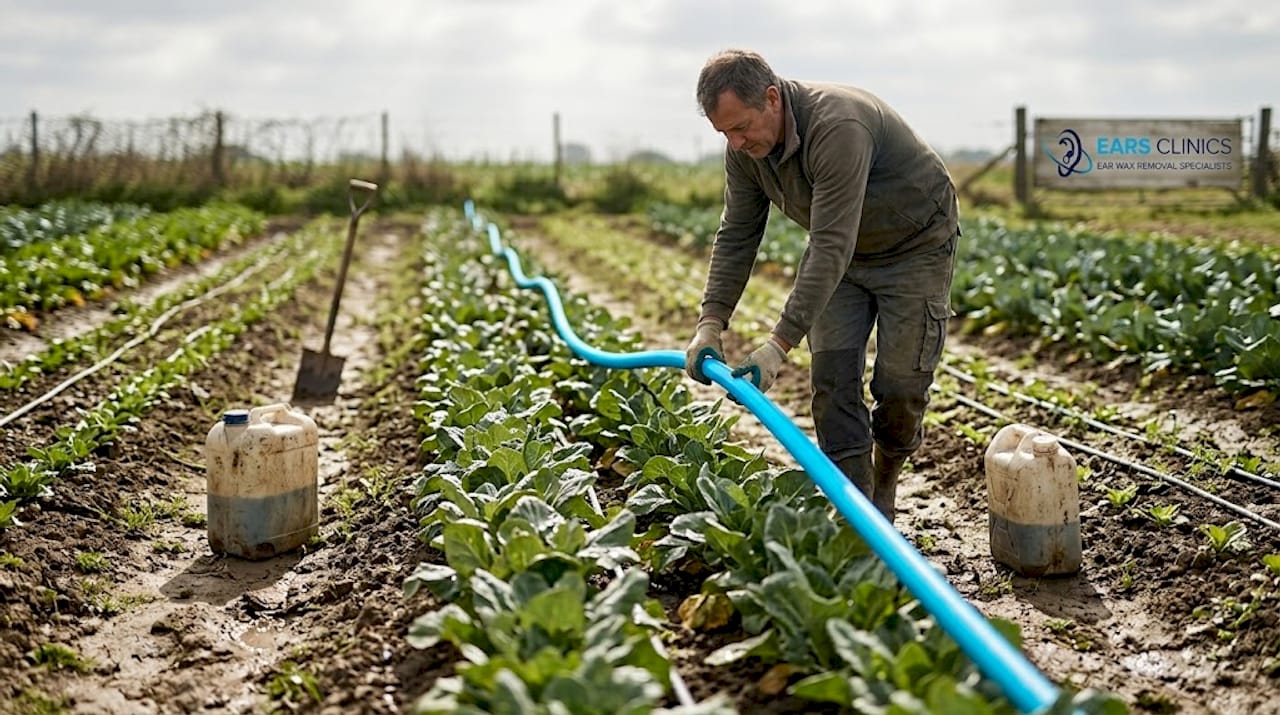
Irrigation involves the precise application of water to land or body parts to promote growth or facilitate cleaning. Its principles of targeted, efficient water delivery are applied in agriculture and in medical ear care to minimize waste and prevent damage. Choosing the appropriate method depends on environmental factors, resource availability, and specific needs for optimal results.
When most people hear the word “irrigation,” they picture vast fields of crops being watered by overhead sprinklers or channelled streams. Yet irrigation is a far more versatile concept than that image suggests. From the ancient civilisations that diverted rivers to grow food in desert regions, to the controlled water flow used in modern ear wax removal procedures, the underlying principle is the same: deliver water precisely where it is needed, in the right amount, at the right time. This article explains irrigation clearly, compares its methods, and draws meaningful parallels with medical ear care.
Key Takeaways
Point | Details |
Irrigation is targeted water use | Irrigation means supplying water directly where it’s needed, in farming or ear care. |
Method matters for success | Choosing the right irrigation type based on the environment maximises efficiency and safety. |
Efficiency prevents waste | Modern irrigation like drip systems reduce water use—just as precise care protects ear health. |
One size doesn’t fit all | Tailoring the method to specific needs gives the best results, whether for crops or in clinical care. |
Expert help improves outcomes | Professional guidance ensures the safest and most effective use of irrigation techniques. |
What is irrigation and why is it important?
Irrigation is the artificial application of water to land or soil, primarily in agriculture, to supplement rainfall, enable crop production in arid areas, and enhance yields. In essence, it is the deliberate act of giving plants a controlled water supply rather than depending entirely on nature to provide it. The word itself carries no mystery; it simply means getting water to where it is needed, reliably and efficiently.
The importance of irrigation cannot be overstated. Without it, vast areas of the world would be unable to produce food at all. Entire economies depend on the ability to grow crops year-round, regardless of seasonal rainfall patterns.
“Irrigation enables the production of food in water-scarce regions, but it requires careful management to prevent salinisation, erosion, and overuse of water resources.” — Britannica
What is particularly interesting is that the same core concept appears in healthcare. Our patient guide on ear irrigation explains how controlled water application is used to safely remove ear wax (cerumen) from the ear canal. Just as land irrigation targets specific areas with measured water flow, medical ear irrigation is a targeted procedure designed to dislodge and flush out wax without harming the delicate structures of the ear.
Why does any of this matter beyond farming? Consider the following:
Food security: Irrigated land produces more than 50% of global crop value while covering a fraction of total farmland.
Economic stability: Consistent harvests underpin agricultural economies, reducing vulnerability to drought.
Medical parallels: Controlled water use in ear care follows the same logic of precision and minimal waste.
Environmental awareness: Understanding irrigation helps communities manage water as a finite shared resource.
Child health applications: Irrigation for children in an ear health context requires the same careful calibration as irrigation in fragile ecosystems.
These parallels reveal that irrigation is not a single-industry concept. It is a broader philosophy of precision and control that applies wherever water needs to be directed with purpose.
Types of irrigation: Comparing methods and efficiency
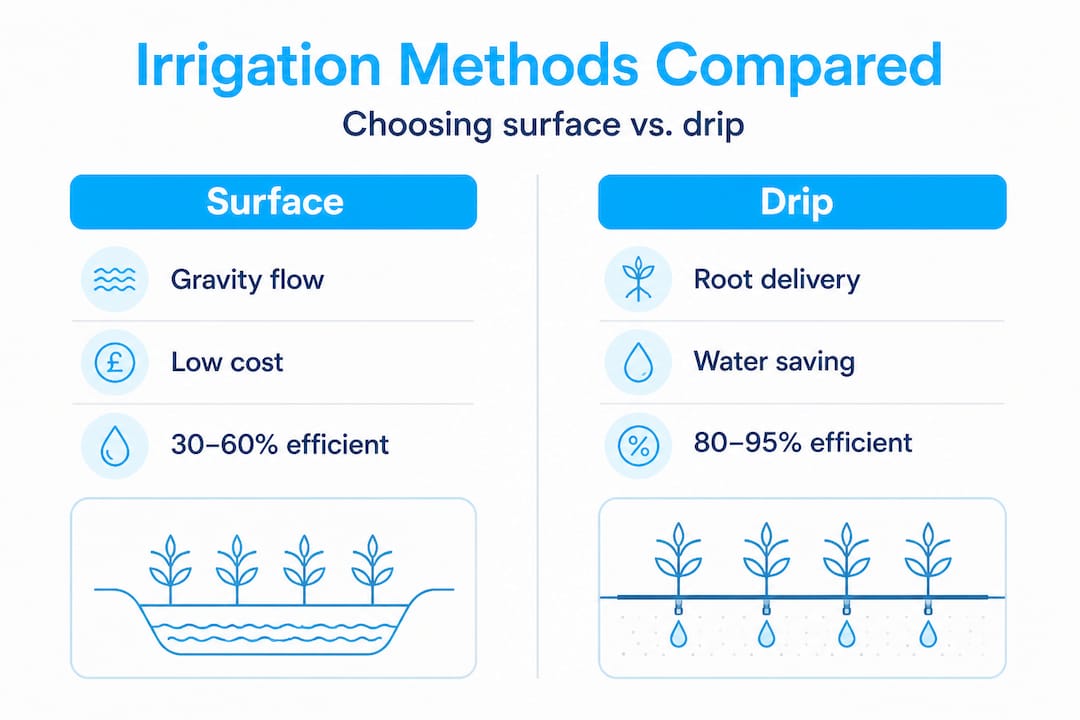
Main irrigation methods include surface (flood, furrow, and basin), sprinkler, drip or micro, and subsurface irrigation. Each method suits different environments, budgets, and crop requirements, and each carries distinct advantages and limitations when it comes to water efficiency and practical application.
Method | How it works | Efficiency | Typical use |
Surface (flood, furrow) | Water flows by gravity across the land surface | 30 to 60% | Row crops, rice paddies |
Sprinkler | Pressurised water sprayed over crops like rainfall | 70 to 85% | Lawns, cereals, vegetables |
Drip or micro | Water delivered via emitters directly to roots | 90 to 95% | Orchards, vineyards, row crops |
Subsurface | Pipes or tubes buried below soil release water near roots | Up to 95% | High-value crops, water-scarce areas |
The efficiency figures above are significant. Surface irrigation achieves only 30 to 60% efficiency, while drip irrigation can reach 90 to 95%. That gap has enormous consequences for water consumption, cost, and environmental impact.
Drip irrigation delivers water directly to plant roots via emitters, minimising evaporation and maximising efficiency. This targeted approach is elegant in its simplicity. Less water travels to areas where it is not needed, which means less waste, less erosion, and healthier plants.
There is a meaningful analogy here for anyone who has experienced a medical ear irrigation procedure. A safe removal procedure guide will show that the most effective ear treatments use precisely controlled water flow, directed only at the wax, with minimal surrounding tissue exposure. More is not always better. The aim is targeted action, not a deluge.
Advantages by method at a glance:
Surface irrigation: Low cost, no mechanical equipment needed, widely accessible.
Sprinkler systems: Versatile across terrain types, good for frost protection.
Drip irrigation: Outstanding water conservation, reduces weed growth, delivers nutrients precisely.
Subsurface irrigation: Minimal evaporation, reduces surface runoff, excellent for arid conditions.
Pro Tip: If you are weighing up irrigation methods for a smallholding or allotment, drip systems often pay for themselves quickly through reduced water bills and healthier plant growth. Similarly, when choosing an ear wax removal method, opting for targeted precision rather than aggressive flushing leads to better outcomes with less discomfort.
Understanding the technical differences between irrigation methods highlights why smart choices matter in both fields. But what factors help you decide which type of irrigation is best?
Choosing the right irrigation: Factors and edge cases
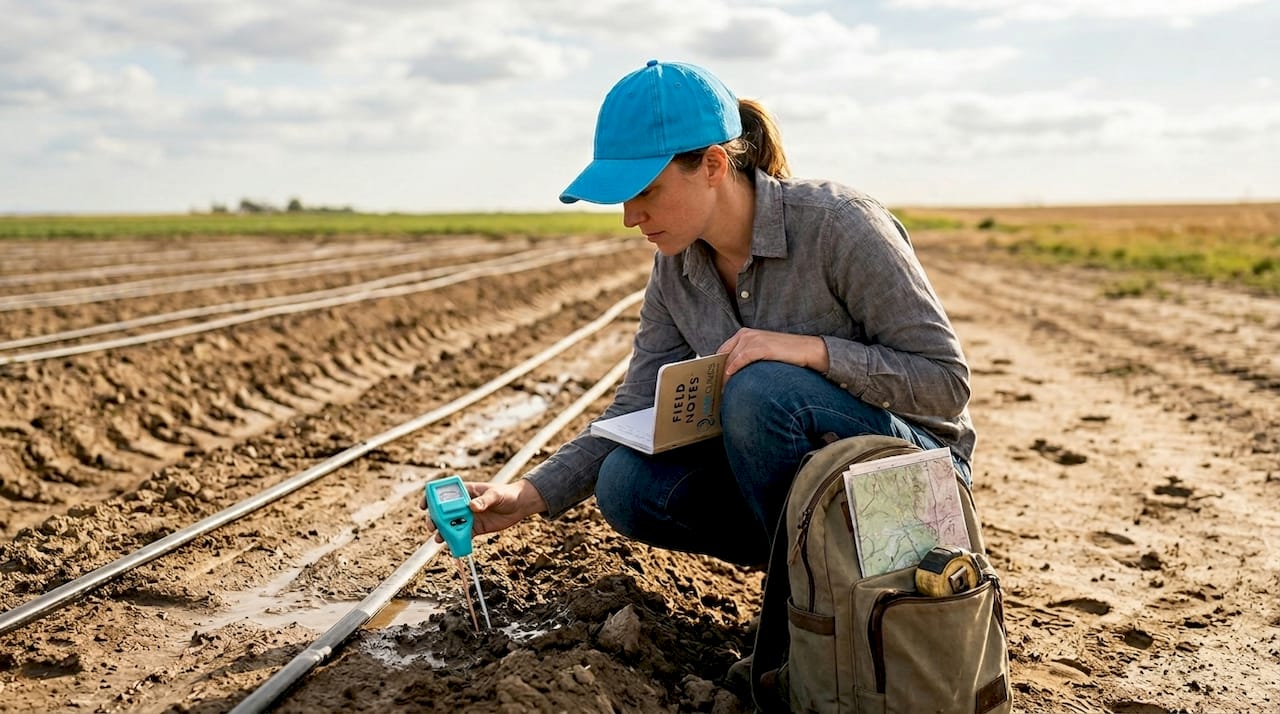
There is no universally perfect irrigation method. Optimal method depends on soil type, topography, crop variety, water source, and energy costs, and no single approach fits every situation. This is a point that is often underappreciated by those new to the subject.
Clay soils suit surface irrigation methods, whilst sandy soils benefit more from drip or sprinkler systems to prevent deep percolation, which is the loss of water deep into the ground before roots can absorb it. Getting the match right between soil type and irrigation method can mean the difference between a thriving harvest and a failed one.
Factor | Surface | Sprinkler | Drip | Subsurface |
Clay or heavy soil | Excellent | Good | Good | Moderate |
Sandy or light soil | Poor | Good | Excellent | Excellent |
Sloped terrain | Poor | Good | Good | Excellent |
Low budget | Excellent | Moderate | Moderate | Poor |
High water scarcity | Poor | Good | Excellent | Excellent |
Row crops | Good | Good | Excellent | Good |
A stepwise approach helps when selecting the right method:
Assess your soil type. Heavy clay retains water well; sandy soils drain quickly.
Map your terrain. Sloped or undulating land makes surface irrigation difficult to control.
Identify your crop. High-value crops justify the higher initial cost of drip systems.
Evaluate your water source. Limited water supply demands the most efficient option available.
Calculate energy costs. Pressurised systems (sprinkler and drip) require pumps, which add running costs.
Consider long-term sustainability. A method that depletes your water source faster than it replenishes is not viable.
The edge cases are where things get especially interesting. Consider a farmer with sandy soil on a slope trying to grow tomatoes in a semi-arid climate. Surface irrigation would lose most of the water to run-off and deep percolation before it reached the roots. A sprinkler system would lose significant moisture to evaporation in the dry, warm air. Drip irrigation is the obvious answer, but it requires initial investment and careful maintenance.
This mirrors a situation familiar in ear care. Different ear canals, different degrees of wax impaction, and different patient ages all call for different ear wax removal types. What works well for an adult with mild wax build-up may not be appropriate for a child or someone with a perforated eardrum. Context is everything.
Pro Tip: Before committing to any irrigation system, test your soil’s drainage rate. A simple percolation test takes less than an hour and can save you from investing in the wrong system entirely. This same mindset applies to ear care: seek a professional assessment before assuming you know the right treatment.
Choosing well leads to better results, but how much does irrigation really matter in the bigger picture?
Why irrigation matters: Impact, risks, and changing trends
The scale of irrigation’s global footprint is remarkable. In the United States alone, irrigation accounts for 47% of freshwater withdrawals, and irrigated farms produce over 50% of crop sales value whilst occupying only 17% of cropland. Those figures illustrate just how productive well-managed irrigation can be when the right method is chosen.
The trend towards more efficient systems is also striking. Pressurised systems such as sprinkler and drip are more efficient than traditional gravity-based approaches. In the western United States, the shift from gravity to pressurised irrigation rose from 37% in 1984 to 74% in 2023. That is a profound change in agricultural practice driven by necessity, efficiency, and sustainability goals.
“Irrigation enables production in water-scarce regions but requires careful management to avoid salinisation, erosion, and overuse of groundwater.” — Britannica
The risks of getting irrigation wrong are serious. Poor water management can lead to:
Salinisation: Excess water causes salt to accumulate in the soil, rendering it infertile over time.
Waterlogging: Over-irrigation suffocates plant roots by removing oxygen from the soil.
Erosion: High-volume surface irrigation can wash away topsoil, reducing future productivity.
Groundwater depletion: Drawing on aquifers faster than they refill creates a long-term water crisis.
Nutrient leaching: Water that drains too quickly carries nutrients away before plants can absorb them.
The lessons here translate clearly to healthcare. Ear wax removal safety is a primary concern for any reputable ear care specialist. Aggressive or poorly targeted irrigation of the ear canal can damage the eardrum, displace wax further inward, or cause discomfort and dizziness. Just as over-irrigation harms crops, excessive water pressure in the ear harms tissue.
The broader lesson is one of respect for the system you are working with. Whether that system is a field of wheat or a human ear, measured, targeted, evidence-based intervention consistently outperforms the blunt application of “more.” Sustainability in agriculture and safety in healthcare both rest on the same principle: do what is needed, no more, no less.
A fresh perspective: What irrigation in agriculture teaches us about ear care
There is a tendency, in both farming and healthcare, to believe that newer or more intensive always means better. The history of irrigation challenges that assumption directly.
For much of the 20th century, surface flooding was the dominant irrigation method because it was cheap and easy to implement. Farmers used more water than was strictly necessary, accepting significant inefficiency as an unavoidable cost of doing business. Then drip irrigation changed the calculation entirely. The shift to efficient methods like drip is now considered key for sustainability in the face of groundwater depletion and climate change. The revelation was not a new technology exactly, but a new philosophy: targeted precision beats brute force.
This same shift is visible in ear care. Cotton buds and ear candles remain popular despite overwhelming clinical evidence that they are ineffective or actively harmful. Yet people continue using them because they seem intuitive; push the problem out or burn it away. The reality, as any NHS-accredited Aural Care Specialist will confirm, is that precision techniques such as microsuction or carefully controlled irrigation yield far better results with far less risk. Our stepwise ear care approach reflects exactly this philosophy, as does the detailed step-by-step ear removal process we follow at every appointment.
The right question is never “which method is best?” in isolation. It is always “which method is best for this patient, at this time, given their specific anatomy and history?” A child’s ear canal differs from an adult’s. Someone with a history of ear surgery needs a different approach entirely. Just as a farmer with clay soil on a slope should not default to surface flooding simply because it is traditional, a patient should not default to self-treatment when a qualified specialist can assess their individual situation.
Pro Tip: Prioritise custom, evidence-based care in every context. Whether you are selecting an irrigation system for your land or seeking help with blocked ears, the most effective outcome comes from matching the method to the specific need, not from applying whatever is most familiar or convenient.
Discover safe solutions and expert support for ear care
If this exploration of irrigation has shed light on why precision matters so much in medical ear care, you may be ready to take the next step for your own hearing health.

At EARS Clinics, we offer a full range of ear wax removal procedures carried out by NHS-accredited Aural Care Specialists at our Glasgow and Edinburgh clinics. Whether you need a routine appointment or a same-day ear wax removal for an urgent blockage, we can help quickly and safely. Appointments are available for adults from £60 and children from £75, with home visits at £180 for those who cannot travel. We are one of the few Healthcare Improvement Scotland (HIS) registered ear clinics in Scotland and are licensed to treat patients from two years of age. For healthcare professionals looking to develop their own skills, we also offer accredited ear wax removal training courses across Scotland and Cumbria.
Frequently asked questions
What is irrigation in simple terms?
Irrigation is the artificial application of water to land or soil, mainly to help plants grow and improve crop yields in areas where natural rainfall is insufficient.
What are the main types of irrigation systems?
The main types are surface (flood, furrow, basin), sprinkler, drip or micro-irrigation, and subsurface irrigation, each suited to different soil types, climates, and crops.
Why does choosing the right irrigation method matter?
Using the right method ensures efficient water use and reduces waste. No single method is universally best; the optimal choice depends on soil type, topography, crop, and available water source.
How does drip irrigation save water?
Drip irrigation delivers water directly to plant roots via emitters, minimising evaporation and surface run-off, making it one of the most water-efficient systems available.
Is irrigation only used in agriculture?
No. Irrigation principles extend to other fields, including medicine, where controlled water application during ear wax removal procedures is essential for safe and effective outcomes.
Recommended