
How is ear wax removed safely: your UK guide

For most adults, ear wax (cerumen) clears naturally without any intervention. When it builds up and causes symptoms, the first step is softening it at home using olive oil, almond oil, or over-the-counter cerumenolytic drops. If home care does not resolve the problem, a trained clinician will remove the wax using one of three clinically accepted methods: microsuction, irrigation, or manual instrumentation. The right method depends on your medical history, the type and position of the wax, and any contraindications the clinician identifies during assessment.
Key points before you start:
Earwax is a natural protective mechanism and routine cleaning is usually unnecessary.
Soften wax with drops before seeking professional removal — it improves outcomes.
Never insert cotton buds, hairpins, or any object into the ear canal.
Seek professional assessment if symptoms persist, worsen, or are accompanied by pain, bleeding, or sudden hearing loss.
Professional removal should only be carried out by trained, regulated clinicians following HIS or CQC standards.
Pro Tip: If you wear hearing aids, you are at higher risk of wax build-up. A regular ear health check with a qualified aural care specialist can prevent impaction before it affects your hearing.
How do you know if your ear is blocked with wax?
Earwax build-up does not always cause obvious pain. The symptoms tend to develop gradually, often in one ear first, and are frequently mistaken for other conditions.
Common signs include:
Muffled or reduced hearing — the most frequent complaint, often described as hearing through cotton wool
A feeling of fullness or pressure in the ear
Tinnitus — ringing, buzzing, or humming that was not there before
Earache or mild discomfort, particularly when chewing or yawning
Intermittent hearing loss that comes and goes
Itching inside the ear canal
A reflex cough, caused by stimulation of the vagus nerve in the ear canal
Symptoms that suggest something other than wax, and that require prompt medical review, include sudden severe pain, bleeding, discharge, dizziness, or any hearing loss following a head injury. A clinician using an otoscope can confirm whether wax is the cause — visual inspection is often the only reliable way to distinguish impaction from other conditions.
Safe home care: softening wax and encouraging natural migration
The safest first step at home is to soften the wax. Do not probe the ear canal. Softening alone is often enough to allow the wax to migrate naturally to the outer ear, where it can be wiped away gently with a cloth.
Choose your softening agent. Olive oil, almond oil (check for nut allergies first), or mineral oil are all suitable. Over-the-counter cerumenolytic drops — such as those containing sodium bicarbonate, hydrogen peroxide variants, or carbamide peroxide — are also effective. Cerumenolytic options vary in formulation; follow the product instructions for dosing.
Apply the drops correctly. Warm the oil or drops to body temperature by holding the bottle in your hand for a minute. Lie on your side with the affected ear facing upward. Instil 2–3 drops into the ear canal.
Allow time to work. Stay lying down for 5–10 minutes to let the drops penetrate. A small piece of cotton wool placed loosely at the entrance (not pushed in) can prevent drips.
Repeat consistently. NHS guidance recommends applying drops 3–4 times a day for 3–5 days. Symptoms may take some time to improve fully.
Use a bulb syringe only if appropriate. If drops alone are insufficient and you have no history of ear surgery, perforation, or grommets, you may gently flush the canal with body-temperature water using a rubber bulb syringe. Never use cold or hot water — temperature differences can cause vertigo.
Stop and seek help if needed. If there is no improvement after consistent softening for the recommended period, or if symptoms worsen at any point, stop home treatment and seek professional assessment.
For a detailed step-by-step guide, the safe ear care at home resource covers softening, timing, and when to stop.

When should you see a pharmacist or GP about earwax?
Not every case of wax build-up needs a GP appointment. Knowing who to contact first saves time and gets you the right advice faster.
Your pharmacist can:
Advise on suitable over-the-counter cerumenolytic drops and how to use them correctly
Confirm whether your symptoms are consistent with wax build-up or suggest you see a GP
Recommend a course of drops before any professional removal
Your GP can:
Examine the ear with an otoscope to confirm impaction
Provide professional removal where the surgery offers it — typically irrigation or, less commonly, microsuction
Refer you to a community ear care service or ENT department if removal is not available at the practice
What to expect from primary care: availability of wax removal at GP surgeries varies considerably across the UK. NICE guidance recommends that removal be offered in primary or community care settings, yet many practices no longer provide the service routinely and instead refer patients elsewhere or prescribe extended courses of drops. If your GP cannot offer removal, a regulated private clinic such as EARS Clinics provides the same clinically accredited procedures with same-day access.
Professional removal methods: microsuction, irrigation, and manual instrumentation explained
When home softening is insufficient, a clinician will select the most appropriate removal method based on your medical history and what they observe during otoscopic assessment. Microsuction, irrigation, and manual instrumentation are all clinically accepted; no single method is universally superior, and the choice is always individualised.
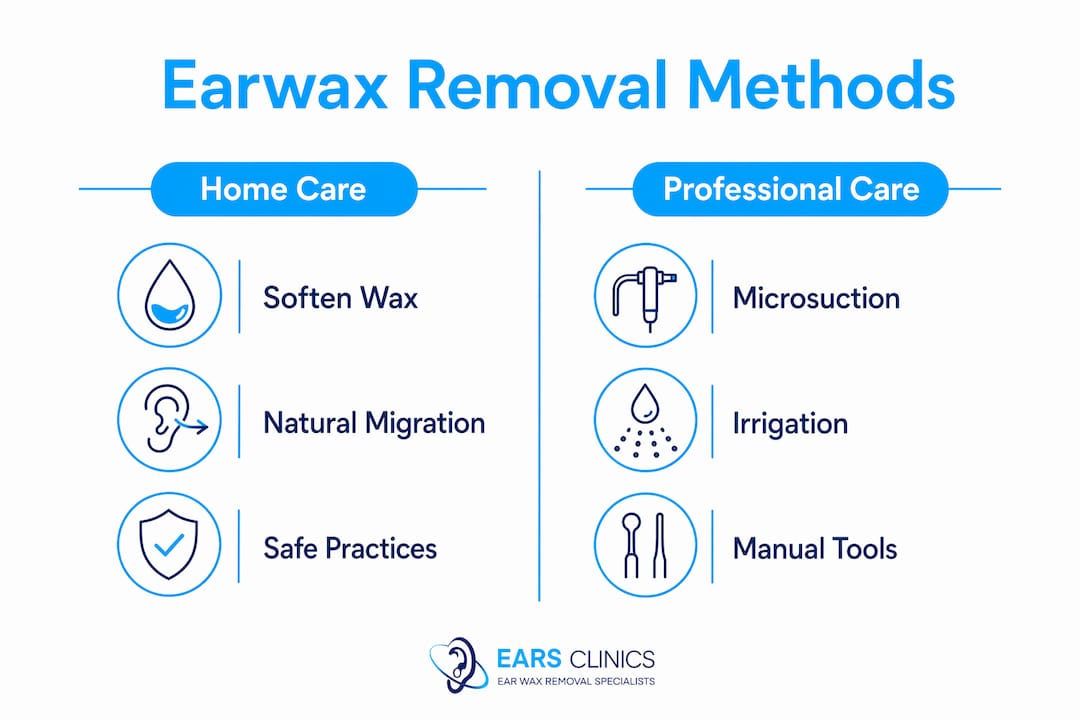
Microsuction
Microsuction uses a fine, low-pressure suction probe to remove wax under direct visualisation, usually with a microscope or loupe. Because no water is introduced, it is suitable in many situations where irrigation is contraindicated — including suspected or confirmed tympanic membrane perforation, grommets, previous ear surgery, and active infection. Most patients find it comfortable, though the suction sound can be startling. A typical appointment takes around a short duration. NICE guidance notes that microsuction is widely preferred by clinicians where available, though it requires specialist equipment and trained staff.
Irrigation
Irrigation flushes the ear canal with warm water or saline using an electronic irrigator. The clinician must first visualise the tympanic membrane with an otoscope to confirm there is no perforation before proceeding. Pre-treatment with softening drops — either immediately before the appointment or for up to five days beforehand — significantly improves success rates and reduces the need for repeat visits. Water temperature matters: irrigation must use water at body temperature, as cooler or warmer water can trigger vertigo. Irrigation is contraindicated where there is a suspected perforation, grommets, a history of ear surgery, or a foreign body in the canal.
Manual instrumentation
Manual instrumentation uses instruments such as a curette, loop, or alligator forceps to remove wax under direct visualisation. It is particularly effective for hard, impacted wax that does not respond well to softening or irrigation. The technique requires a high level of clinician skill and good patient cooperation, as the instruments work in close proximity to the canal wall and eardrum. When performed by a trained aural care specialist, it is safe and can be faster than other methods for certain presentations.
Comparison of professional removal methods
Method | Safety / contraindications | Who it suits | How it works | Comfort | Hard vs soft wax | Setting | Typical time | Typical cost |
Microsuction | Safe with perforation, grommets, post-surgery, infection | Most patients; preferred when irrigation is contraindicated | Suction probe under direct vision | Generally comfortable; suction noise can startle | Effective for both | Clinic | a short duration | Private: from £60 (EARS Clinics) |
Irrigation | Contraindicated with perforation, grommets, recent surgery, foreign body | Patients with intact eardrum and no surgery history | Warm water flush via electronic irrigator | Comfortable when water is body temperature | Better for soft wax; pre-softening needed for hard | Clinic / GP | a short duration | NHS (where available) or private |
Manual instrumentation | Requires intact canal; higher skill threshold | Hard impactions; patients who cannot tolerate water | Curette, loop, or forceps under direct vision | Tolerable; requires patient cooperation | Most effective for hard, impacted wax | Clinic | a short duration | Private: from £60 (EARS Clinics) |
Before any procedure, a trained clinician will check: otoscopic visualisation of the eardrum, history of perforation or ear surgery, presence of grommets, active infection, and patient cooperation. This assessment determines which method is safest for you.
Red flags: when to seek urgent or professional care
Some symptoms should not be managed at home, even temporarily. Stop self-care and seek prompt medical attention if you experience any of the following:
Sudden or significant hearing loss, particularly if it develops quickly
Intense or worsening ear pain
Bleeding from the ear canal
Discharge (fluid or pus) from the ear
Dizziness or vertigo
Facial weakness or numbness
High fever alongside ear symptoms
Any ear symptoms following a head injury
Persistent symptoms despite correct use of softening drops for the full recommended duration should also prompt professional assessment rather than continued home treatment.
How long does ear wax removal take, and what does it cost in the UK?
Timings to expect:
Home softening: 3–5 days of consistent drops; symptom improvement may take up to two weeks
In-clinic procedures: most microsuction or irrigation appointments take around a short duration per ear, with additional time for otoscopic assessment and, where provided, before-and-after imaging
Pre-treatment tip: using drops for 3–5 days before your clinic appointment typically reduces procedure time and improves comfort
Cost in the UK:
NHS route: where GP surgeries still offer removal, it is provided free within NHS pathways. Availability varies widely; many practices now refer patients to community services or decline to treat uncomplicated wax.
Private clinics: charges apply per appointment. At EARS Clinics, appointments are priced at £60 for adults (over 18s), £75 for under-18s, and £180 for home visits. Same-day appointments are available.
Unsafe methods and common mistakes to avoid
Some widely used ear cleaning habits cause more harm than they prevent. These are the ones to stop immediately.
Cotton buds: the packaging itself warns against inserting them into the ear canal. They push wax deeper rather than removing it, and can scratch the canal wall or rupture the eardrum.
Ear candles: research confirms they do not work and carry a genuine risk of burns, wax deposits from the candle itself, and canal injury.
Unregulated ear vacuums: no clinical evidence supports their use, and suction applied without proper assessment can cause trauma.
Forcing objects into the canal: hairpins, pen lids, folded tissue — all carry the same risk of perforation, infection, and deeper impaction.
Home irrigation without assessment: if you have any of the contraindications listed above, flushing the ear at home is unsafe. A clinician must assess first.
The natural remedies that do have evidence behind them are simple: warm oil drops, cerumenolytic solutions, and gentle bulb syringing when appropriate. Everything else is best left to a trained professional.
How EARS Clinics approaches ear wax removal
EARS Clinics provides NHS-accredited aural care using microsuction, irrigation, and manual instrumentation, all performed by trained Aural Care Specialists. The clinics are registered with Healthcare Improvement Scotland (HIS) and are among the few regulated ear healthcare providers in Scotland, serving patients in Glasgow and Edinburgh.
Every appointment begins with a thorough otoscopic assessment. The clinician reviews your medical history, screens for contraindications, and selects the safest and most appropriate procedure for your specific presentation. No single method is applied by default.
Services include:
Otoscopic assessment with before-and-after imaging
Microsuction, irrigation, and manual instrumentation
Same-day and routine appointments
Home visits for patients who cannot attend a clinic
Specialist care for children (from age 2) and patients with complex or sensitive ear conditions
Clinical correspondence with GPs and ENT teams where required
Appointments can be booked directly at earhealthservice.co.uk. The meet the team page details the qualifications and accreditations of the clinical staff.
Key takeaways
Microsuction, irrigation, and manual instrumentation are all clinically valid methods for ear wax removal; the safest choice depends on your individual history and is always determined by a trained, regulated clinician.
Point | Details |
Soften first | Apply olive or almond oil drops several times daily for a few days before seeking professional removal. |
Avoid probing | Cotton buds, ear candles, and unregulated vacuums cause harm and have no clinical evidence of benefit. |
Know the red flags | Sudden hearing loss, bleeding, discharge, vertigo, or severe pain require prompt medical attention, not home care. |
Understand your options | Microsuction suits most patients including those with contraindications to irrigation; irrigation and instrumentation are valid alternatives when clinically appropriate. |
EARS Clinics | Provides HIS-registered, NHS-accredited microsuction, irrigation, and instrumentation in Glasgow and Edinburgh, with same-day appointments from £60. |
The case for clinician-led ear care
There is a tendency to treat earwax as a minor inconvenience — something to sort out at home with whatever is to hand. The clinical reality is more nuanced. The ear canal is a short, narrow passage ending at a delicate membrane, and the consequences of getting it wrong range from a pushed-in impaction to a perforated eardrum. What makes professional removal genuinely safe is not the equipment alone; it is the assessment that precedes it. A trained clinician looks at the ear, considers the history, and chooses accordingly. That individualised decision is something no home remedy or unregulated device can replicate.
Microsuction is often the preferred method where it is available, and for good reason — it works under direct vision without introducing water, which matters enormously when contraindications are present. But irrigation and manual instrumentation, performed by a competent clinician following proper assessment, are not inferior options. They are different tools for different presentations. The goal is always the same: clear the wax safely, with minimal discomfort, and without causing harm.
Book a private, regulated ear wax removal appointment
If home softening has not resolved your symptoms, or if you would prefer not to wait for an NHS referral, EARS Clinics offers same-day and routine appointments with NHS-accredited Aural Care Specialists in Glasgow and Edinburgh.
Every appointment includes a full otoscopic assessment before any procedure is performed. Clinicians are trained in microsuction, irrigation, and manual instrumentation, and will select the method that is safest for your ear. The clinics are registered with Healthcare Improvement Scotland (HIS), making them among the few fully regulated ear care providers in Scotland.
Appointments are priced starting from a moderate fee for adults, with variations for children and home visits. To book or to find out more about the procedures available, visit earhealthservice.co.uk for same-day availability.
Useful sources and further reading
The following sources informed this article and are recommended for further reading:
Earwax build-up — NHS: The NHS patient-facing guidance on symptoms, safe home care, and when to seek professional help. A reliable first reference for anyone in the UK.
Management of earwax — NCBI Bookshelf (NICE guideline evidence review): The clinical evidence review underpinning NICE recommendations on removal methods, settings, and pre-treatment. Authoritative for clinicians and informed patients.
Cerumen Impaction Removal — StatPearls, NCBI Bookshelf: A clinical reference covering procedural detail for microsuction, irrigation, and manual instrumentation, including contraindications and technique.
How to remove cerumen manually and with irrigation — Merck Manual (Professional): Step-by-step procedural guidance for clinicians on safe irrigation technique, water temperature, and manual removal.
Safety and effectiveness of earwax removal methods — NIHR Health Technology Assessment, NCBI Bookshelf: A systematic review and economic evaluation of removal methods for the UK NHS, providing context on the evidence base and cost-effectiveness of different approaches.
Recommended