
Ear drops not working? Here's what actually clears earwax

Ear drops usually soften earwax rather than remove it, so if your ear still feels blocked after several days, that is not a failure on your part. It means the wax is compacted enough to need a different approach. The single most important next step is to keep using the correct softening drops for the full course recommended, then get professional help if nothing changes.
Try this before doing anything else:
Warm the bottle in your hand for a short time; cold drops can cause dizziness and may not flow properly.
Lie with the affected ear facing up and stay still for a few minutes after applying drops.
Use the recommended number of drops, twice daily, for the duration indicated by the product instructions.
According to NHS guidance, if symptoms persist after a full course of drops or the ear stays severely blocked, it’s time to seek professional clinical assessment rather than continuing to self-treat.
Key Takeaways
Ear drops soften wax rather than dissolve it instantly, so a fair trial of correct technique for several days, followed by professional removal if the blockage persists, is the safest and most effective path.
Point | Details |
Give drops a real trial | Use correct technique, warmed drops, and the full recommended course before judging them ineffective. |
Know your red flags | Severe pain, discharge, sudden hearing loss, or vertigo mean stop self-treating and seek assessment. |
Escalate softeners in order | Try olive oil or Earol first, then sodium bicarbonate drops if the plug remains after weeks. |
Avoid drops with certain conditions | Skip all ear drops if you have a perforation, grommet, or recent ear surgery. |
Book professional removal when needed | Earhealthservice offers microsuction, irrigation and manual instrumentation with same-day appointments in Glasgow and Edinburgh. |
Symptoms of earwax build-up versus signs you need urgent care
Most earwax blockages feel more annoying than alarming: muffled hearing, a sense of fullness, mild tinnitus, or an itchy, blocked sensation that comes and goes. These symptoms respond well to softening drops and time in the majority of cases.
Some signs mean you should stop self-treating and get seen sooner rather than later:
Severe or worsening ear pain
Discharge that is thick, smelly, or blood-stained
Sudden or significant hearing loss in one ear
Dizziness, vertigo, or a spinning sensation
Fever alongside ear symptoms
You should also avoid ear drops altogether if you have a known perforated eardrum, a grommet or ventilation tube, or have had recent ear surgery. Putting drops into a compromised ear can introduce infection or cause pain that has nothing to do with wax. If any of this applies to you, NHS advice is to see a pharmacist or GP for a proper assessment instead of guessing.
How to use ear drops correctly
Most cases of “the drops didn’t work” actually come down to technique, not the product itself. Getting this right gives you a genuinely fair trial before you consider anything else.
Warm the bottle by holding it in your palm or under warm (not hot) water for a couple of minutes.
Lie on your side with the affected ear upward, or tilt your head so the ear faces the ceiling.
Gently pull your outer ear up and back (down and back for children) to straighten the ear canal.
Apply the stated dose, typically two to five drops depending on the product.
Stay tilted for 5 to 10 minutes so the liquid reaches the wax rather than running straight back out.
Repeat according to the schedule on the label, usually twice daily.
This warming-and-positioning method mirrors clinical guidance on correct ear drop technique, and it addresses the most common reasons drops seem ineffective.
Softening takes days, not minutes. Expect to judge results after 3 to 5 days of consistent use, not after one or two applications.
Pro Tip: Gently wiggling your earlobe for a few seconds after applying drops helps work the liquid past any air pockets and down towards the blockage, rather than letting it sit at the entrance of the canal.
Why ear drops may not work for your blocked ear
Sometimes the technique is perfect and the drops still don’t clear things. There are usually mechanical, product, or medical reasons behind this.
Mechanical causes are the most common. Wax can become truly impacted, particularly in narrower ear canals, or if cotton buds or hearing aids have repeatedly pushed it deeper rather than out. Drops soften surface wax efficiently but struggle to penetrate a dense, compacted plug sitting further along the canal.
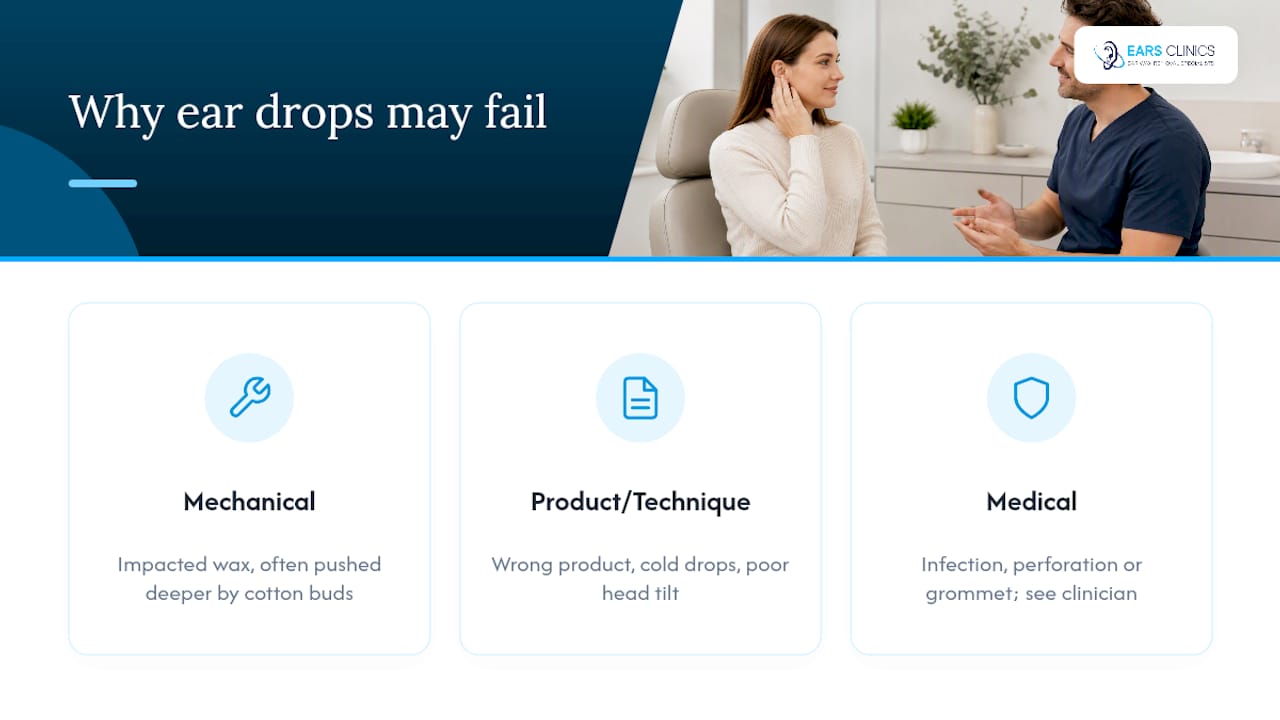
Product or technique issues come next. Using the wrong product for the type of wax, applying drops cold, using too few drops, or not staying tilted long enough all reduce effectiveness. A clinical resource on ear drop troubleshooting points to incorrect head position and drops touching the ear canal wall as frequent culprits.
Medical causes change the picture entirely. Infection, inflammation, a perforated eardrum, or a grommet can all mean drops are ineffective or unsuitable. One paradox worth knowing: softening a plug can temporarily make hearing feel worse, because the wax swells before it clears. If your ear feels more blocked after starting drops, that’s often a sign the wax needs removing by a clinician rather than more softening.
Alternatives to ear drops worth trying before clinical removal
If a week of correct technique hasn’t shifted things, a different softening product, or a different approach entirely, may help before you need an appointment.
Olive oil or Earol spray: a gentle, widely available option. NHS Kernow patient guidance recommends olive oil or Earol for up to 4 weeks as the first line.
Sodium bicarbonate drops (Otex): a stronger alkaline softener, typically trialled for a further 2 weeks if oil-based drops haven’t worked.
Hydrogen-peroxide-based OTC cleaners: can help with smaller amounts of surface wax, though clinical advice notes a true plug often won’t resolve with drops alone.
Worth knowing: evidence for olive oil’s effectiveness is genuinely mixed. Some reviews note it can delay clearance or even increase wax volume in certain cases rather than help. Avoid all of the above, and skip bulb-syringe irrigation at home entirely, if you suspect a perforation, have had ear surgery, or have a grommet, since home irrigation carries real safety caveats when the eardrum isn’t intact.
Professional ear wax removal options in the UK
When drops and softeners have had a fair trial and your ear is still blocked, professional removal is the sensible next move. There are three main clinical methods, and choosing between microsuction, irrigation and manual instrumentation depends on your ear health, not personal preference.
Microsuction: uses gentle suction under microscope visualisation. It’s the method current NICE guidelines favour, largely because it’s precise, doesn’t involve water, and suits patients with grommets or a history of perforation where irrigation would be unsafe.
Irrigation: uses pulsed water to flush wax out, and remains a valid, effective option for many patients with an intact eardrum and no history of ear surgery.
Manual instrumentation: uses fine specialist tools to lift wax out directly, often used for wax sitting near the entrance of the canal or alongside another method.
The practical route is usually pharmacist first, for advice and to rule out anything needing urgent attention, then a GP if red flags are present or self-care has failed. GPs can refer to ENT or a local microsuction service where indicated, though NHS wait times for non-urgent ear wax removal vary significantly by area. Private clinics like Earhealthservice offer the same regulated procedures with same-day appointments, which matters if you’re waiting weeks for an NHS slot and your hearing is genuinely affected. Whichever method suits you, it should only be carried out by a trained clinician working to recognised safety standards.
What actually happens during a microsuction appointment
A microsuction appointment starts with a check of your eardrum using an otoscope or microscope, confirming there’s no perforation and that suction is appropriate for your ear. The clinician then uses a fine suction tip under direct visualisation to remove wax gently, re-checking the eardrum as they go.

Appointments are typically short, and many patients notice improved hearing immediately. Some clinics, including Earhealthservice’s microsuction service, take before-and-after images so you can see the difference and keep for your own records.
Pro Tip: Bring a list of any ear drops you’ve already tried and for how long, plus details of any ear surgery or perforation history. It helps your clinician choose the safest method for you within minutes rather than starting from scratch.
Preventing future earwax build-up
A few consistent habits reduce how often you’ll need to deal with this again.
Avoid cotton buds inside the ear canal; they push wax deeper rather than removing it.
If you’re prone to build-up, use olive oil drops once weekly as maintenance, not daily.
Dry ears thoroughly after swimming, and hearing-aid users should have wax checked every 6 to 12 months.
Our view on when self-care should stop
Softening drops are a genuinely good first step, and most people never need anything more. But we’d rather a patient came in for an assessment too early than left a compacted plug untreated for months. Microsuction is our preferred, NICE-aligned method, though irrigation and manual instrumentation remain entirely valid where a patient’s history makes them the safer choice. Regulated practice under Healthcare Improvement Scotland isn’t a formality to us; it’s the reason we can make that judgement call safely on your behalf.
Book professional ear wax removal with Earhealthservice
If you’ve given softening drops a proper trial and your ear is still blocked, Earhealthservice gets you seen far faster than the typical NHS waiting list, often on the same day, without needing a GP referral first. Every appointment is carried out by NHS-accredited Aural Care Specialists using microsuction, irrigation, or manual instrumentation, whichever suits your ear safely.
Earhealthservice is registered with Healthcare Improvement Scotland, one of the few regulated ear health clinics operating in Scotland, treating patients from age 2 upwards, including those with grommets, perforations, or complex histories that need extra care. Clinics run in Glasgow and Edinburgh, with home visits available for patients who can’t easily travel in. If drops haven’t worked after a fair trial, book an appointment online and get your ears properly checked by a specialist rather than persisting with a plug that isn’t shifting.
Frequently asked questions
Why are my ear wax drops burning? A stinging or burning sensation usually means the drops have reached a small perforation or irritated skin, or that sodium bicarbonate drops are simply stronger than oil-based ones. Stop use and see a pharmacist if burning is severe or persistent.
How long should I try olive oil ear drops before giving up? NHS-aligned guidance suggests up to 4 weeks for olive oil or Earol before moving to sodium bicarbonate drops, then a further 2 weeks before considering professional removal.
Can ear drops make earwax worse before it gets better? Yes. Softening can cause a plug to swell temporarily, which sometimes makes hearing feel worse for a few days before it improves or clears.
What should I do if ear drops aren’t relieving pain? Pain that doesn’t ease with drops, or gets worse, suggests something other than simple wax build-up, such as infection or a perforation. See a pharmacist or GP rather than continuing self-treatment.
Is microsuction better than irrigation for a stubborn blockage? Microsuction is the NICE-preferred method because it’s precise and doesn’t involve water, making it suitable for more patients including those with grommets or perforations. Irrigation remains a safe, valid option for patients with an intact eardrum, and a clinician will choose based on your history.
This article is general information, not a substitute for advice from a qualified doctor. Consult a qualified healthcare professional about your own circumstances before acting on anything here.
Sources
This guide draws on NHS patient guidance and peer-reviewed clinical resources rather than general search results, because ear health advice needs to be accurate.
Recommended