
Workplace hearing care guide for adults in Scotland

TL;DR:
Hearing difficulties at work are often caused by overlooked ear wax buildup and noise exposure. Proper fit testing, protection, and timely professional ear care are essential to prevent irreversible damage. Private clinics in Scotland offer quick, effective treatment options beyond long NHS waiting times.
Hearing difficulties at work are more common than most people realise, and ear wax buildup is one of the most frequently overlooked causes. In noisy environments, from construction sites to open-plan offices, the combination of sound exposure and blocked ears creates a compounding problem that quietly affects your concentration, communication, and safety. This workplace hearing care guide covers the risks you need to know, the protection measures that actually work, and how adults in Scotland can access professional ear care quickly, without navigating lengthy NHS waiting times.
Understanding workplace hearing risks and ear wax issues
Recognising the hazards that affect your hearing at work is the first step towards protecting it properly. Many adults in Scotland are surprised to discover that their hearing difficulties stem from two overlapping problems: noise exposure and ear wax buildup, each capable of causing real harm on its own.
Noise-induced hearing loss develops gradually from prolonged exposure to loud sound. The critical threshold is 85 decibels (dBA), measured as an eight-hour time-weighted average. At this level, employers must implement hearing conservation programmes that include noise monitoring, hearing protection provision, and regular audiometric (hearing threshold) testing. Exposure above 85 dBA without adequate protection leads to irreversible damage to the hair cells inside the cochlea, the part of your inner ear responsible for converting sound into nerve signals.
Ear wax, known medically as cerumen, plays a protective role in healthy ears. However, buildup can partially block the ear canal, reducing sound clarity and making it far harder to hear warning signals, colleagues, or safety instructions in an already noisy workplace. If you regularly use hearing protection devices such as earplugs, those devices can inadvertently push wax deeper into the canal, accelerating impaction. For more on workplace ear health in Scotland, including how Scottish workplaces are approaching these issues, the picture is one of growing awareness but persistent gaps in individual care.
Key workplace noise exposure thresholds:
Noise level (dBA) | Employer obligation |
Below 80 dBA | General duty of care applies |
80 to 84 dBA | Provide hearing protection on request |
85 dBA and above | Mandatory hearing protection zones and programmes |
87 dBA and above | Maximum permissible exposure even with protection |
Understanding where your workplace sits on this scale matters enormously. It shapes what your employer is required to provide and what you are entitled to ask for.
Signs that ear wax may be contributing to your hearing difficulties:
Muffled or reduced hearing in one or both ears
A feeling of fullness or pressure in the ear
Ringing or buzzing sounds (tinnitus)
Difficulty following conversations in noisy settings
Earache or mild discomfort without obvious cause
Preparing for effective hearing care in the workplace
Once you understand the risks, preparation becomes practical. This means knowing which hearing protection devices suit your work environment, how to use them correctly, and why proper fit matters far more than most people appreciate.

Hearing protection devices fall into two main categories: earmuffs, which cover the entire outer ear, and earplugs, which are inserted directly into the ear canal. Both can achieve adequate noise reduction when worn correctly. Some workplaces use variable attenuation earplugs, which reduce damaging noise levels whilst preserving speech frequencies, making communication safer and easier during protection use. The choice between devices should be guided by the noise environment, the duration of exposure, and any individual ear anatomy considerations.
Fit is where most programmes fall short. 40% of hearing conservation programmes fail not because of poor equipment, but because of inadequate fit testing and insufficient training for workers. A foam earplug worn incorrectly can lose up to two thirds of its rated noise reduction. Fit testing, which measures how much attenuation an individual actually achieves with a specific device, is not yet universally mandated in the UK, but it represents best practice and should be considered standard in any well-run auditory wellness programme.
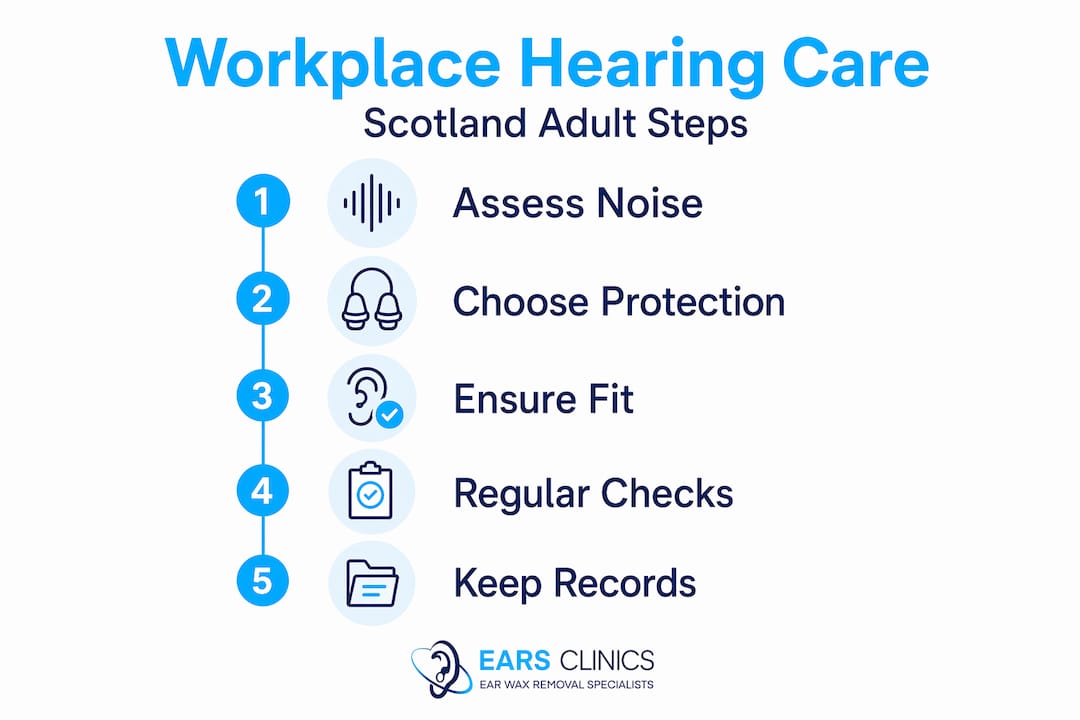
Overprotection is a genuine problem too. Hearing protection must reduce noise to below 85 dB, but not so far that workers become isolated from their environment. When protection makes it impossible to hear colleagues or alarms, workers begin removing it intermittently, which defeats the purpose entirely. Matching the attenuation rating of the device to the actual noise level in your workplace, rather than defaulting to the highest-rated option available, is a more effective and practical approach.
Comparison of common hearing protection types:
Device type | Best suited for | Key consideration |
Foam earplugs | High-noise, intermittent use | Requires correct insertion technique |
Earmuffs | Variable noise, quick removal needed | Can be uncomfortable in warm conditions |
Custom-moulded earplugs | Long shifts, individual fit required | Higher upfront cost, best attenuation accuracy |
Variable attenuation earplugs | Environments requiring communication | Allows speech whilst reducing harmful peaks |
For further reading on safe ear healthcare best practices specific to Scotland, understanding the clinical standards that govern ear care alongside workplace protection is equally important.
Pro Tip: Ask your employer specifically about fit testing rather than accepting a standard-issue earplug. If fit testing is not offered, request it in writing. Documented fit testing significantly reduces your risk of hearing damage and creates a clear record of due diligence on both sides.
Executing safe ear wax removal and hearing care procedures
If you are already experiencing reduced hearing or the symptoms of ear wax impaction, no amount of better-fitted earplugs will fully resolve the issue. Professional ear wax removal is necessary, and the method used matters considerably.
There are three clinically recognised approaches:
Microsuction: A fine, low-pressure suction device removes wax under direct visualisation using a microscope or camera. This is the preferred method recommended by NICE (the National Institute for Health and Care Excellence), as it does not require water and allows the clinician to see exactly what they are doing throughout the procedure.
Irrigation: Previously known as ear syringing, modern irrigation uses a controlled flow of body-temperature water to dislodge and flush out wax. It is appropriate for most patients but is not suitable for those with a history of perforated eardrums, ear infections, or previous ear surgery.
Instrumentation: Sometimes called manual removal, this technique uses fine instruments such as a Jobson Horne probe or a Hartmann’s forceps to carefully extract wax. It is particularly useful for dry or compacted wax that does not respond well to suction or water.
The selection of method depends on your clinical history, the nature and location of the wax, and the condition of your ear canal. This is precisely why professional assessment by a trained clinician is non-negotiable. For a fuller explanation of ear instrumentation techniques and when each approach is appropriate, understanding the clinical reasoning helps you ask the right questions at your appointment.
Why you should never attempt self-removal:
Cotton buds compact wax rather than removing it, often worsening blockage
Ear candles have no clinical evidence of effectiveness and carry a genuine risk of burns
Unguided irrigation at home can cause eardrum perforation if the water pressure is too high
Attempting removal without proper lighting and instrumentation risks missing wax or injuring the canal wall
Pro Tip: If your GP has advised using olive oil drops before a professional appointment, use them consistently for five to seven days beforehand. Softened wax responds far better to microsuction and irrigation, making the procedure quicker and more comfortable.
Verifying hearing health and maintaining long-term protection
Treatment is not the end of the process. Ongoing monitoring is what keeps your hearing protected over the long term, particularly in noisy working environments where re-exposure is continuous.
Audiometric testing measures your hearing thresholds across a range of frequencies, providing a baseline against which future results are compared. When a standard threshold shift is detected (a meaningful change in hearing sensitivity), workers must be notified within 21 days, and their hearing protection must be refitted or upgraded. This is a legal requirement under occupational health regulations, and it exists because early detection is the only way to prevent mild loss from progressing to significant impairment.
Ongoing hearing health maintenance checklist:
Schedule audiometric testing at least annually if you work in noise-exposed environments
Keep a personal record of your test results to track changes over time
Report any new symptoms, such as tinnitus or sudden changes in hearing clarity, to your employer and a healthcare professional promptly
Ensure hearing protection is replaced when visibly worn, compressed, or damaged
Revisit professional ear wax removal if symptoms of blockage return
Employer responsibilities at each monitoring stage:
Stage | Employer action required |
Baseline testing | Record results and retain for duration of employment |
Threshold shift detected | Notify worker within 21 days, refit protection |
Persistent shifts | Refer to occupational health physician |
Leaving employment | Provide copy of audiometric records to worker |
Documentation matters for individuals as much as it does for employers. Personal records of audiometric tests, hearing protection issued, and any professional ear care received form the basis of any future compensation claim if noise-induced hearing loss is later attributed to workplace exposure.
Pro Tip: If your employer has not conducted audiometric testing and you work in a noisy environment above 85 dBA, you have the right to request it under the Control of Noise at Work Regulations 2005. Put your request in writing and keep a copy.
For practical next steps on step-by-step ear care and what to expect during professional treatment, having clarity on the process reduces anxiety considerably.
Rethinking hearing protection: beyond compliance to culture change
Here is the uncomfortable truth that most workplace hearing guides avoid: compliance-based hearing programmes are failing workers, not because the regulations are inadequate, but because rules alone cannot change behaviour in a noisy environment.
The Health and Safety Executive is clear that employees often remove hearing protection intermittently, particularly during breaks, short tasks, or when communication becomes difficult. Even brief unprotected exposures at high noise levels cause damage. A worker removing earplugs for just 30 minutes of an eight-hour shift in a 95 dBA environment receives significantly more noise dose than their records suggest.
The answer is cultural, not legislative. When managers and supervisors wear hearing protection consistently in noisy zones, usage rates among workers increase measurably. When hearing health is discussed openly in toolbox talks and safety briefings rather than buried in annual paperwork, workers begin to understand what is genuinely at stake. This is particularly important because hearing loss is gradual and painless until it is irreversible. There is no moment of crisis that prompts action the way a cut or a near-miss does.
Smart monitoring technology, including connected dosimeters that track individual noise exposure throughout a shift, is becoming more accessible and adds genuine value. But technology complements rather than replaces leadership. A dosimeter that shows a worker exceeded safe exposure levels means nothing if management does not act on the data and no one explains the results in plain terms.
Effective workplace hearing programmes treat hearing care as an ongoing conversation rather than a tick-box exercise. Pair that approach with accessible professional ear care for wax-related issues, and the overall burden of hearing impairment in Scottish workplaces reduces meaningfully. That is the standard worth aiming for.
Private professional ear care solutions with EARS Clinics
If you are dealing with reduced hearing, a feeling of fullness in your ears, or tinnitus that is affecting your work, waiting weeks for an NHS appointment should not be your only option.
EARS Clinics offer private, professional ear wax removal in Glasgow and Edinburgh, using microsuction, irrigation, and instrumentation performed by fully trained, NHS-accredited Aural Care Specialists. As one of the few Healthcare Improvement Scotland registered ear care clinics in Scotland, EARS Clinics operate under the strictest clinical guidelines, treating patients from the age of two upwards. Appointments start at £60 for adults over 18, with home visits available at £180 for those who cannot attend in person. You can review the full range of ear wax removal procedures to understand which approach suits your situation, and meet the team of specialists who will be caring for you. Same-day appointments are frequently available, so there is no need to let ear wax compromise your hearing, your safety, or your performance at work.
Frequently asked questions
What are the primary workplace noise levels requiring hearing protection in Scotland?
Employers must provide hearing protection when noise reaches 85 dBA averaged over eight hours, following HSE guidelines to prevent permanent hearing damage.
Why is microsuction preferred for professional ear wax removal?
Microsuction is the preferred NICE-recommended method because it allows direct visualisation of the ear canal throughout the procedure, making it the safest option for most patients, including those with sensitive ears.
How can workers ensure their hearing protection is effective?
Proper fit testing and consistent use are the two most critical factors, given that 40% of hearing programmes fail due to poor fitting and inadequate training rather than equipment quality.
What should an employer do if audiometric testing shows hearing threshold shifts?
Employers must notify affected workers within 21 days of a detected threshold shift, refit or retrain with appropriate hearing protection, and arrange follow-up audiometric testing to monitor any further changes.
Can ear wax removal be done privately with faster access than the NHS?
Yes, adults in Scotland can book private ear wax removal through EARS Clinics in Glasgow and Edinburgh, with same-day appointments frequently available and no requirement for pre-treatment softening drops before attending.
Recommended