
Why earwax buildup happens and what to do about it
- 2 days ago
- 12 min read

Earwax builds up when your ear canal produces more cerumen than it can clear, or when something blocks the wax’s natural path outward. Usually, tiny hairs and skin cells carry wax to the ear opening on their own, where it dries and falls away unnoticed. Buildup happens when that migration process stalls, often because of narrow canals, ageing skin, hearing aid use or, most commonly, cotton buds pushing wax further in rather than out.
Impaction is more common in adults aged 55 and over, along with hearing aid and earplug users, according to NHS guidance. If you’re dealing with mild fullness or slightly muffled hearing, a short course of softening drops may be all you need. If you’ve got pain, sudden hearing loss or discharge, skip the home remedies and speak to a pharmacist or clinician instead.
Stop putting cotton buds, fingers or anything else in your ear canal.
Try softening drops for a few days only if you have no pain, discharge or history of a perforated eardrum.
Book a pharmacist consultation or clinical assessment if symptoms persist beyond a week or worsen at any point.
Consider professional removal, such as microsuction, if home softening doesn’t clear the blockage.
Quick fact: Earwax impaction becomes significantly more likely from age 55 onwards, and even more so among people who wear hearing aids or use earplugs regularly.
Pro Tip: If your ear feels blocked after swimming or showering, wait 24 hours before trying anything. Trapped water often mimics wax buildup and clears on its own.
Key Takeaways
Earwax buildup happens when normal outward migration is blocked by canal anatomy, ageing, hearing aid use or cotton bud damage, and professional microsuction offers the safest, most visualised way to clear it.
Point | Details |
Main cause | Blocked migration from narrow canals, ageing wax, hearing aids or cotton bud damage drives most impaction cases. |
Safe first step | Try softening drops for three to five days only if you have no pain, discharge or eardrum history concerns. |
Red flags | Severe pain, sudden hearing loss, bleeding or fever mean a GP visit, not home treatment. |
Preferred clinical method | Microsuction is favoured under NICE guidance, with irrigation and manual instrumentation as valid alternatives. |
Professional booking | Earhealthservice offers same-day and home visit appointments with HIS-registered specialists across Glasgow and Edinburgh. |
Why earwax buildup causes noticeable symptoms
Earwax impaction rarely arrives without warning. Most people notice a specific cluster of symptoms that builds gradually rather than all at once, and recognising the pattern early makes treatment far simpler.
The most reported signs include:
Reduced or muffled hearing, often described as sounds feeling “underwater”
A sensation of fullness or pressure in one or both ears
Earache, ranging from mild discomfort to a dull, persistent ache
Tinnitus, a ringing, buzzing or humming noise with no external source
Itching inside the ear canal
Dizziness or a mild sense of imbalance in more advanced cases
These symptoms overlap with several other ear conditions, which is exactly why self-diagnosis has its limits. NHS guidance lists hearing loss, earache, tinnitus and vertigo among the recognised markers of cerumen impaction, but the same symptoms can also point to infection, fluid behind the eardrum or, rarely, something more serious.
There’s a meaningful difference between temporary muffled hearing after a swim and a blockage that’s been building for weeks. The first usually clears within a day. The second tends to worsen gradually, sometimes accompanied by a subtle change in tinnitus pitch or a growing sense of pressure that doesn’t shift with yawning or swallowing.
Severe pain, sudden hearing loss, heavy bleeding, persistent discharge or fever are not typical earwax symptoms. These warrant a same-day GP appointment or emergency care, not a bottle of olive oil.
Why earwax builds up: the biological and behavioural causes
Cerumen is produced by glands lining the outer third of your ear canal, and its job is genuinely protective. It traps dust, repels water and creates a mildly acidic environment that discourages bacteria and fungi from taking hold. Under normal conditions, the skin of the ear canal migrates outward, carrying wax with it, helped along by everyday jaw movements from talking, chewing and yawning. Most people never think about earwax because this system works quietly in the background.
Buildup happens when that outward journey gets interrupted. Several factors contribute, and they often overlap rather than acting alone:
Narrow or curved ear canals slow the natural outward flow of wax, giving it more opportunity to compact before it reaches the opening.
Excess canal hair can physically trap wax, particularly in older adults, where hair growth in the ear often increases.
Drier, harder wax becomes more common with age as gland activity changes, making natural clearance less efficient.
Overproduction of cerumen, which varies significantly between individuals for reasons that aren’t fully understood.
Skin conditions such as eczema or psoriasis affecting the ear canal can alter the normal shedding process.
Hearing aids, earplugs and in-ear earphones create a physical barrier that traps wax and prevents it from migrating out naturally, a pattern well documented in NHS clinical guidance.
Behaviour plays just as large a role as anatomy. Cotton buds are the single most common culprit clinicians see, and the mechanism is almost mechanical: pushing an object into the canal shoves soft wax deeper, where it compacts against the eardrum and hardens. Repeated attempts to “clean” the ear this way don’t just fail to remove wax. They actively make things worse, partly through simple displacement and partly because stimulating the hair follicles lining the canal can encourage further wax production. The more you dig, the more your body responds by making more wax to protect the irritated skin.
Pro Tip: If you feel the urge to clean inside your ear with a cotton bud, wipe the outer ear with a damp cloth instead. Your ear canal is largely self-cleaning, and interference almost always backfires.
Safe ways to soften earwax at home
Home softening is reasonable for mild symptoms without red flags, but it’s not right for everyone. Before trying anything, rule out a perforated eardrum, recent ear surgery, active infection or discharge. If any of those apply to you, skip home treatment entirely and speak to a clinician first.
For most people with straightforward blockage, a short softening routine can work well:
Warm the drops slightly by holding the bottle in your hand for a minute. Cold liquid in the ear can trigger dizziness.
Lie on your side with the affected ear facing upward.
Apply the recommended number of drops, typically two to three, following the product’s instructions.
Stay still for five to ten minutes to let the liquid work its way in, then tilt your head to let excess drain out onto a tissue.
Repeat this once or twice daily for three to five days, which is the typical window for softening to take effect.
Gently wipe the outer ear with a soft cloth afterwards. Never insert anything into the canal itself.
Olive oil and mineral oil are widely used and generally considered gentle, low-risk options. Recognised commercial products containing carbamide peroxide are also available and tend to work faster for genuinely hardened wax, though Harvard Health notes they should still be avoided if there’s any possibility of a perforated eardrum. Hydrogen peroxide solutions carry an additional caution: they can leave residual moisture in the canal, and that damp environment can encourage bacterial growth if the ear isn’t properly dried afterwards.
If pain develops or worsens, stop immediately.
If you notice bleeding or fresh discharge, stop and contact a pharmacist or GP.
If hearing seems to get worse rather than better after two or three days, the softening approach likely isn’t working, and continuing regardless won’t help.
If you’re unsure whether your eardrum is intact, particularly after a past ear infection, ask a pharmacist before starting.
A short period of a few days is generally the time most home softening regimens need. If your symptoms haven’t meaningfully improved by then, it’s a sign the blockage needs a clinical hand rather than more patience.
Pro Tip: Softening drops don’t remove wax. They loosen it so your body, or a clinician, can clear it more easily. Don’t expect instant relief.

When to see a pharmacist, GP or ear specialist
Deciding where to turn depends heavily on how severe your symptoms are and whether you’ve already tried safe self-care without success.
A pharmacist is usually the right first stop if your symptoms are mild, you have no red flags, and you simply need advice on which softening drops to try or how to use them correctly. They can also flag early on if something sounds like it needs a GP referral instead.
A GP becomes the better route if you’ve noticed red flags such as significant pain, sudden hearing changes, discharge or signs of infection, or if you’ve tried softening at home without improvement. GPs can also refer you onward for specialist care if needed, and they’ll assess your ear canal and eardrum using an otoscope before deciding on next steps.
A specialist, whether an ENT consultant or a regulated ear health clinic, is the right call for recurrent impaction, hearing aid users who repeatedly trap wax, or anyone with neurological symptoms alongside ear blockage, such as persistent dizziness. This is also where professional removal via microsuction typically happens.
Care route | Typical reason to contact | What they can do | What to expect |
Pharmacist | Mild symptoms, first-time blockage, unsure which drops to use | Recommend suitable softening products, advise on safe use, flag if GP referral is needed | Usually same-day, no appointment required |
GP | Red flags, recurrent blockage, failed home softening | Otoscopy assessment, prescribe treatment, refer to specialist if needed | Days to a couple of weeks depending on local demand |
Ear specialist clinic | Recurrent impaction, hearing aid users, complex ear history | Microsuction, irrigation or manual instrumentation with direct visualisation | Often same-day or next-day appointments available |
Bring a rough timeline of when symptoms started, any treatments you’ve already tried, and details of hearing aid or earplug use. This helps whichever clinician you see get to the right answer faster, without repeating tests unnecessarily.
Clinical removal methods: microsuction, irrigation and manual instrumentation
Microsuction is generally the preferred technique under current NICE guidance, largely because it allows the clinician to see exactly what they’re removing in real time. Irrigation and manual instrumentation remain safe, clinically valid options too, and the right choice ultimately depends on your ear canal’s shape, your medical history and how the wax has hardened.

Microsuction uses a fine suction device under direct visualisation, usually via a microscope or video otoscope, to gently draw wax out without introducing any liquid. It tends to suit people with narrow canals, a history of perforation, or those who find water-based methods uncomfortable, and it’s often quicker than other approaches. The main limitation is that very hard, deeply impacted wax may need pre-softening with drops first.
Irrigation uses a controlled flow of warm water, sometimes with saline, to flush wax out of the canal. It works well for softer wax and can clear both ears efficiently in a single sitting, though it isn’t suitable for anyone with a perforated eardrum, active infection or a history of ear surgery.
Manual instrumentation, using a fine curette, allows a clinician to lift wax out directly under vision. It’s often used for wax sitting close to the ear canal opening or for smaller amounts that don’t need suction or fluid. This technique demands precise control, which is why it should only ever be performed by a trained, competent clinician.
Microsuction: no liquid used, excellent visualisation, generally comfortable, but may need pre-softening for very hard wax.
Irrigation: effective for softer wax, can treat both ears quickly, unsuitable if the eardrum is perforated or if there’s active infection.
Manual instrumentation: precise and controlled, well suited to wax near the canal opening, requires a skilled, steady hand.
Whichever method a clinician recommends, the decision should always be based on your specific ear health and history, not a one-size-fits-all default. Removal should only be performed by trained clinicians regulated by Healthcare Improvement Scotland or the Care Quality Commission, since improper technique can risk canal damage or infection.
One method deserves a firm warning rather than a place in this comparison: ear candling doesn’t work and can cause burns or further ear damage. It has no place in safe ear care.
Pro Tip: Most professional removal appointments typically take a short appointment of some minutes. Expect brief, mild discomfort at most, and don’t be surprised if your clinician recommends a few days of softening drops beforehand if your wax has hardened significantly.
How to reduce future earwax buildup
Prevention is largely about restraint rather than active intervention. The single biggest change most people can make is simply leaving their ears alone.
Do:
Wipe the outer ear with a damp cloth rather than inserting anything into the canal.
Clean hearing aids and earbuds regularly, since built-up debris on these devices can transfer back into the canal.
Book a fitting check for hearing aids if you notice recurring wax trapped against the device.
Consider periodic professional cleaning, once or twice a year, if you’re prone to recurrent impaction, particularly if you wear hearing aids or have narrow ear canals.
Don’t:
Use cotton buds, hairpins, or any object inside the ear canal, even if it feels satisfying in the moment.
Overuse in-ear earphones for extended periods without giving your ears a break.
Ignore recurring blockage in the hope it’ll sort itself out. Patterns tend to repeat until the underlying cause, whether anatomical or device-related, is addressed.
Pro Tip: If you’re a regular hearing aid user and notice wax buildup every few months, ask your clinician about scheduling routine maintenance cleaning rather than waiting until you’re fully blocked. It’s far easier to manage little and often than to deal with hardened, impacted wax later.
What happens during a professional earwax removal appointment
A typical appointment starts with a conversation, not a procedure. The clinician will ask about your symptoms, how long you’ve noticed them, any previous ear problems, and whether you use hearing aids or earplugs regularly. This is followed by otoscopy, a visual examination of the canal and eardrum, which tells the clinician exactly what they’re dealing with before choosing a method.
From there, the clinician selects the safest and most appropriate removal technique based on what they’ve seen and your medical history. Some clinics offer before and after imaging, which lets you see the wax that’s been removed and confirm the canal is clear. It’s a small detail, but it does a lot to build confidence that the job’s been done properly.
Assessment: history taking and otoscopic examination of the ear canal and eardrum.
Method selection: microsuction, irrigation or manual instrumentation, chosen individually rather than by default.
Treatment: typically fifteen to thirty minutes, often with visual confirmation via microscope or video otoscope.
Aftercare: guidance on avoiding future buildup, plus a plan for recurrent cases if relevant.
Clinics performing this kind of care should be registered with Healthcare Improvement Scotland or the Care Quality Commission, and staffed by trained Aural Care Specialists who understand the full range of ear anatomy they might encounter, including children’s ears and complex medical histories.
A common scenario clinicians describe: a hearing aid user in their sixties arrives with progressively muffled hearing over several weeks, having tried shop-bought drops with no success. Otoscopy reveals hardened wax pressed against the eardrum. Microsuction under direct vision clears it in minutes, with immediate improvement in hearing reported before the patient leaves the chair.
It’s worth repeating, because it matters: ear candling remains ineffective and risky, regardless of how it’s marketed. Genuine improvement comes from direct visualisation and trained hands, not smoke and wax.
Why evidence-led ear care matters more than quick fixes
Ear health sits in an odd spot in public perception. It feels minor, almost trivial, right up until hearing loss or persistent discomfort starts affecting daily life. What strikes us most, looking across the range of cases clinics see, is how often people delay proper care because they’ve been managing symptoms with home remedies that were never designed to fix the underlying problem.
The safest approach is rarely the most dramatic one. It’s methodical: a proper history, a look inside the ear before any decision is made, and a removal method chosen for that specific ear rather than applied by default. That matters even more for children, for hearing aid users who trap wax repeatedly, and for anyone with a complicated ear history where the wrong technique could cause real harm. Regulatory oversight from bodies like Healthcare Improvement Scotland exists precisely because ear care done badly has consequences, and done well, it’s genuinely straightforward.
Booking professional ear wax removal with EARS Clinics
If home softening hasn’t shifted your symptoms, or you’d rather skip the DIY stage altogether, Earhealthservice offers same-day microsuction, irrigation and manual instrumentation appointments without the waiting times typical of NHS referral routes, and without preconditions before you’re seen.
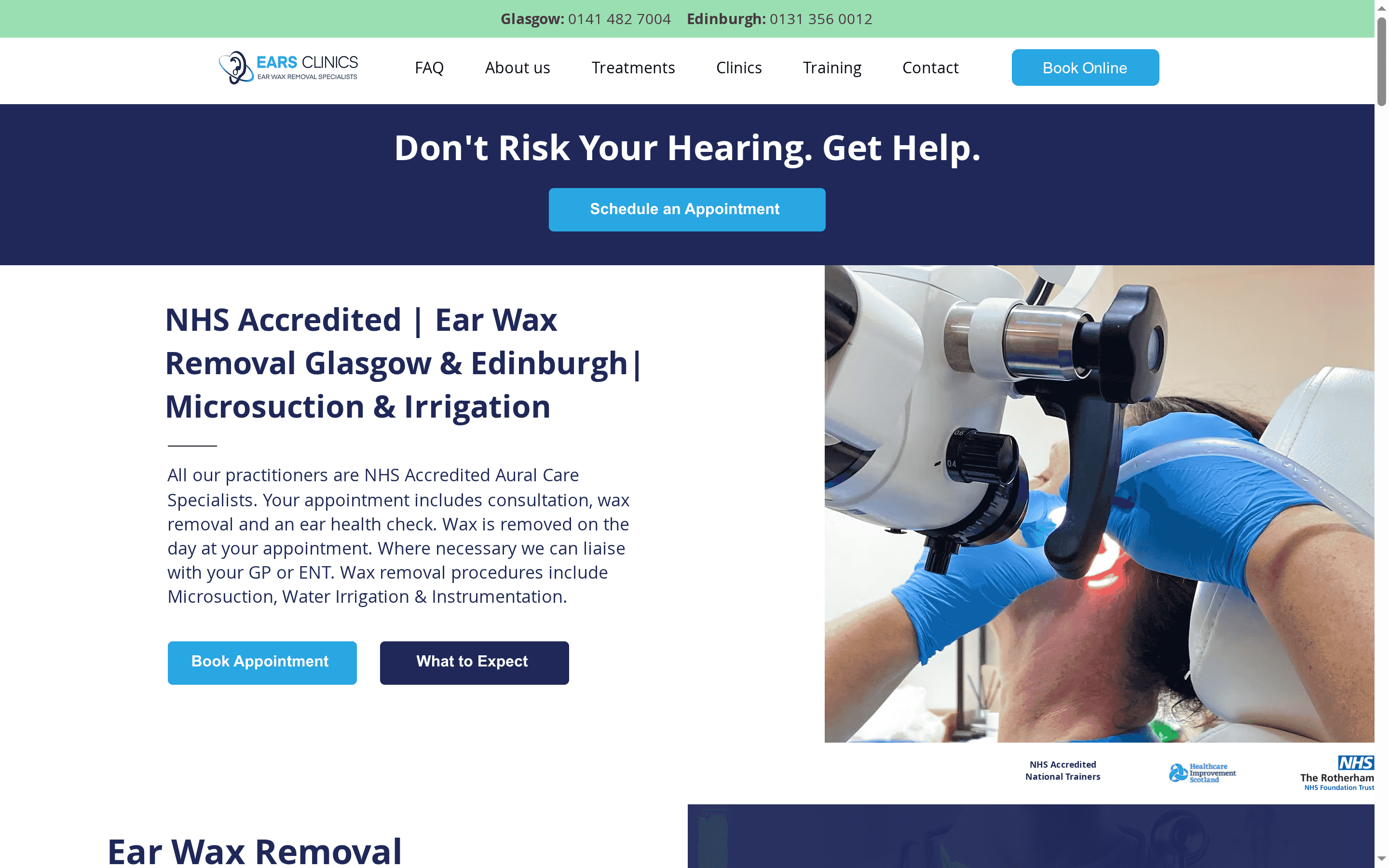
Every appointment starts with a proper assessment, including otoscopy, before your clinician selects the safest method for your ear canal and history. Earhealthservice is registered with Healthcare Improvement Scotland and licensed to treat patients from age two, with NHS-accredited Aural Care Specialists carrying out every procedure. Appointments are available in-clinic in Glasgow and Edinburgh, as same-day slots when needed, or as home visits for patients who find travelling difficult. If your wax has hardened significantly, your clinician may advise a short course of softening drops beforehand to make removal quicker and more comfortable.
Pricing starts at £60 for adults and £75 for under-18s, with home visits priced at £180. If you’re unsure which method suits your situation, book a consultation and let a trained specialist assess your ears properly rather than guessing at home.
Frequently asked questions
Why does earwax buildup happen in the first place? Earwax buildup happens when the ear’s natural outward migration process is disrupted, most often by narrow ear canals, ageing, hearing aid use, or cotton buds pushing wax deeper rather than out.
Is earwax buildup normal? Some earwax is entirely normal and protective, but buildup severe enough to cause symptoms like hearing loss or fullness isn’t something to just live with. It’s a sign your ear’s clearance process needs help.
Can earwax buildup cause hearing loss? Yes, impacted earwax is a common and reversible cause of temporary hearing loss. Once the blockage is cleared, whether through softening drops or professional removal, hearing typically returns to normal.
What’s the safest way to remove earwax at home? Softening drops such as olive oil, mineral oil or recognised commercial products used for three to five days are generally safe, provided you have no perforated eardrum, recent ear surgery, or active infection.
When should I see a clinician instead of treating it myself? See a pharmacist or GP if home softening hasn’t worked after about a week, or immediately if you notice severe pain, sudden hearing loss, bleeding, discharge or fever.
This article is general information, not a substitute for advice from a qualified doctor. Consult a qualified healthcare professional about your own circumstances before acting on anything here.
Sources
If you’d rather skip the research and get a professional opinion straight away, Earhealthservice offers assessment and removal appointments across Glasgow and Edinburgh, including same-day and home visit options.
Recommended