
Why short waiting times matter for ear health
- Jun 20
- 8 min read

TL;DR:
Short waiting times in ear health care reduce the risk of symptom worsening and improve clinical outcomes. Prompt treatment and active communication increase patient satisfaction and trust, which encourages timely care; delays can lead to more complex health issues. Private clinics offering same-day appointments and transparent updates help patients access faster, safer ear care with better overall experience.
Short waiting times in ear health care are defined as the period between a patient recognising symptoms and receiving clinical treatment, and reducing this period directly improves outcomes. When ear wax builds up or an infection develops, every additional day without treatment carries real clinical risk. Microsuction, the method recommended by NICE guidelines, works best when performed promptly by a trained Aural Care Specialist before symptoms worsen. At Earhealthservice, we see this reality every week: patients who act quickly recover faster, and those who delay often arrive with more complex presentations. Understanding why short waiting times matter is the first step to protecting your hearing.
Why short waiting times matter for clinical outcomes in ear care
Delayed treatment in ear health is not a neutral event. Unmanaged waiting periods are clinically active phases that carry a genuine risk of symptom deterioration, medication escalation, and mental health decline. This means a patient waiting several weeks for ear wax removal is not simply inconvenienced. Their condition may be actively worsening.
The risks that accumulate during a prolonged wait include:
Hearing loss progression: Compacted cerumen (ear wax) can press against the eardrum, reducing sound transmission. The longer it remains, the harder it becomes to remove safely.
Infection risk: Moisture trapped behind a wax blockage creates conditions where bacterial or fungal infections can develop, particularly in patients who use hearing aids or swim regularly.
Tinnitus and balance disturbance: Pressure from wax build-up can trigger ringing in the ears or dizziness, both of which affect daily functioning and mental wellbeing.
Anxiety and social withdrawal: Hearing difficulty caused by wax build-up is strongly associated with increased anxiety and reduced social engagement, particularly in older adults.
Prompt intervention using microsuction, irrigation, or manual instrumentation removes the blockage before these complications take hold. Practitioners at Earhealthservice select the most appropriate technique based on each patient’s medical history and clinical presentation, following the strictest Healthcare Improvement Scotland (HIS) guidelines. The importance of immediate ear care cannot be overstated when symptoms are already present.
Pro Tip: If you are experiencing muffled hearing, a sensation of fullness in the ear, or tinnitus, do not wait for symptoms to resolve on their own. These are signs that wax may already be impacting your ear canal and prompt assessment is advisable.

How does waiting time affect patient satisfaction in ear care?
Patient satisfaction in healthcare is not determined solely by the quality of treatment received. The time a patient waits before that treatment begins carries equal weight in how they judge the entire experience.
Research shows that 75% of patients prioritise the quickest available appointment when dealing with urgent health concerns. This figure reflects a fundamental truth: when something is wrong with your body, speed of access shapes your confidence in the provider. A clinic that can see you today signals competence and care. One that asks you to wait three weeks signals the opposite, regardless of how skilled its practitioners are.
Four factors consistently determine how patients perceive their waiting experience:
Actual wait duration: Efficient scheduling that keeps waits to around 12 minutes is associated with higher patient satisfaction scores in outpatient settings. Even small reductions in wait time produce measurable improvements in how patients rate their care.
Perceived wait duration: Patients consistently overestimate how long they have waited when given no information. Transparent communication during the wait reduces this distortion significantly.
Telephone accessibility: Long call centre wait times reduce perceived accessibility and satisfaction before a patient has even set foot in the clinic. Booking ease matters as much as appointment speed.
Clinician competence and regulation: Patients who know their practitioner is NHS-accredited and regulated by HIS or the Care Quality Commission (CQC) report greater confidence in the care they receive, even when waits are unavoidable.
The benefits of minimal waiting extend beyond comfort. They build the kind of trust that brings patients back and encourages them to recommend a service to others. For ear health specifically, where many patients are anxious about their hearing, that trust is clinically valuable.
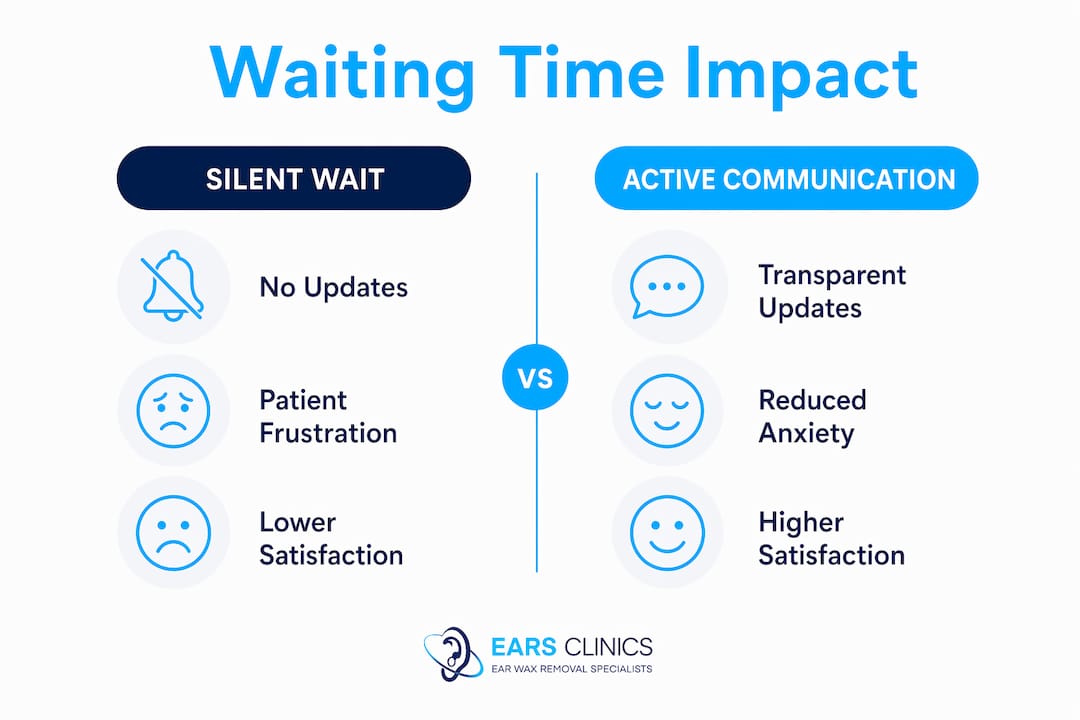
Silent wait vs active communication: which approach works better?
The way a clinic manages the time between booking and treatment is as important as the wait itself. Two distinct approaches exist: the silent wait and active communication.
Approach | What it involves | Patient impact |
Silent wait | Patient books, receives no updates, arrives and waits with no information | Uncertainty increases perceived wait time; anxiety rises; satisfaction falls |
Active communication | Patient receives confirmation, reminders, and real-time updates on appointment status | Perceived wait feels shorter; anxiety reduces; trust in provider increases |
The evidence strongly favours active communication. Clinics that provide transparent updates during waiting see a 26% increase in patient retention and a 34% improvement in satisfaction scores compared to those that leave patients in silence. That is a substantial difference achieved not by treating patients faster, but simply by keeping them informed.
A related concept from scheduling research is strategic idling. Distributing wait times evenly across stages of the patient journey reduces peak frustration more effectively than concentrating delays at a single point. A patient who waits five minutes at reception, five minutes in the waiting room, and two minutes in the treatment room feels less frustrated than one who waits zero, zero, and twelve minutes respectively. Ear care clinics that apply this principle to their scheduling create a calmer, more positive patient experience without necessarily reducing total appointment time.
Pro Tip: When booking an ear care appointment, ask the clinic whether they send confirmation messages and appointment reminders. A clinic that communicates proactively before your visit is likely to manage your care with the same attentiveness once you arrive.
How can patients minimise waiting times for ear treatment?
You have more control over your waiting time than you may realise. The following steps help you access prompt, safe ear care without unnecessary delay.
Book a same-day or urgent appointment directly. Private clinics such as Earhealthservice offer same-day ear wax removal without the pre-treatment conditions that NHS pathways often require. This removes weeks from the typical waiting period.
Choose a regulated provider. Earhealthservice is registered with Healthcare Improvement Scotland (HIS) and treats patients from two years of age. Regulated clinics follow defined safety protocols, which means your treatment is both prompt and clinically appropriate. Learn more about the benefits of NHS-accredited clinics before you book.
Communicate your symptoms clearly when booking. Tell the clinic exactly what you are experiencing, including hearing loss, fullness, tinnitus, or pain. This helps the practitioner prepare the right equipment and select between microsuction, irrigation, or manual instrumentation before you arrive.
Understand what to expect during the appointment. Microsuction uses gentle suction to remove wax under direct visualisation. Irrigation uses a controlled flow of water. Manual instrumentation uses fine instruments to extract wax. All three are safe when performed by a trained Aural Care Specialist. Knowing this in advance reduces anxiety and makes the appointment faster.
Do not use cotton buds or ear drops as a substitute for treatment. These can compact wax further or mask symptoms, making clinical removal more complex and potentially extending your overall care pathway.
The short waiting time advantages of private ear care are most fully realised when patients arrive prepared and informed. A well-prepared patient enables a faster, safer appointment for everyone involved.
Key takeaways
Prompt ear care access reduces clinical risk, improves patient satisfaction, and prevents the symptom deterioration that unmanaged waiting periods cause.
Point | Details |
Waiting is clinically active | Unmanaged waits allow wax compaction, infection, and mental health decline to progress. |
Speed builds patient trust | 75% of patients prioritise the fastest available appointment for urgent health concerns. |
Communication reduces perceived wait | Active updates increase satisfaction by 34% and retention by 26% compared to silent waits. |
Regulation matters | Choose a HIS or CQC-regulated provider to ensure safe, competent treatment regardless of wait time. |
Same-day access is available | Private clinics like Earhealthservice offer same-day appointments without NHS pre-treatment conditions. |
Why I believe waiting time management is a clinical responsibility, not just a scheduling problem
Working in ear health care, I have seen the consequences of delayed treatment more times than I would like. A patient who waits six weeks for a GP referral arrives at our clinic with wax so compacted that what should have been a ten-minute microsuction procedure becomes a careful, multi-stage process. Another patient has developed anxiety about their hearing that will outlast the wax removal itself.
The conventional view treats waiting lists as an administrative inconvenience. I think that framing is wrong. Waiting periods are active phases of care that require monitoring and management, not passive gaps between booking and treatment. Every clinic has a responsibility to treat the wait as part of the patient’s clinical experience.
At Earhealthservice, this means offering same-day appointments, communicating proactively with patients, and ensuring our Aural Care Specialists are NHS-accredited and HIS-regulated. It also means being honest with patients about what to expect and why prompt treatment matters. The urgency of ear care is not always obvious to patients until symptoms become severe. Our job is to make that case clearly and then act on it.
Reducing waiting times is not a luxury feature of private care. It is a clinical obligation that every ear health provider should take seriously.
— EARS
Get prompt, expert ear care with Earhealthservice
If you are experiencing ear wax build-up, muffled hearing, or any of the symptoms described in this article, prompt treatment is the most effective course of action.
Earhealthservice operates regulated ear care clinics in Glasgow and Edinburgh, registered with Healthcare Improvement Scotland (HIS). Our NHS-accredited Aural Care Specialists perform microsuction, irrigation, and manual instrumentation, selecting the safest method for your individual presentation. Same-day appointments are available for adults and children from two years of age. Appointments start from £60 for adults, £75 for under-18s, and £180 for home visits. Explore our full range of ear wax removal procedures or book a same-day appointment today.
FAQ
Why do short waiting times matter for ear health?
Short waiting times prevent ear wax from compacting further, reduce infection risk, and stop associated symptoms such as tinnitus and hearing loss from worsening. Prompt treatment by a trained Aural Care Specialist produces better clinical outcomes than delayed intervention.
What is the safest method for ear wax removal?
Microsuction is the method recommended by current NICE guidelines and is considered the gold standard for ear wax removal. Irrigation and manual instrumentation are also safe and clinically valid options when selected by a qualified practitioner based on your medical history.
How does waiting time affect patient satisfaction?
Research shows that efficient scheduling with waits of around 12 minutes produces significantly higher satisfaction scores. Both actual and perceived wait times influence how patients rate their overall care experience.
Can I get same-day ear wax removal in Scotland?
Yes. Earhealthservice offers same-day ear wax removal appointments at its clinics in Glasgow and Edinburgh, with no requirement for pre-treatment softening drops or a GP referral. Home visits are also available for patients who cannot attend in person.
Does communication during a wait actually improve the experience?
Yes. Active updates during waiting improve satisfaction even when the total wait time is longer, because uncertain waits feel more stressful than informed ones. Clinics that communicate proactively retain more patients and receive higher satisfaction ratings.
Recommended