
What to use to clean ear wax safely and effectively

TL;DR:
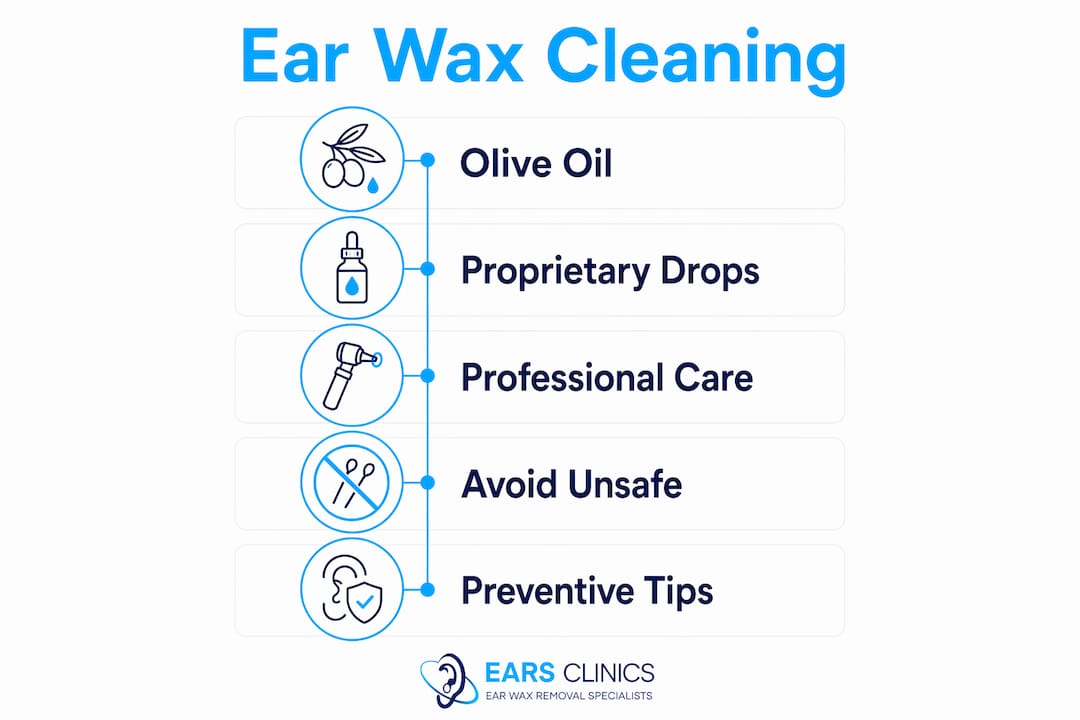
Ear wax naturally protects the ears and usually clears on its own through self-cleaning. Safe removal options include olive oil drops or professional microsuction, while practices like cotton swabs and ear candles are unsafe and ineffective. Proper ear hygiene involves minimal intervention and seeking professional help when home methods fail or complications arise.
Ear wax, known clinically as cerumen, is a natural protective secretion produced by the ear canal. The ears are largely self-cleaning, and for most people, cerumen migrates outward without any intervention. Problems arise when wax accumulates faster than it clears, causing muffled hearing, discomfort, or a blocked sensation. Knowing what to use to clean ear wax safely means choosing methods backed by NHS guidance and NICE guidelines, such as olive oil drops or professional microsuction, and avoiding practices like cotton swabs or ear candles that carry real clinical risks. This article covers every evidence-based option, from gentle home remedies to professional removal, so you can make an informed decision.
What to use to clean ear wax at home safely
The safest home remedy for ear wax is olive oil drops. NHS guidelines recommend applying olive oil drops 3–4 times daily for 3–5 days to loosen mild buildup, with natural clearance taking approximately two weeks. That timeline matters: drops soften the wax so the ear’s own migration mechanism can do the work.

Mineral oil is an equally valid alternative. Mineral oil softens wax but does not remove it independently. It aids natural migration rather than extracting hardened impactions, which is why patience is required.
The correct technique makes a significant difference:
Warm the oil to body temperature by holding the bottle in your hands for a few minutes. Cold drops can cause dizziness.
Lie on your side with the affected ear facing upward.
Apply 2–3 drops using a clean dropper or pipette.
Stay in that position for 5–10 minutes to allow the oil to reach the wax.
Sit up slowly and allow any excess oil to drain onto a tissue.
Repeat 3–4 times daily for up to five days.
Do not insert the dropper tip into the ear canal.
Proprietary ear drops containing sodium bicarbonate or hydrogen peroxide are also available from pharmacies. These work on the same softening principle and are appropriate for mild to moderate buildup.
Pro Tip: If you experience any pain, discharge, or sudden hearing loss after applying drops, stop immediately and seek professional advice. These symptoms may indicate a perforated eardrum or infection, in which case home remedies are contraindicated.
How to safely perform ear irrigation at home
Ear irrigation involves flushing the canal with a gentle stream of warm water or saline to dislodge softened wax. It is appropriate for adults with no history of ear problems, but it carries specific risks if performed incorrectly.
Before attempting irrigation at home, check whether it is suitable for you. Irrigation is contraindicated if you have any of the following:
A perforated eardrum or a history of eardrum perforation.
A history of ear surgery or a mastoid cavity.
Diabetes, immune deficiency, or a condition requiring anticoagulant medication. Ear irrigation is contraindicated for patients with diabetes, immune disorders, or those on blood thinners due to elevated infection risk.
Active ear infection or discharge.
Prior head or neck radiation treatment.
If none of these apply, follow these steps for safe home irrigation:
Soften the wax first with olive oil drops for at least three days before attempting irrigation.
Warm the irrigation solution (water or saline) to approximately 37 °C. Solutions must be warmed to 37 °C to prevent caloric stimulation of the inner ear, which causes dizziness.
Use a purpose-made rubber bulb syringe available from pharmacies. Never use a dental water jet device. Dental irrigators generate pressure far beyond what the ear canal can safely tolerate.
Tilt your head so the affected ear faces upward. Gently pull the outer ear upward and backward to straighten the canal.
Direct the stream toward the roof of the canal, not straight at the eardrum.
Allow water to drain freely. Do not seal the ear canal.
Dry the outer ear gently with a soft towel.
Stop immediately if you feel pain, dizziness, or notice any discharge. These are signs to seek professional assessment before continuing.
Pro Tip: Never use irrigation if you are unsure whether your eardrum is intact. A professional ear examination before attempting home irrigation is the safest starting point, particularly if you have had repeated ear infections.
What professional ear wax removal methods are recommended?
Professional removal is the most reliable and safest approach, particularly when home remedies have not resolved the blockage or when a patient has a complex ear history. Clinicians regulated by Healthcare Improvement Scotland (HIS) or the Care Quality Commission (CQC) select the safest method based on each patient’s medical history and clinical presentation.
Three clinical methods are used in practice:
Method | How it works | Best suited for |
Microsuction | A fine suction probe removes wax under direct microscopic vision | Most patients; preferred by NICE guidelines |
Irrigation | Controlled warm water flushes wax from the canal | Patients with soft wax and intact eardrums |
Manual instrumentation | Specialist tools dislodge and remove wax under direct vision | Patients unsuitable for irrigation or suction |
Microsuction is the method preferred by current NICE guidelines. It does not require pre-softening, works on hardened wax, and allows the clinician to see the canal throughout the procedure. Patients typically describe it as quick and comfortable.
Professional removal is required when a patient has a perforated eardrum, a history of ear infection, or when home irrigation has failed. Attempting irrigation in these circumstances risks serious injury. A trained Aural Care Specialist assesses the ear before selecting any method, which is precisely why professional care produces better outcomes than unguided home attempts.
Manual instrumentation uses fine probes or curettes to physically dislodge wax under direct vision. It is particularly useful when wax is positioned close to the eardrum or when suction is not tolerated. All three methods remain clinically valid; the practitioner’s assessment determines which is appropriate.
Why are cotton swabs and ear candles unsafe?
Cotton swabs are the most commonly misused ear cleaning tool. Cotton swabs push wax deeper into the canal and can damage the eardrum, causing infections and irritation. The ear canal’s skin is thin and sensitive. Repeated swabbing strips the protective wax layer, leaving the canal vulnerable to bacterial and fungal infection.
The risks of common unsafe methods include:
Cotton swabs: Pack wax against the eardrum, cause micro-abrasions, and increase infection risk. The ear is self-cleaning; inserting swabs disrupts this process and introduces bacteria.
Ear candles: Marketed as a natural remedy, but carry no clinical benefit. Burns to the ear canal, face, and hair are documented risks.
Camera-tipped gadget tools: Sold online as safe alternatives, but without clinical training, these tools risk eardrum perforation and canal injury.
The evidence on ear candles is particularly clear:
Ear candles do not remove ear wax. The dark debris collected in the candle after use is candle wax residue, not cerumen. Introducing a lit candle near the ear canal creates burn risk with no therapeutic benefit. Ear candles are ineffective and unsafe, and experts universally advise against their use.
Many patients are surprised to learn that the “wax” they see after ear candling is simply the candle’s own material. This misconception drives continued use of a practice that clinical experts reject entirely.
How to prevent ear wax buildup and maintain ear health
The most effective strategy for preventing excessive wax accumulation is minimal intervention. The ear canal is designed to clean itself through a process called epithelial migration, where skin cells and wax move naturally from the eardrum toward the outer ear.
Practical steps to support healthy ear function include:
Clean only the outer ear. Use a damp flannel to wipe the visible part of the ear after bathing. Never insert the flannel or any object into the canal.
Avoid inserting objects. This includes cotton swabs, hairpins, and fingernails, all of which disrupt the natural migration process.
Use ear protection in noisy or dusty environments. Prolonged exposure to dust can increase wax production in some individuals.
Keep ears dry after swimming. Trapped moisture softens the canal skin and increases infection risk. Tilt your head to drain water naturally.
Use olive oil drops periodically if you are prone to buildup. A few drops once or twice a week can keep wax soft enough for natural clearance.
Some people naturally produce more wax than others. Factors including narrow ear canals, hearing aid use, and certain skin conditions can all increase accumulation. If you experience repeated blockages, a regular check-up with an Aural Care Specialist is the most practical way to stay ahead of the problem. Learning how to prevent ear wax build up through consistent, gentle habits reduces the need for intervention over time.
Key takeaways
Safe ear wax removal relies on using clinically recommended methods such as olive oil drops or professional microsuction, and avoiding harmful practices like cotton swabs and ear candles that worsen blockage or cause injury.
Point | Details |
Olive oil drops are the first-line home remedy | Apply 3–4 times daily for 3–5 days; allow two weeks for natural clearance. |
Irrigation requires careful preparation | Warm solution to 37 °C and check for contraindications before attempting at home. |
Microsuction is the NICE-preferred clinical method | It works on hardened wax without pre-softening and allows direct visual monitoring. |
Cotton swabs and ear candles cause harm | Both push wax deeper or create injury risk with no clinical benefit. |
Ears are largely self-cleaning | Minimal intervention and gentle outer-ear hygiene prevent most buildup problems. |
Our view on safe ear wax cleaning
Patients often arrive at EARS Clinics having already tried cotton swabs, ear candles, or gadgets purchased online. The pattern is consistent: the original blockage has worsened, and in some cases there is canal irritation or micro-abrasions that complicate removal. The well-intentioned attempt to fix the problem has made it harder to treat.
The self-cleaning nature of the ear is genuinely underappreciated. Most people who think they need to clean their ears regularly simply do not. The ear canal produces wax for a reason: it traps dust, repels water, and has mild antibacterial properties. Removing it aggressively strips a protective layer that the body replaces at a cost.
Where home remedies are appropriate, olive oil drops used correctly are effective and safe. The mistake most people make is expecting immediate results. Two weeks feels like a long time when your hearing is muffled, but the process works when followed correctly.
The cases that genuinely require professional care are those involving hardened impactions, a history of ear surgery, or repeated infections. In these situations, attempting home irrigation is not just ineffective. It is risky. A microsuction procedure takes minutes in a clinical setting and resolves what weeks of home treatment cannot.
The most common misconception we encounter is that professional ear care is a last resort. Patients wait months before booking an appointment, often because they assume the problem will resolve on its own or that professional treatment is complicated. In reality, a clinical assessment takes very little time and provides certainty that no home remedy can match.
— EARS
Professional ear wax removal with EARS Clinics
Persistent or severe ear wax buildup responds best to professional care from trained, regulated specialists.

Earhealthservice operates EARS Clinics in Glasgow and Edinburgh, registered with Healthcare Improvement Scotland (HIS) and NHS-accredited. The team of Aural Care Specialists offers microsuction, irrigation, and manual instrumentation, selecting the safest method based on your individual ear history and clinical presentation. Appointments are available in clinic, on the same day, or as home visits for patients who cannot travel. Pricing starts at £60 for adults over 18, £75 for under-18s, and £180 for home visits. Booking is straightforward, with no requirement to pre-treat with drops before your appointment.
FAQ
Is it safe to use Q-tips to clean your ears?
Q-tips and cotton swabs are not safe for cleaning inside the ear canal. They push wax deeper, cause micro-abrasions, and increase the risk of infection and eardrum damage.
What is the best ear wax removal method at home?
Olive oil drops applied 3–4 times daily for 3–5 days are the NHS-recommended first-line home remedy. Natural clearance takes approximately two weeks.
When should I see a professional for ear wax removal?
Seek professional removal if home drops have not worked after two weeks, if you have a perforated eardrum, a history of ear surgery, or if you experience pain, discharge, or sudden hearing loss.
Are ear candles effective for removing wax?
Ear candles are ineffective and unsafe. The debris collected after use is candle wax residue, not cerumen, and the procedure carries a documented risk of burns.
How can I prevent ear wax buildup long-term?
Clean only the outer ear with a damp flannel, avoid inserting objects into the canal, and use olive oil drops periodically if you are prone to accumulation. Regular check-ups with an Aural Care Specialist help manage recurring buildup.
Recommended