
What softens ear wax: safe methods and when to act

TL;DR:
Applying olive oil or medicated drops safely softens ear wax and promotes natural removal.
Persistent blockage or symptoms after treatment require professional removal by a trained clinician.
Ear wax softening is the process of using cerumenolytic agents, such as olive oil or medicated drops, to loosen hardened cerumen and prepare it for natural expulsion or professional removal. Knowing what softens ear wax matters because hardened wax is the leading cause of ear canal blockage, producing symptoms including muffled hearing, a sensation of fullness, and mild discomfort. The most commonly recommended softening agents are olive oil, mineral oil, and carbamide peroxide drops. NHS guidance and clinical standards support softening as a safe first step, provided there are no contraindications. This article covers the best agents, safe application technique, and when professional care is the right choice.
What softens ear wax? Agents, oils, and medicated drops
Cerumenolytics are substances that alter the texture of ear wax to make it easier to remove. They do not dissolve wax entirely. Softening agents change wax consistency but rarely remove it on their own, meaning professional extraction may still be necessary afterwards.
Oil-based softeners
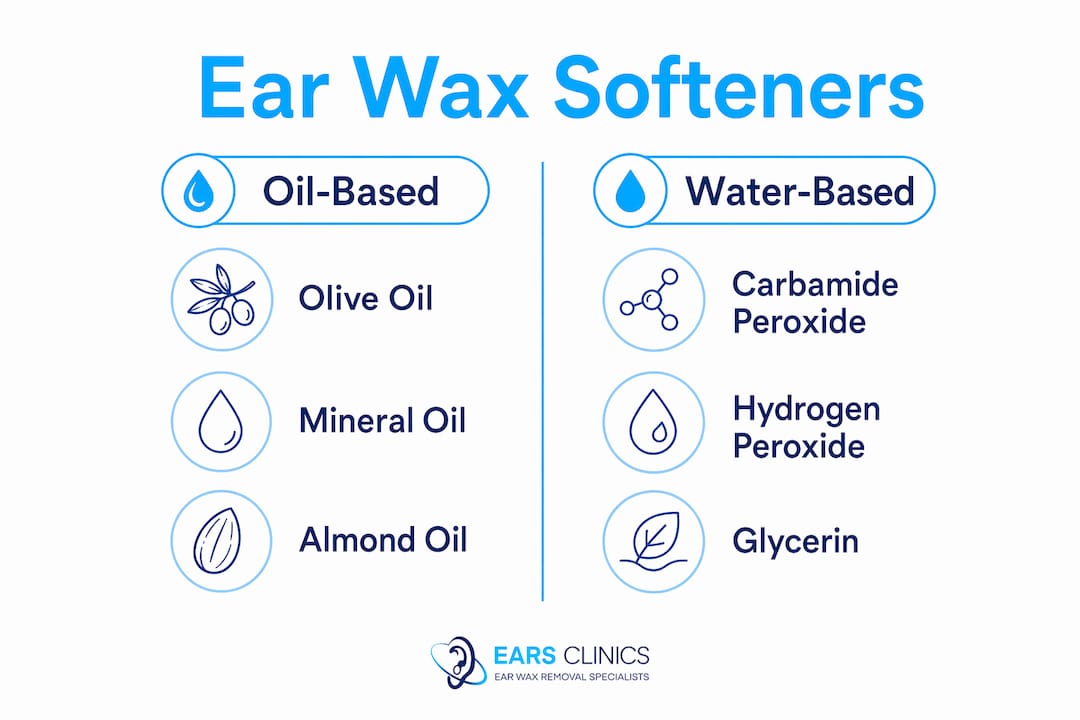
Olive oil is the most widely recommended oil-based softener in the UK. It is inexpensive, well tolerated, and supported by NHS guidance. Almond oil and mineral oil work on the same principle, coating the wax to reduce its hardness and encourage it to migrate naturally towards the outer ear. All three are suitable for regular home use in adults without contraindications.
Water-based and medicated drops
Carbamide peroxide and hydrogen peroxide are the active ingredients in many commercial ear wax drops. Glycerin is another common ingredient, often combined with other agents to soften wax gently. No single cerumenolytic ingredient has been shown to be superior to water in clinical trials. That finding is significant: it means a simple, correctly applied softening agent is as effective as a branded product in most cases.
Pro Tip: Warm your oil or drops to body temperature before use by holding the bottle in your hands for a few minutes. Cold liquid in the ear canal can cause dizziness.
The table below summarises the most common softening agents, their typical usage, and key considerations.
Agent | Typical use | Key consideration |
Olive oil | 3–4 drops, 3–4 times daily | NHS recommended; well tolerated |
Mineral oil | 3–4 drops, twice daily | Good for sensitive ear skin |
Carbamide peroxide | As directed on packaging | Effervescent action; avoid with perforated eardrum |
Hydrogen peroxide | Diluted solution only | Can irritate sensitive skin if overused |
Glycerin | Often combined with other agents | Gentle; suitable for mild blockages |
Warm water | Irrigation by a clinician | As effective as medicated agents in trials |
NHS guidance recommends olive oil applied 3–4 times daily for 3–5 days, with full results possible over two weeks. Patience is genuinely required here. Wax that has hardened over months will not soften overnight.
When is it unsafe to soften ear wax at home?
Home softening is not appropriate for everyone. Applying drops to a damaged or perforated ear canal carries real clinical risk, including infection and pain. A professional examination before self-treatment is the gold standard for safe diagnosis, confirming both the presence of wax and the integrity of the eardrum.
The following conditions are contraindications for home softening or irrigation:
Perforated eardrum or history of eardrum perforation
Recent ear surgery
Active ear infection or ear discharge
Diabetes or a weakened immune system
History of radiation therapy to the head or neck
Grommets or ventilation tubes in place
These contraindications apply equally to softening drops and to ear irrigation. If you are unsure whether any of these apply to you, seek clinical advice before using any drops at home.
Ear candling deserves a direct warning. Ear candling is ineffective and dangerous, carrying documented risks of facial and ear burns. The debris visible after the procedure is candle residue, not ear wax. No regulated clinical body endorses it.
Pro Tip: If you experience ear discharge, sudden hearing loss, or pain, stop all home treatment immediately and contact a clinician. These symptoms suggest a condition that requires professional assessment, not self-care.
Routine over-cleaning of the ear canal can cause irritation, dryness, and dermatitis. Ear wax has a protective function: it traps dust, repels water, and has mild antibacterial properties. Removing it unnecessarily disrupts that natural defence. For guidance on maintaining healthy ear hygiene without overdoing it, the best ear care practices resource from Earhealthservice covers this in detail.
How to apply ear wax softeners safely
Correct technique makes a meaningful difference to both comfort and outcome. Follow these steps for safe home application.
Wash your hands thoroughly before handling drops or oils.
Warm the bottle to approximately body temperature (around 37°C) by holding it in your closed hand for two to three minutes.
Tilt your head so the affected ear faces upward.
Gently pull the outer ear upward and backward to straighten the ear canal.
Apply 3–4 drops directly into the ear canal.
Hold the position for three to five minutes to allow the liquid to reach the wax.
Place a clean piece of cotton wool loosely at the ear opening to absorb any excess.
Repeat 3–4 times daily for up to five days, or as directed.
Liquid temperature near 37°C is clinically important. Liquid that is too cold or too warm stimulates the vestibular system, causing dizziness and nausea. This applies to both home drops and clinical irrigation.
After a course of softening, wax may migrate out naturally. You may notice small pieces of wax on your pillow or cotton wool. That is the process working as intended. Gently cleaning the outer ear with a warm, damp cloth is safe. Do not insert cotton buds, ear spoons, or any other object into the ear canal. DIY tools carry a high risk of pushing wax deeper or perforating the eardrum, often requiring clinical intervention to resolve.
For a full step-by-step guide to safe home ear care, Earhealthservice provides a detailed home ear care guide covering drops, positioning, and when to stop.
Professional ear wax removal: methods and when to seek help
Softening agents prepare wax for removal but do not always complete the job. When blockage persists after a full course of drops, or when symptoms such as significant hearing loss or pain are present, professional removal is the appropriate next step.
Three clinically validated ear wax removal methods are used by trained Aural Care Specialists:
Microsuction uses a fine suction device to draw wax from the canal under direct visualisation. It is the preferred method per current NICE guidelines and is considered the safest option for most patients. The microsuction procedure does not require pre-softening, though softened wax is generally easier and more comfortable to remove.
Irrigation uses a controlled flow of warm water to flush wax from the canal. It is safe and effective when contraindications are absent, and the clinician has confirmed eardrum integrity beforehand.
Manual instrumentation involves the use of specialist tools such as a Jobson Horne probe to remove wax under direct vision. It is appropriate for specific presentations where suction or water is unsuitable.
The table below outlines the key differences between these three methods.
Method | How it works | Best suited for | Key consideration |
Microsuction | Suction under direct vision | Most patients; NICE preferred | No water; safe with most ear conditions |
Irrigation | Warm water flush | Soft or semi-soft wax | Contraindicated with perforated eardrum |
Manual instrumentation | Specialist probe under direct vision | Hard wax; narrow canals | Requires experienced clinician |
Clinicians regulated by Healthcare Improvement Scotland (HIS) or the Care Quality Commission (CQC) select the safest method based on each patient’s medical history and clinical presentation. No single method is applied universally. Signs that professional care is needed without delay include persistent blockage after five days of drops, pain, sudden hearing loss, tinnitus, or any discharge from the ear. You can also read more about why the NHS rarely offers ear wax removal to understand why private clinics like Earhealthservice fill an important gap in care.
Key takeaways
Softening ear wax with olive oil or medicated drops is a safe and effective first step, but persistent blockage or pain requires professional removal by a trained clinician.
Point | Details |
Best softening agents | Olive oil, mineral oil, and carbamide peroxide are all clinically appropriate options. |
NHS-recommended dosage | Apply drops 3–4 times daily for 3–5 days; allow up to two weeks for full effect. |
Liquid temperature matters | Use drops warmed to approximately 37°C to avoid dizziness during application. |
Know the contraindications | Perforated eardrum, active infection, and recent surgery all rule out home softening. |
When to see a professional | Persistent blockage, pain, or hearing loss after a full course of drops requires clinical assessment. |
What I have learned from years of treating ear wax blockages
Patients often arrive at our clinics having tried softening drops for a day or two and concluded they do not work. The most common reason is not the product. It is the technique and the timeline. Drops applied at the wrong temperature, for too short a period, or without the correct head position simply do not reach the wax effectively. When patients follow the correct method for the full recommended course, the majority see a meaningful improvement.
The other pattern I see regularly is over-cleaning. Ear wax has a genuine protective role, and patients who use drops or cotton buds habitually, without any blockage, often present with dry, irritated ear canals that are more prone to infection. The ear is largely self-cleaning. Intervening only when there is a clear symptom is the right approach.
Ear candling continues to appear in conversations with patients. The clinical evidence against it is unambiguous. It does not remove wax. It does carry real risks of burns. No amount of anecdotal reassurance changes that. If a patient asks about it, the answer is always the same: it is not safe, and it does not work.
What I would encourage every patient to take away is this: softening is a preparation, not a cure. If drops have not resolved your symptoms after a full course, that is not a failure. It is a signal that professional removal is the right next step, and that step is straightforward, safe, and quick when carried out by a trained specialist.
— EARS
Professional ear wax removal at Earhealthservice
Earhealthservice operates EARS Clinics in Glasgow and Edinburgh, providing NHS-accredited ear wax removal for patients from age two upwards. The clinics are registered with Healthcare Improvement Scotland (HIS) and are among the few fully regulated ear healthcare providers in Scotland.

Appointments are available in clinic, with same-day options and home visits for patients who cannot travel. Procedures include microsuction, irrigation, and manual instrumentation, with the method selected by a trained Aural Care Specialist based on your clinical presentation. Costs are £60 for adults, £75 for under-18s, and £180 for home visits. To view all available ear wax removal procedures or to book an appointment, visit the Earhealthservice website or book online directly.
FAQ
What is the most effective home remedy for ear wax?
Olive oil applied 3–4 times daily for 3–5 days is the most widely recommended home remedy, supported by NHS guidance. No medicated drop has been shown to be clinically superior to a simple oil-based softener.
How long does it take for ear wax softeners to work?
Softening drops typically begin to loosen wax within a few days, but full results can take up to two weeks. Wax that has hardened over a long period requires consistent, correctly applied treatment before it migrates naturally.
Can I use olive oil if I have a perforated eardrum?
No. A perforated eardrum is a contraindication for all ear drops and irrigation. If you suspect a perforation, seek professional assessment before using any softening agent at home.
Why does ear wax sometimes get worse after using drops?
Softening agents change the consistency of wax, which can temporarily cause it to swell slightly before it begins to move. This is normal. If symptoms worsen significantly or pain develops, stop treatment and consult a clinician.
When should I see a professional instead of treating at home?
Seek professional care if symptoms persist after a full five-day course of drops, or if you experience pain, sudden hearing loss, tinnitus, or discharge. Earhealthservice offers same-day appointments at EARS Clinics in Glasgow and Edinburgh for prompt assessment and treatment.
Recommended