
What is the best way to clean ear wax safely?

TL;DR:
Ears are self-cleaning and usually do not require active cleaning unless symptoms like hearing loss or discomfort occur.
Safe home care involves softening wax with approved oils and avoiding objects like cotton swabs, which cause harm.
Professional removal methods such as microsuction are safest and most effective for significant blockages or persistent symptoms.
Earwax, known clinically as cerumen, is a natural substance produced by the ear canal to protect, moisturise, and clean itself. The best way to clean ear wax is to let the ear manage it naturally in most cases, intervening only when symptoms such as hearing loss, discomfort, or a feeling of fullness arise. When cleaning is needed, the safest approaches range from gentle home maintenance using softening agents to professional removal via microsuction, irrigation, or manual instrumentation performed by trained clinicians. Methods like cotton swabs and ear candling cause more harm than good and carry real risks of injury.
What is the best way to clean ear wax, and do you even need to?
Ears are self-cleaning by design. Cerumen traps dust and debris, prevents dryness, and acts as a natural barrier against infection. The jaw movements of talking and chewing gradually move old wax from the canal to the outer ear, where it dries and falls away. For most people, no active cleaning is needed at all.
Cleaning becomes necessary only when this natural process breaks down and wax accumulates. The symptoms that signal a genuine build-up include:
Reduced or muffled hearing
A sensation of fullness or pressure in the ear
Ringing or buzzing sounds (tinnitus)
Earache or mild discomfort
An itching sensation inside the canal
Certain groups are more prone to build-up. People with narrow or curved ear canals, those who wear hearing aids or in-ear earphones, and anyone with skin conditions such as eczema in the ear canal all face a higher risk. Frequent use of cotton swabs is itself one of the most common causes of wax impaction, because swabs push wax deeper rather than removing it. If you recognise these symptoms, that is the point at which safe cleaning methods become relevant.
Safe home techniques for gentle ear wax maintenance
Home care is appropriate for mild maintenance, not for clearing a significant blockage. The following steps reflect medically approved practice for adults and parents managing children’s ear health at home.
Clean only the outer ear. Use a soft, damp cloth or flannel to wipe gently around the outer ear and the visible entrance to the canal. Never insert anything into the canal itself.
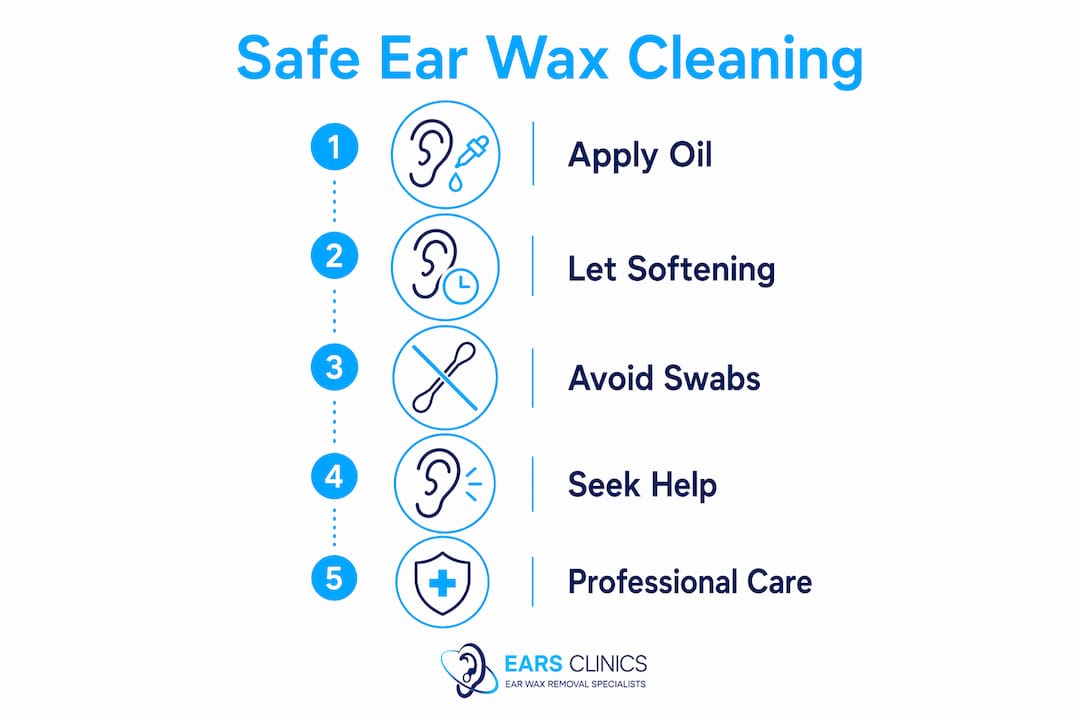
Apply a softening agent. Mineral oil, olive oil, or almond oil can help loosen wax so it moves out naturally. Warm the oil slightly to body temperature before use.
Use ear drops correctly. Tilt your head to one side, apply the recommended number of drops, and remain in that position for around five minutes. This allows the solution to penetrate and soften the wax before it drains away.
Time it well. Applying drops before a shower is practical, as the warm water and steam can assist natural drainage.
Repeat as directed. Most softening treatments work best when used consistently over several days rather than as a single application.
Applying drops for five minutes supports the ear’s natural clearing process without forcing wax out mechanically. This approach is gentle and carries minimal risk when used correctly.
Contraindications matter. Do not use oil drops or irrigation solutions at home if you have a perforated eardrum, a history of ear surgery, or an active ear infection. In these cases, professional assessment is the only safe route.

Pro Tip: Warm the oil to body temperature by holding the bottle in your hands for a minute before applying. Cold drops can cause brief dizziness by stimulating the balance organ inside the ear.
Cotton swabs are not a safe cleaning tool. Inserting them into the canal compacts wax against the eardrum and risks perforation. Ear candling, which involves placing a lit hollow candle in the ear, provides no clinical benefit. Research confirms that the debris left behind after candling is candle wax and soot, not earwax, and the FDA warns against its use due to documented burns and blockages. For a full explanation of why candling is harmful, the risks of ear candling are covered in detail separately.
Professional ear wax removal: methods and clinical advantages
When home softening is insufficient or symptoms are significant, professional removal is the correct step. Clinicians select the most appropriate method based on each patient’s medical history and clinical presentation.
Method | How it works | Key considerations |
Microsuction | A fine suction probe removes wax under direct visualisation using a microscope or loupe | Preferred by current NICE guidelines; suitable for most patients; dry procedure with no fluid |
Irrigation | Warm water is gently flushed into the canal to dislodge softened wax | Effective but contraindicated with perforated eardrums, ear surgery history, infections, or compromised immunity |
Manual instrumentation | Clinicians use small tools such as curettes or Jobson Horne probes to remove wax directly | Suitable for specific wax types or presentations; requires skilled hands and direct visualisation |
Microsuction is the method most widely recommended because it allows the clinician to see exactly what they are doing throughout the procedure. Professional removal by trained clinicians regulated by Healthcare Improvement Scotland (HIS) or the Care Quality Commission (CQC) provides a level of safety that no home method can replicate. Irrigation carries specific contraindications: it must not be used in patients with eardrum perforations, recent ear surgery, active infections, or compromised immune systems, because of the risk of introducing pathogens into the middle ear.
For patients with recurring build-up, professional removal once or twice a year is a reasonable and clinically supported approach. A full microsuction procedure guide explains what to expect during the appointment and how to prepare.
Pro Tip: If you wear hearing aids, schedule a professional check every six months. Hearing aids accelerate wax build-up by blocking the canal’s natural ventilation and self-cleaning movement.
What are the risks of unsafe ear wax removal methods?
Several widely used DIY methods carry genuine clinical risks. Understanding them helps you make safer decisions for yourself and your children.
Cotton swabs compact wax against the eardrum rather than removing it. Improper use of cotton swabs is one of the leading causes of wax impaction and eardrum damage.
Ear candling is universally advised against by medical professionals. The FDA warns against ear candling because it causes burns to the face and ear canal and can deposit candle debris inside the ear.
Camera-equipped DIY devices create a false sense of control. Hand tremors during use cause eardrum perforations that require surgical repair. The magnified view does not compensate for the lack of clinical training.
Hydrogen peroxide solutions used incorrectly, or used when the eardrum is damaged, can cause pain, irritation, and infection.
Essential oils and alternative remedies lack clinical evidence. No peer-reviewed research supports their use as a treatment for wax impaction.
“Professional clinics offer the equipment and training to prevent the eardrum injuries that DIY methods routinely cause.” — Henry Ford Health
Stop self-treatment and seek professional care if you experience sudden hearing loss, pain, discharge, bleeding, or persistent dizziness after attempting home cleaning. These are signs of potential eardrum damage or infection that require clinical assessment without delay. You can find guidance on spotting wax build-up to help you recognise when symptoms have moved beyond what home care can address.
Key takeaways
The safest approach to ear wax cleaning is to leave healthy ears alone, use approved softening agents for mild maintenance, and seek professional microsuction, irrigation, or manual instrumentation for symptomatic blockages.
Point | Details |
Ears are self-cleaning | Active cleaning is unnecessary for most people unless symptoms like hearing loss or discomfort appear. |
Safe home care is limited | Use a damp cloth for the outer ear and approved softening agents; never insert objects into the canal. |
Microsuction is the preferred method | Current NICE guidelines favour microsuction as the safest professional removal technique. |
DIY methods cause harm | Cotton swabs, ear candling, and camera devices all carry documented risks of eardrum damage. |
Professional care is regulated | Clinicians regulated by HIS or CQC select the right method based on each patient’s history and presentation. |
What we see every day at EARS Clinics
The most common misconception we encounter is that ears need regular, active cleaning. Adults come to us having used cotton swabs daily for years, genuinely believing they were keeping their ears healthy. In almost every case, the swabs had compacted the wax and created the very blockage they were trying to prevent.
Parents are often anxious about their children’s ears, which is completely understandable. Children’s ear canals are narrower, and wax can accumulate more quickly. The instinct to clean is natural, but inserting anything into a child’s ear canal without clinical guidance carries real risk. We are licensed to treat patients from two years of age, and we see children regularly in a calm, reassuring environment.
The other pattern we see frequently is patients who have tried ear candling after reading about it online. Without exception, the procedure did nothing to remove their wax. Several arrived with minor burns or additional debris in the canal from the candle itself.
Microsuction is the method we use most often, and patients are consistently surprised by how quick and comfortable it is. The procedure takes minutes, requires no pre-softening in most cases, and produces an immediate improvement in hearing. Clinical examination before any treatment is non-negotiable. The right method depends on what we find, not on a fixed protocol.
Our honest advice is this: use gentle home care for maintenance, avoid anything that goes inside the canal, and come to us when symptoms appear. That combination keeps ears healthy and avoids the injuries we see from well-intentioned but unsafe DIY attempts.
— EARS
Professional ear wax removal at EARS Clinics
Earhealthservice provides NHS-accredited ear wax removal at clinics in Glasgow and Edinburgh, with home visits available across the region. All procedures, including microsuction, irrigation, and manual instrumentation, are performed by trained Aural Care Specialists regulated by Healthcare Improvement Scotland (HIS).

Appointments are available same-day, with no requirement to pre-soften wax before attending. Pricing is £60 for patients over 18, £75 for under-18s, and £180 for home visits. For a full overview of available procedures and to book, visit the ear wax removal procedures page at earhealthservice.co.uk. Safe, effective care from a regulated clinic is always the right choice over an unguided home attempt.
FAQ
Do ears need regular cleaning?
Most ears do not need active cleaning. The ear canal is self-cleaning, and wax naturally migrates outward on its own.
What is the safest way to remove ear wax at home?
The safest home method is applying a few drops of warmed mineral oil or olive oil to soften wax, then allowing it to drain naturally. Never insert cotton swabs or other objects into the canal.
When should I see a professional for ear wax removal?
Seek professional care if you experience muffled hearing, ear pain, tinnitus, or a feeling of fullness that does not resolve within a few days of home softening.
Is microsuction safe for children?
Microsuction is safe for children when performed by a trained clinician. Earhealthservice is licensed to treat patients from two years of age in a calm, clinical environment.
Why is ear candling not recommended?
Ear candling is ineffective and dangerous. The debris it produces is candle wax and soot, not earwax, and the procedure carries documented risks of burns and canal blockage.
Recommended