
Narrow Ear Canal Wax: When 3–7 Days of Drops Fail, Use Microsuction

Narrow ear canals trap wax more easily than average ones, which is why muffled hearing or a persistent blocked feeling often refuses to shift on its own. A short, careful trial of over-the-counter drops is reasonable if there are no red flags, but pain, discharge, or worsening symptoms mean it is time for a clinician to look inside your ear. When anatomy is compromised, microsuction is usually the safest removal method, with irrigation and manual instrumentation reserved for cases where they are clinically appropriate.
TL;DR:
Narrow ear canals make wax buildup more gradual and harder to remove due to anatomical factors such as bony growths, scar tissue, or sharp curves.
Self-treatment with drops is only suitable for mild, progressive symptoms and should be stopped immediately if symptoms worsen or signs of infection appear.
Microsuction is the safest and most effective professional removal method for narrow or curved canals, as it provides clear visualization and avoids fluid risks.
Recurrent impaction in narrow canals requires ongoing maintenance with weekly drops and regular clinician checks, rather than repeated home irrigation attempts.
Only seek professional removal if home treatments fail or symptoms worsen, and always consult a trained clinician who can assess canal anatomy for safe, tailored intervention.
Symptoms of narrow ear canal wax buildup
Wax trapped in a narrow canal tends to announce itself gradually rather than overnight. Most people notice hearing that seems to dim over days or weeks, a sensation of fullness, or a low hum that will not settle.
Typical symptoms include:
Muffled or reduced hearing, often worse on one side
A feeling of fullness or pressure in the ear
Tinnitus (ringing or buzzing)
Itching inside the canal
An intermittent dry cough (linked to the vagus nerve, which runs close to the ear canal)
Mild, dull ache rather than sharp pain
Sudden onset alongside severe pain, discharge, bleeding, fever, or dizziness points to something beyond simple wax, such as an infection or perforation, and needs prompt assessment rather than home treatment. Gradual, painless muffling that comes and goes with jaw movement is far more typical of straightforward impaction.
Why narrow ear canals make wax removal harder
The ear canal has two sections: an outer, cartilaginous portion nearer the opening, and an inner, bony section closer to the eardrum, joined at a natural narrowing called the isthmus. Wax is meant to migrate outward from this bony section on its own, carried by jaw movement and skin cell turnover, but a naturally narrow or curved canal disrupts that self-clearing process.
Several anatomical factors make this worse:
Congenital narrowing (stenosis) present from birth
Bony growths such as exostoses or osteomas, often linked to repeated cold-water exposure
Scar tissue from previous infections, surgery, or trauma
A sharply curved canal that traps wax at the bend rather than letting it travel out
Guideline-level evidence confirms that anatomical narrowing is a recognised risk factor for impaction and should shape how a clinician chooses a removal method. Inserting cotton buds or earbuds to “help” only compounds the problem, pushing wax deeper past the isthmus where it becomes compacted against the eardrum.
Is it wax? How to tell and when to get checked
Not every blocked feeling in the ear comes from wax, so a few simple checks help you work out what you are dealing with before reaching for drops.
Note whether hearing improves with jaw movement. Wax that shifts slightly when you yawn or chew often confirms a mechanical blockage rather than an inner ear problem.
Look for visible wax at the canal entrance using a torch and mirror, though anything more than a glance is best left to a clinician given how easy it is to push wax further in.
Track the pattern of onset. Gradual muffling over days or weeks supports wax; sudden, one-sided hearing loss needs urgent medical review regardless of wax history.
Book a clinical examination if self-checks are inconclusive. A clinician confirms wax impaction through otoscopy, sometimes with microscope visualisation for narrow or curved canals, and may add tympanometry or audiometry if hearing loss seems disproportionate to visible wax.
Refer urgently to a GP or ENT if you have sudden hearing loss, severe pain, facial weakness, or vertigo alongside ear symptoms, since these can signal something other than cerumen impaction.
Safe self-care for narrow canals: what to try and when to stop
Earwax is protective, not a sign of poor hygiene, and clinical guidance is clear that it only needs removing when it causes symptoms or blocks an examination. If your symptoms are mild and gradual, with no history of ear surgery or perforation, a short trial of drops is a sensible first step.
Choose a water-based or oil-based cerumenolytic, such as one containing docusate sodium or simple olive oil.
Use for three to seven days as directed on the packaging, which mirrors the typical treatment window clinicians recommend before mechanical removal.
Lie on your side with the affected ear upwards, instil the drops, and stay in that position for several minutes so the liquid can work its way in rather than running straight out.
Repeat once or twice daily as directed, and expect gradual softening rather than instant relief.
Stop immediately and see a clinician if you notice worsening blockage, new or increasing pain, discharge, or if you have a history of ear surgery or a suspected perforated eardrum. The NHS advises strongly against cotton buds and ear candling, both of which tend to compact wax further rather than clear it, and repeated home irrigation without a clinician first visualising your eardrum carries a real risk of pushing infected fluid against a compromised canal.
Pro Tip: If drops make the blockage feel temporarily worse, that is not unusual in a narrow canal. Softened wax sometimes swells before it can migrate out, and that is often the exact point at which people benefit more from professional microsuction than from continuing home treatment.
Microsuction, irrigation or manual removal: which suits a narrow canal?
Three techniques dominate professional wax removal, and the right one depends on your specific anatomy rather than personal preference alone.
Microsuction uses a fine suction device under magnified vision to lift wax out without introducing any fluid. Because the clinician sees the canal throughout, this dry, visualised technique is frequently the preferred option for narrow, curved, or previously operated canals.
Irrigation uses gentle water flow to flush wax free, and works well in a straightforward canal with an intact eardrum. It becomes riskier where the tympanic membrane cannot be fully seen or where stenosis, exostoses, or prior surgery are present, since trapped fluid behind narrowed anatomy raises the chance of infection.
Manual instrumentation uses small curettes or forceps under magnification, particularly useful for firm, hard wax sitting near the canal entrance where suction alone struggles to gain purchase.
ENT-level guidance specifically recommends suctioning over irrigation once canal stenosis or previous ear surgery is on record, precisely because trapped moisture in a narrowed space is harder to detect and treat early. A trained clinician will usually start with a pharmacist for simple cases, escalate to a GP if symptoms persist, and refer to an ear clinic or ENT specialist for anatomically complex canals or when repeat treatment is needed.
Preventing repeated wax buildup in narrow ear canals
Recurrent impaction is common once a canal is naturally narrow, so ongoing maintenance matters more than a single removal appointment.
Apply a weekly dose of mineral oil or a mild cerumenolytic if your clinician recommends a maintenance schedule, which guidance supports for people with a history of recurrent impaction.
Book periodic clinician-led checks rather than waiting for symptoms to return, especially if you have had more than one impaction in a year.
Clean hearing aid moulds and earbuds regularly, and give your ears breaks from prolonged use, since trapped devices can push wax further into an already narrow space.
Never insert cotton buds, hairpins, or “ear cleaning tools” bought online.
Surgery, specifically canalplasty to widen the bony canal, is reserved for rare, severe cases where repeated impaction genuinely disrupts hearing and conservative management has failed after full ENT assessment. For almost everyone else, regular professional maintenance keeps the problem manageable without ever reaching that point.
Why choose a regulated ear clinic for narrow canal wax
Anatomy this variable deserves a clinician who can actually see what they are working with, not a generic removal kit. Earhealthservice, trading as EARS Clinics, is NHS-accredited and registered with Healthcare Improvement Scotland, and every microsuction, irrigation, or manual instrumentation appointment is carried out by a trained Aural Care Specialist rather than a general assistant.
What to expect from a typical appointment:
A full assessment of your canal anatomy and symptom history before any method is chosen
A treatment approach matched to your specific canal shape and clinical presentation, not a one-size-fits-all default
Same-day or home visit appointments where availability allows, useful if symptoms have escalated quickly
Bring details of any previous ear surgery, perforation history, or hearing aid use to your appointment. That history shapes whether microsuction, irrigation, or manual instrumentation is the safest route for your ears specifically.
What happens if narrow ear canal wax is left untreated
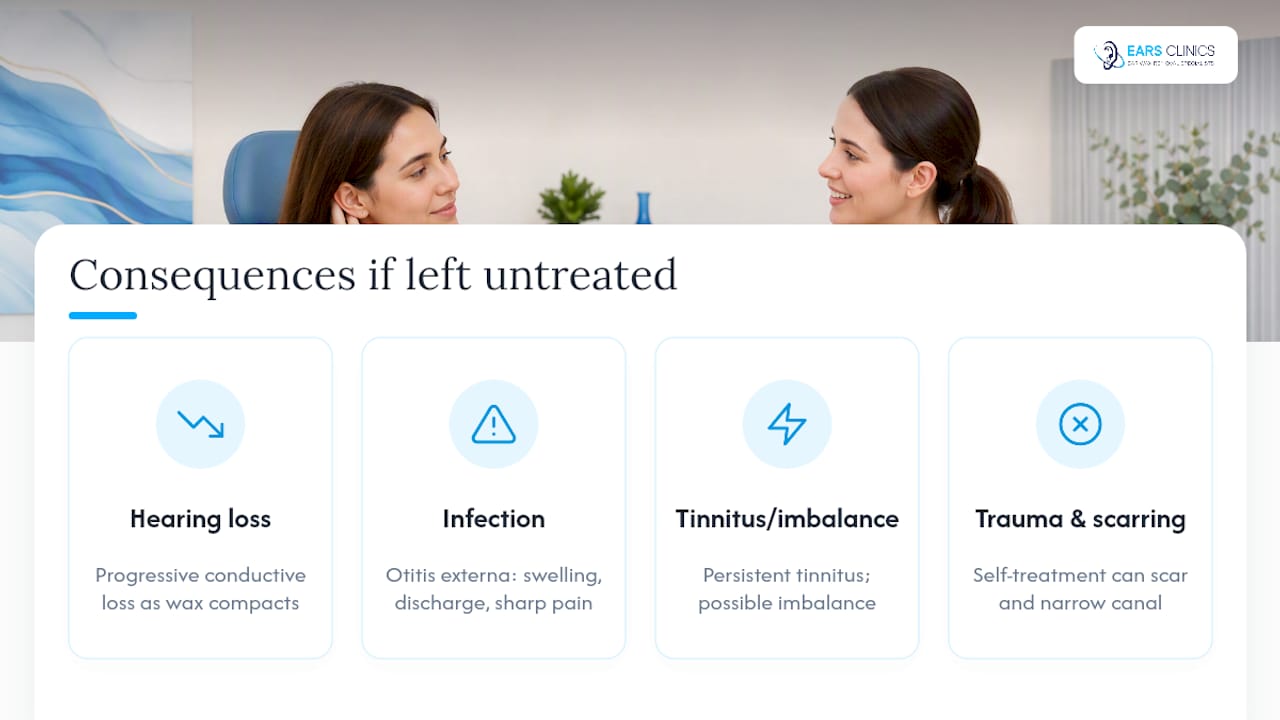
Left alone, impacted wax in a narrow canal rarely resolves itself the way it might in a wider one, simply because there is less room for even softened wax to migrate out naturally. The most immediate consequence is progressive conductive hearing loss, which can feel subtle at first but becomes more noticeable as wax hardens and compacts further against the eardrum.
Persistent moisture trapped behind a wax plug, particularly after unsuccessful attempts at home irrigation, creates a favourable environment for bacterial or fungal growth. This can develop into otitis externa, an infection of the outer ear canal that brings swelling, discharge, and often sharp pain rather than the dull ache typical of simple impaction. In a canal that is already narrow, swelling from infection has even less space to expand into, which can intensify pain and block the canal further.
Chronic, untreated impaction has also been associated with persistent tinnitus and, in some cases, contributes to a sensation of imbalance if pressure builds against the eardrum for an extended period. Repeated, unsuccessful self-treatment attempts, particularly with cotton buds or improvised tools, raise the risk of trauma to the thin skin lining a narrow bony canal, which can then scar and narrow the space still further, creating a cycle where each impaction becomes harder to clear than the last. Addressing wax buildup within a reasonable window, rather than repeatedly self-treating a canal that is not clearing, breaks that cycle before it becomes established.
Does narrow canal wax feel different? Consistency and removal
People with narrow ear canals often report wax that behaves differently from what family members with wider canals describe. Because migration out of the canal is slower and less efficient, wax tends to sit in place longer, drying out and hardening rather than being carried away while still soft.
This has practical implications for removal. Hard, compacted wax responds less predictably to drops alone, and a longer softening period is often needed before any drops make a real difference. Clinicians frequently combine a short course of cerumenolytic drops with manual instrumentation or microsuction, rather than expecting suction alone to shift a plug that has calcified against the canal wall over weeks or months.
Consistency also varies with skin type and age. Older adults tend to produce drier, flakier wax that compacts readily in a narrow space, while younger adults may have softer wax that nonetheless struggles to migrate past a sharply curved isthmus. Recognising which pattern applies to you helps a clinician judge how long a softening trial should run before mechanical removal, and whether irrigation is even a sensible option given how firmly hardened wax can resist water flow in a constricted canal.
Managing comfort during professional wax removal
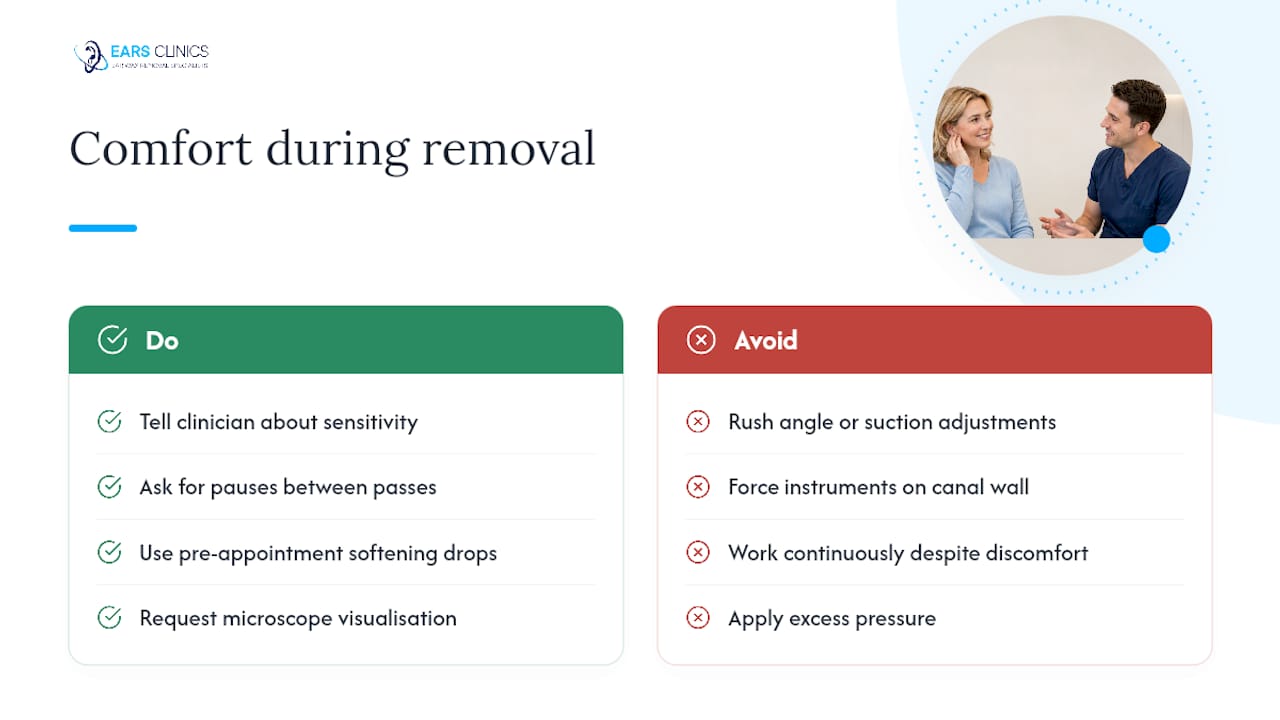
Discomfort during professional removal in a narrow canal usually comes down to pressure and unfamiliar sensation rather than genuine pain, and experienced clinicians manage both carefully. Microsuction, in particular, produces a distinctive noise that surprises many patients, though the sensation itself is typically described as odd rather than painful.
Clinicians adjust instrument angle and suction strength specifically for narrow or curved canals, moving slowly to avoid contact with the thin skin covering the bony section, where even light trauma can cause disproportionate discomfort. Visualisation under a microscope allows the practitioner to see exactly how close instruments are to the canal wall throughout, reducing the chance of an accidental touch that would otherwise cause a sharp, momentary sting.
For patients who find any ear contact uncomfortable, communicating this before the appointment allows the clinician to pace the procedure accordingly, pausing between passes rather than working continuously. Where wax is particularly hard or firmly compacted, pre-treatment with softening drops in the days before an appointment reduces the mechanical force needed during removal itself, which in turn lowers discomfort. Manual instrumentation, when used, tends to require the steadiest hand in a narrow canal, and magnified vision is what allows a clinician to work precisely without needing to apply excess pressure.
Our take on managing narrow ear canal wax
Most advice online treats narrow canals as a footnote to general earwax guidance, when it should really be the starting point. Anatomy dictates almost everything else, from which drops are worth trying to which removal method is genuinely safe, and that gets buried under generic “try olive oil” advice that ignores why the wax got stuck in the first place.
The conventional wisdom oversells irrigation as a universal fix. It works well in a straightforward canal, but guidance is consistent that a narrowed or scarred canal changes the risk calculation entirely, favouring visualised techniques over flushing fluid into a space you cannot fully see behind.
If there is one priority worth taking from this, it is knowing your own stop signal. A short trial of drops is reasonable; persistent or worsening symptoms afterwards are not a reason to try harder at home, but a reason to get looked at by someone who can actually see what your canal is doing.
— EARS
Book professional narrow canal wax removal with EARS Clinics
Earhealthservice, trading as EARS Clinics, is the practical next step once self-care has run its course or your history rules out home irrigation altogether. Unlike a generic pharmacy kit or a DIY irrigation bulb, every appointment starts with a proper assessment of your canal anatomy, so the method chosen, whether microsuction, irrigation, or manual instrumentation, actually fits your ears rather than guessing.

Appointments run from NHS-accredited clinics in Glasgow and Edinburgh, with same-day treatment available when symptoms have escalated and waiting simply is not an option. Home visits are also offered for anyone who finds travelling with blocked or painful ears difficult. Every clinician is a trained Aural Care Specialist working to Healthcare Improvement Scotland standards, so anatomy that a general practice might hesitate over, narrow, curved, or previously scarred canals, gets handled by someone with the right visualisation tools and experience. If you recognise your own symptoms in this guide, book an assessment appointment and bring your ear history along; it is the single most useful thing you can hand a clinician before they even look inside.
This article is general information, not a substitute for advice from a qualified doctor. Consult a qualified healthcare professional about your own circumstances before acting on anything here.
Sources
Recommended