
24 to 72 Hours After Microsuction: When a Blocked Ear Is Normal

A blocked or muffled ear after microsuction is usually normal and settles within 24 to 72 hours as the canal recovers. Fullness, a faint echo, brief sound sensitivity, or short-lived tinnitus are all common in this window. Seek prompt review for severe pain, bleeding, discharge, or dizziness that does not ease, since these fall outside what a normal recovery looks like.
TL;DR:
Most mild discomforts after microsuction, like fullness or tinnitus, resolve within 72 hours, but severe pain or bleeding require urgent review.
Persistent blocked sensation may result from residual wax, inflammation, Eustachian tube dysfunction, or fluid buildup, not just remaining wax.
Avoid inserting objects like cotton buds or home suction devices after treatment, as they risk injury and are unnecessary for recovery.
Use ear drops only if advised by a clinician, and consider pre-softening wax with drops for five days before microsuction to reduce irritation.
Contact a healthcare provider if pain worsens, hearing does not improve within 72 hours, or if there is discharge, bleeding, or persistent dizziness.
What to expect immediately after microsuction
The moment wax is cleared, sound can seem strangely loud or echoey. That is not a sign anything has gone wrong. Wax dampens sound the way a hand cupped over the ear does, and once it is gone, your brain has to recalibrate to a canal that suddenly carries far more acoustic detail than it has in weeks or months.
Alongside that, several sensations are common straight after treatment:
Mild sensitivity or tenderness in the canal, especially if wax had built up against the eardrum.
A tingling or “ticklish” feeling as the canal skin readjusts.
Brief tinnitus, or an odd awareness of your own breathing and pulse.
Minor irritation from small grazes or disturbed ear hair, which typically fades within a day.
ENT UK’s patient information describes these effects as expected and temporary for most patients.
Common causes of a persistent blocked sensation after wax removal
When fullness lingers longer than a couple of days, several distinct mechanisms could be at play, and they are not all located in the ear canal itself.
Residual wax deeper in the canal. Wax lodged behind a bend or fold in the canal sometimes needs a second pass to clear fully.
Canal swelling or irritation. The gentle manipulation involved in microsuction, irrigation, or manual instrumentation can leave canal skin mildly inflamed for a short period.
Eustachian tube dysfunction. Pressure imbalance in the middle ear can feel identical to a wax blockage even though the canal itself is completely clear.
Middle ear effusion. Fluid behind the eardrum, sometimes following a cold or pressure change, produces the same muffled sensation.
Rare complications. Infection or trauma to the eardrum can occur, though these are genuinely uncommon.
A prospective study following microsuction patients found that around 55% reported minor, short-lived side effects such as dizziness, noise sensitivity, or temporarily reduced hearing, while serious complications like eardrum damage or infection occurred in fewer than 1 in 10,000 cases. That gap between “common but mild” and “rare but serious” is worth holding onto when you are assessing your own recovery.
How long recovery usually takes and what counts as worrying
Most blocked sensations follow a predictable pattern, which makes it easier to judge whether yours is tracking normally or drifting off course.
First few hours: Mild fullness, sound sensitivity, or a faint echo. This is the most intense the sensation typically gets.
24 to 72 hours: The majority of patients notice steady improvement, with muffled hearing clearing and any tenderness fading.
Up to seven days: A smaller number of people, particularly those with more inflamed canals beforehand, take slightly longer to feel fully normal.
Within that timeline, watch for signs that things are not settling as expected: pain that worsens rather than eases after 24 hours, any new discharge, hearing that has not improved by the 72 hour mark, or dizziness that persists rather than fading. Aftercare guidance from ear clinics consistently points to this same window as the useful benchmark for deciding whether to seek review.
Safe self-care: what helps and what to avoid after microsuction
The single most damaging thing you can do to a recovering ear canal is put something inside it. Cotton buds, ear candles, and home suction gadgets all risk pushing debris deeper or irritating already-sensitive canal skin, and none of them are necessary for a canal that has just been professionally cleared.
What actually helps:
Showering and washing your hair as normal the same day, then drying the outer ear gently with a towel rather than probing inside it.
Using ear drops only if your clinician has specifically advised it, since unnecessary moisture can occasionally aggravate a sensitive canal.
Gentle yawning or a soft Valsalva manoeuvre (pinching the nose and blowing softly) if pressure feels trapped, though this should be avoided if you have any pain, discharge, or a known perforation.
Holding off on swimming or flying if you are still symptomatic, since pressure changes can aggravate an already irritated canal.
Pro Tip: If you have hard, stubbornly blocking wax, using softening drops for around five days before your appointment can make the procedure quicker and gentler, and tends to reduce post-treatment irritation and brief vertigo. This is standard advice in NHS aural care leaflets covering pre-treatment preparation.
When to contact the clinic, GP or ENT, and what they will check
Certain symptoms warrant a call rather than a wait-and-see approach. Contact your clinic, your GP, or NHS 111 for urgent advice if you notice:
Pain that is increasing rather than settling.
Hearing loss that persists or worsens instead of improving.
Any discharge or bleeding from the ear.
Dizziness or vertigo that does not resolve within a day or two.
At review, a clinician will typically examine the canal under a microscope or otoscope, check for residual wax or inflammation, and may carry out a basic hearing check. Depending on what they find, next steps range from a straightforward repeat clearance, to watchful waiting if Eustachian tube dysfunction seems the likely cause, to referral for ENT assessment or treatment if infection or fluid build up is suspected.
EARS Clinics: how we help with post-microsuction concerns
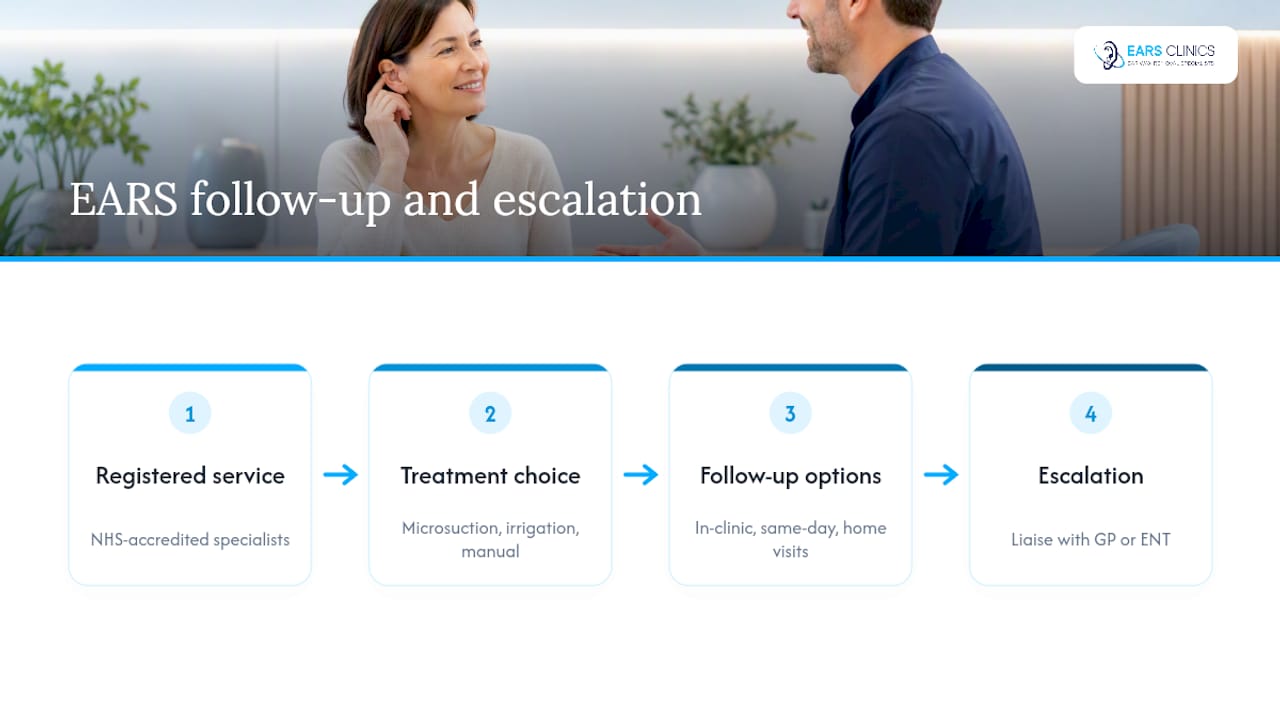
If a blocked sensation lingers past what feels reasonable, having somewhere accessible to turn matters. EARS Clinics is Healthcare Improvement Scotland registered, and every procedure is carried out by NHS-accredited Aural Care Specialists trained in microsuction, irrigation, and manual instrumentation. Your practitioner selects whichever method suits your ear canal and medical history best, rather than defaulting to one technique regardless of presentation.
Follow-up options are built around convenience: in-clinic appointments, same-day slots when something needs a prompt look, and home visits for anyone who cannot easily travel. If symptoms point to something beyond the canal, such as Eustachian tube dysfunction or possible middle ear involvement, we can liaise directly with your GP or an ENT specialist to keep your care joined up.
Clinician perspective: normal reactions and when we ask you to return
Most of what patients describe after treatment, whether that’s fullness, echo, or a day of odd sensitivity, is the ear canal readjusting, not a problem. What we do ask is that you phone us rather than wait it out if pain is climbing, hearing has not shifted by 72 hours, or dizziness sticks around. Ringing early costs you nothing and saves you days of needless worry.
— EARS
If symptoms persist: book a follow-up or repeat microsuction
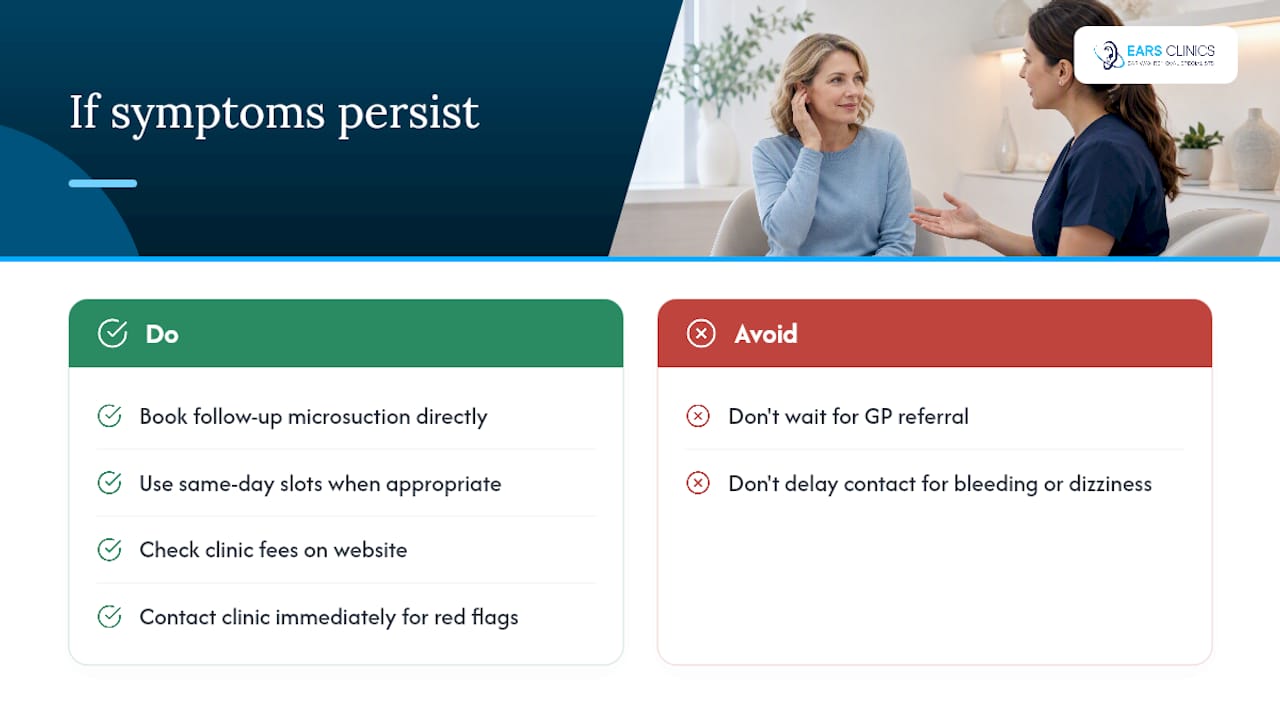
Earhealthservice gets you seen faster than the standard route through routine NHS ear care, with no referral or waiting list needed before you can walk in. If your blocked ear has not settled within the expected window, you can book a follow-up microsuction appointment directly, without going through a GP first.
Current clinic visit and home visit fees are detailed on our website. Same-day slots are offered where clinically appropriate, alongside a wider range of microsuction and irrigation services for recurring wax issues. If you are experiencing any red-flag symptoms such as worsening pain, bleeding, or persistent dizziness, contact the clinic promptly rather than waiting for your next scheduled visit.
Where we looked: official guidance and key studies
This guide draws on NHS guidance on earwax build-up for safe self-care and treatment options, ENT UK’s patient information on microsuction for procedural expectations and complication rates, and a peer-reviewed prospective study for the statistics on minor side effects and rare serious complications. Together, these sources anchor the timeline and red-flag advice given throughout this article in established clinical practice rather than general assumption.
This article is general information, not a substitute for advice from a qualified doctor. Consult a qualified healthcare professional about your own circumstances before acting on anything here.
Sources
Recommended