
2% of people cough when their ear is touched. Ear wax cough reflex and clinic steps
- 4 days ago
- 7 min read

Touching the ear canal or clearing cerumen can trigger a cough because the auricular branch of the vagus nerve, known as Arnold’s nerve, supplies sensation to the outer ear canal and feeds directly into the brainstem’s cough centre. This affects roughly 2 to 3% of healthy people but a far larger share of those with chronic cough. It is rarely dangerous on its own, though persistent or unexplained coughing deserves clinical assessment, and safe professional wax removal is widely available.
TL;DR:
About 2 to 3% of healthy people experience a cough triggered by ear canal stimulation, but the rate is much higher in those with chronic cough.
Impacted cerumen pressing against the canal wall is the most common cause of ear-cough reflex, especially when firmly lodged or pressing on the eardrum.
The reflex is more likely to occur in individuals with vagal hypersensitivity or already prone to cough, often serving as a clinical clue during chronic cough evaluations.
Safe ear wax removal methods include microsuction, irrigation, and manual instruments, with microsuction being the preferred technique to minimize triggering the cough reflex.
Home attempts like cotton buds or ear candles are dangerous and ineffective; professional assessment and removal protect against injury and manage the reflex safely.
The ear wax cough reflex: how it actually works
The mechanism sounds unlikely until you look at the wiring. The auricular branch of the vagus nerve, universally referred to as Arnold’s nerve, is the only place in the human body where the vagus nerve reaches the skin’s surface. It supplies part of the external auditory canal, a section of the tympanic membrane and the back of the ear, and it travels straight back to the brainstem’s nucleus tractus solitarius, the same relay station that processes signals from the airway and lungs.
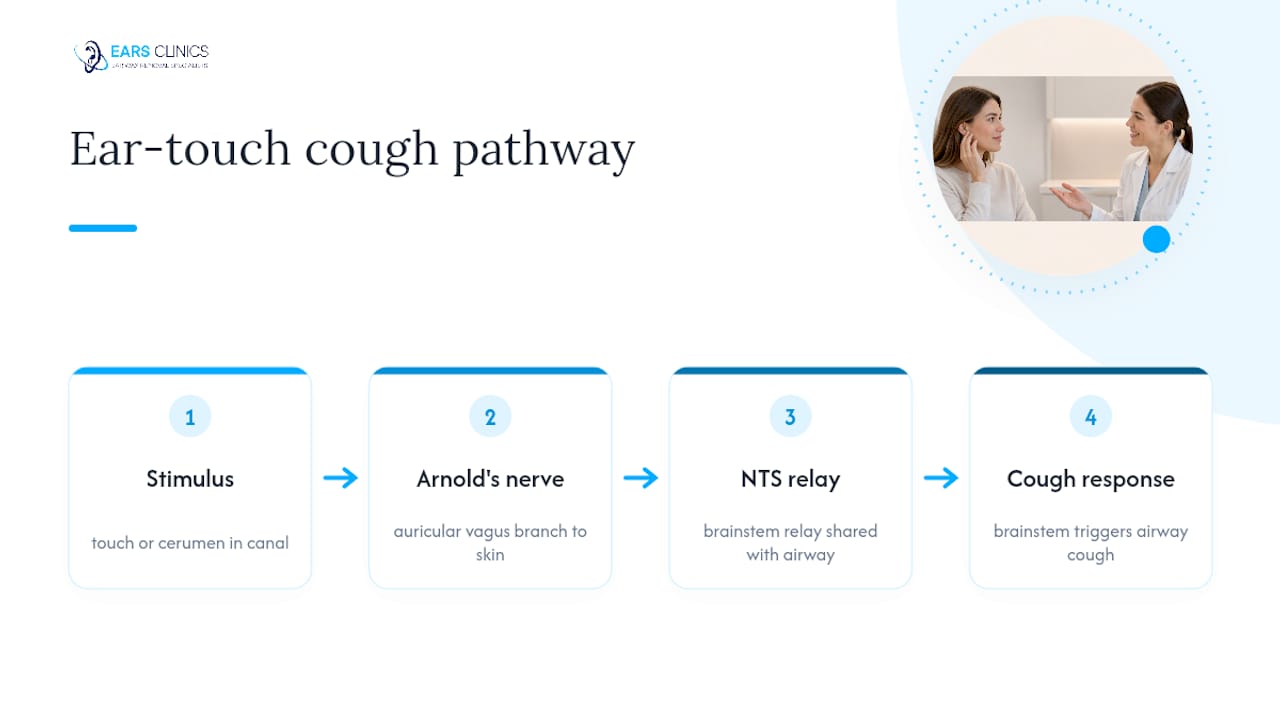
That shared wiring is the whole story. When something brushes the ear canal wall, whether it is a curette, a cotton bud, a jet of water during irrigation or a stubborn plug of cerumen shifting under pressure, Arnold’s nerve fires off an afferent signal indistinguishable, at the brainstem level, from a signal coming up from the trachea. The brain does not have a reliable way to separate “something touched my ear” from “something is irritating my airway”, so it defaults to the airway’s standard defensive response: cough.
This is the cough reflex mechanism operating somewhere it was never really designed for. Most people never notice it because the sensitivity of Arnold’s nerve varies enormously from one person to the next. Some patients cough every single time a clinician looks in their ear canal. Others could have a cotton bud rotated against the same spot and feel nothing at all.
That variability has a name in respiratory medicine: vagal hypersensitivity. In people whose vagal pathways are already primed to overreact, often because of chronic cough or an underlying airway sensitivity, the ear canal becomes an unusually reliable trigger point. A reflex that is a curiosity in most people can be a genuine clinical clue in others.
How common is the ear wax cough reflex?
Prevalence figures vary sharply depending on who is being studied, and that gap tells its own story. In generally healthy adults and children, only around 2% experience a cough when the external auditory canal is stimulated.
Researchers typically test for the reflex using a simple, standardised method: a cotton bud gently rotated against the wall of the ear canal, with the response noted as positive or negative. It sounds unscientific for a clinical study, but it is remarkably consistent across the research.
The size of the gap between healthy volunteers and chronic cough patients is itself the clinically interesting finding. It suggests the reflex is not just a random neurological quirk. It is far more likely to surface in people whose cough reflex arc is already dialled up, which is why clinicians increasingly treat a positive ear-cough test as a small but useful data point during a chronic cough work-up.
What triggers the reflex: wax, foreign bodies and procedural factors
Ear canal issues causing cough tend to fall into a short, recognisable list. Impacted cerumen is the most frequent culprit, particularly when a wax plug sits firmly against the canal wall or presses on the eardrum. Hair, skin flaking and trapped foreign bodies, especially in children, can do the same thing. Pressure from an examining instrument, an ill-fitting hearing aid mould, or even a firm jet of water during irrigation can all set it off.
Clinical procedures add another layer. The type of instrument matters, and so, oddly enough, does the examiner. One observational study of otologic clinics recorded the reflex in 12.9% of procedures, with a noticeable right-ear predominance linked to examiner handedness, likely because most clinicians approach and probe the right canal at a slightly different angle than the left.
Impacted cerumen pressing against the canal wall or tympanic membrane
Foreign bodies, hair or skin debris trapped in the canal
Otoscope specula, curettes and suction tips during examination or removal
Water pressure during irrigation
Ill-fitting hearing aids or earplugs
Cough is rarely the only sign. Some patients gag simultaneously, because the glossopharyngeal nerve sits close to Arnold’s nerve in the brainstem, and a few even experience mild lacrimation, a watering eye on the stimulated side.
Pro Tip: If you know you cough or gag when anyone touches your ears, mention it before an ear wax removal appointment. Clinicians can adjust technique and pacing rather than being caught out mid-procedure.

When a cough from the ear canal actually matters
Most cases of ear wax and throat irritation resolving into a cough are entirely benign; they are a nerve doing something unexpected, not a sign of disease. But there is a specific clinical scenario worth knowing about: cough hypersensitivity syndrome. This is where the cough reflex arc itself has become oversensitive, and the Arnold’s nerve response effectively becomes a diagnostic window into that wider vagal sensitivity.
A CHEST commentary on chronic cough evaluation specifically recommends ear inspection as part of a standard chronic cough work-up, precisely because impacted cerumen has occasionally been identified as a contributing, and correctable, factor. The clinical workflow is usually straightforward:
Examine the ear canal and tympanic membrane for wax, debris or other obstruction.
Remove any impaction using an appropriate professional method.
Reassess the cough after removal, sometimes over several days.
Refer to ENT or a respiratory specialist if the cough persists once the ear is clear.
Case reports in the Arnold’s nerve literature describe patients whose long-standing cough resolved simply after cerumen removal, no medication involved, just clearing the physical trigger. In more refractory cases, where the cough reflects an underlying sensory vagal neuropathy rather than a mechanical trigger, some case series report improvement with gabapentin. This is specialist-led treatment, prescribed and monitored by a clinician who has weighed the risks and benefits for that individual, never something to self-manage.
How clinicians safely remove ear wax and manage the reflex
Current NICE guidance favours microsuction as the preferred method of ear wax removal, largely because it offers direct visualisation and precise control with a low complication rate. Irrigation and manual instrumentation remain safe, clinically valid alternatives, and a competent practitioner chooses between the three based on your ear anatomy, your medical history and how the wax is presenting, not a one-size-fits-all default.
Microsuction: a fine suction device removes wax under magnified, direct vision, usually the gentlest option where the cough reflex is a concern.
Irrigation: a controlled, temperature-regulated water flow softens and clears wax, well suited to certain presentations but less precise where the reflex is highly active.
Manual instrumentation: a curette or specialised probe lifts wax out directly, useful for firm or superficial plugs.
If you know you have a strong ear-cough reflex, tell your clinician before they start. A good microsuction workflow includes brief pauses, careful instrument positioning to minimise unnecessary canal contact, and immediate withdrawal if coughing or gagging begins, followed by reassessment before continuing. None of this should feel rushed or alarming; it is standard practice.
This is precisely why ear care should only be carried out by trained, competent clinicians working to recognised best-practice standards, regulated by bodies such as Healthcare Improvement Scotland or the Care Quality Commission. If you are dealing with wax build-up, cough, or both, you can book ear wax removal with EARS Clinics at Earhealthservice.
What not to try at home, and safe first steps
Cotton buds tend to push wax deeper rather than clearing it, and ear candles have no credible evidence behind them while carrying a real burn risk. Unregulated at-home suction gadgets can also injure the canal or eardrum with no clinician on hand to intervene.
Never insert cotton buds, hairpins or any object into the ear canal.
Avoid ear candling entirely; it has no proven clinical benefit.
Use softening drops only if advised by a clinician, not as a routine habit.
Book a professional assessment if wax feels impacted or a cough persists.
Seek urgent review for severe pain, bleeding, discharge, sudden hearing loss or fever.
Mayo Clinic’s guidance is consistent on this point: persistent symptoms need a professional assessment, not another DIY attempt.
A clinic perspective: managing the ear-cough reflex safely
At Earhealthservice, most ear-cough reflex cases are entirely manageable. Our regulated practitioners use microsuction, irrigation or manual instrumentation depending on what your ear actually needs, adjusting technique the moment a reflex appears. Clearing impacted wax often settles both the cough and the hearing loss it was masking. If you recognise this reflex in yourself, book an assessment rather than guessing at home.
— EARS
Sources
This article is general information, not a substitute for advice from a qualified doctor. Consult a qualified healthcare professional about your own circumstances before acting on anything here.
Recommended