
How to remove a lot of ear wax safely

TL;DR:
Cerumen impaction causes symptoms like muffled hearing and earache due to excessive ear wax buildup. Safe removal involves softening agents like carbamide peroxide or mineral oil, followed by gentle irrigation or professional microsuction if necessary. Avoid using cotton buds or ear candles, and seek professional help when at-home methods fail or symptoms worsen.
Cerumen impaction, the clinical term for a significant ear wax build-up, is defined as an accumulation of wax that causes symptoms such as muffled hearing, a sensation of fullness, tinnitus, or earache. Knowing how to remove a lot of ear wax safely requires two things: the right softening agent and an appropriate removal technique. The most effective approach combines carbamide peroxide or mineral oil drops with careful irrigation at home, or professional microsuction for stubborn or very large blockages. Attempting removal without understanding the correct method risks pushing wax deeper, damaging the eardrum, or worsening the blockage. This guide covers every safe option, from at-home softening to NHS-accredited clinical procedures.
What do you need before removing a lot of ear wax at home?
Safe at-home treatment starts with the right tools and an honest assessment of your situation. Reaching for the nearest cotton bud is the single most common mistake people make, and it reliably makes things worse.
Recommended softening agents
Carbamide peroxide drops (such as Debrox or Earex): carbamide peroxide drops release oxygen on contact with wax, creating a gentle fizzing action that breaks down hardened cerumen. This makes them the gold standard for softening large clumps before removal.
Mineral oil or baby oil: Both coat and soften wax without causing irritation. They are a reliable choice for people with sensitive ear canals.
Glycerin or olive oil: Gentle, widely available, and effective for moderate build-ups. Olive oil is a well-established natural remedy for ear wax softening and is safe for most adults.
Hydrogen peroxide (3% solution): Effective but must be used cautiously. Hydrogen peroxide, mineral oil, and glycerin drops are all safe softening agents when applied correctly, though they can cause mild irritation if overused.
Equipment you will need
A rubber bulb syringe or a dedicated ear irrigation kit is the standard tool for flushing softened wax. Use only body-temperature water. Water that is too cold or too hot can trigger dizziness by stimulating the balance organs in the inner ear.
Safety checks before you begin
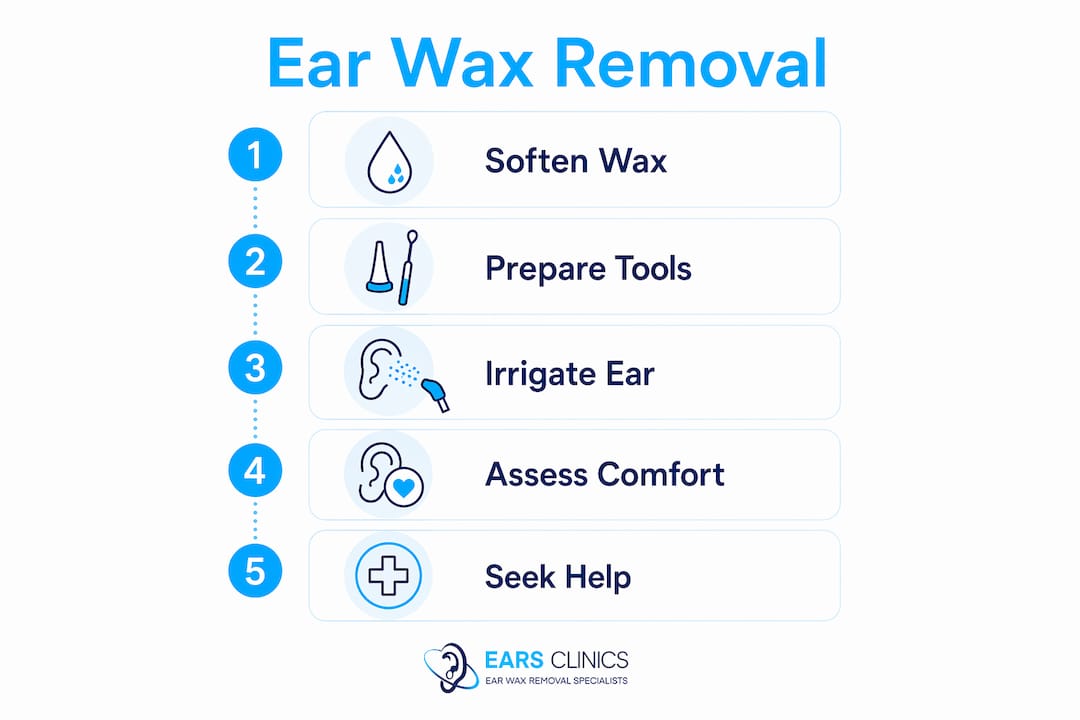
Never attempt home removal if you have a history of a perforated eardrum, ear surgery, or a current ear infection. A baseline professional ear examination is the most reliable way to rule out contraindications before you start. This single step prevents the majority of complications that arise from home treatment.
Pro Tip: If you are unsure whether your eardrum is intact, book a professional assessment before using any drops or irrigation. Applying drops through a perforated eardrum can cause significant pain and infection.
How to safely remove large ear wax build-ups at home
The soften-and-flush method is the safest home removal method for significant cerumen build-up. Follow these steps carefully and stop immediately if you experience pain, dizziness, or bleeding.
Warm the drops to body temperature. Hold the bottle in your hand for one to two minutes. Cold drops cause dizziness. This step takes seconds and prevents unnecessary discomfort.
Lie on your side with the affected ear facing upward. Pull the outer ear gently upward and backward to straighten the ear canal. This allows the drops to travel deeper and coat the wax evenly.
Apply the recommended number of drops. For carbamide peroxide products, this is typically five to ten drops. For mineral oil or olive oil, three to five drops are sufficient. Follow the product instructions precisely.
Stay in position for five to ten minutes. You may hear a fizzing or crackling sound if using carbamide peroxide. This is normal and indicates the drops are working. Do not stand up immediately.
Drain and gently wipe the outer ear. Tilt your head to allow the drops and any loosened wax to drain onto a tissue. Never insert anything into the canal to remove residue.
Repeat once or twice daily for two to three days. Consistent softening over several days is far more effective than a single application. Rushing this stage is the most common reason home treatment fails.
Irrigate with body-temperature water. Fill a bulb syringe with warm water. Gently direct the stream toward the upper wall of the ear canal, not straight at the eardrum. Use light, steady pressure. Avoid inserting the syringe tip more than a few millimetres into the canal.
Tilt your head to drain. Allow water and loosened wax to flow out freely. Repeat the irrigation two to three times per session if needed.
Dry the ear canal gently. Tilt your head and allow the ear to drain naturally, or use a clean towel to absorb moisture from the outer ear only.
Pro Tip: If your symptoms have not improved after three to five days of consistent softening and irrigation, do not persist. Worsening pain, sudden hearing loss, or discharge are signs to stop and seek professional assessment promptly.
For a more detailed walkthrough of each stage, the step-by-step removal guide from Earhealthservice covers both home and clinic approaches in full.

Professional ear wax removal: which method is right for you?
When home methods are insufficient, or when the build-up is very large, hardened, or accompanied by symptoms such as significant hearing loss, professional removal is the correct course of action. Trained clinicians use three primary techniques, and the choice between them depends on wax consistency, ear anatomy, and the patient’s medical history. There is no single method that suits every patient.
Method | How It Works | Best For | Key Advantage |
Microsuction | Gentle suction removes wax under direct microscopic visualisation | Most build-ups, including hardened wax | No water used; safe for perforated eardrums |
Irrigation | Controlled water flow flushes softened wax from the canal | Soft to moderate wax with intact eardrum | Comfortable and well-tolerated |
Manual instrumentation | Curettes or forceps remove wax with tactile precision under microscopy | Hard, impacted wax close to the eardrum | Direct control; no fluid required |
Microsuction is currently the preferred method recommended by NICE guidelines for ear wax removal. It involves direct visualisation of the ear canal throughout the procedure, making it precise, safe, and far less likely to cause complications than irrigation. Professionals using microsuction can see exactly what they are doing at every moment, which is a significant clinical advantage.
Manual instrumentation under microscopy provides the tactile control needed for hardened wax that resists both drops and suction. Curettes and forceps allow a clinician to work around the contours of the ear canal without applying pressure to the eardrum. This technique is particularly valuable for patients with very dense or impacted cerumen.
Trained clinicians select the method based on wax hardness, ear anatomy, patient history, and comfort. No single approach works for every presentation. A clinician who assesses before treating will always achieve a safer and more effective outcome than one who applies the same technique to every patient.
In the UK, ear care clinicians should be regulated by Healthcare Improvement Scotland (HIS) or the Care Quality Commission (CQC). Choosing a regulated provider is not optional. It is the baseline standard of safe care.
What are the biggest risks when removing large amounts of ear wax?
Several common practices cause genuine harm, despite being widely used. Understanding these risks is the most direct way to protect your hearing.
Cotton buds: Improper home removal using cotton swabs pushes wax deeper into the canal and risks eardrum damage. Cotton buds are designed for the outer ear only and should never enter the ear canal.
Ear candles: Ear candling can cause burns to the face, ear canal, and eardrum. It is not medically recommended and has no clinical evidence of effectiveness.
DIY gadgets with cameras and suction: Ear cleaning gadgets with cameras carry a real risk of eardrum puncture requiring surgical repair. Medical professionals advise against them. The appearance of convenience does not offset the clinical risk.
High-pressure irrigation: Excessive water pressure can rupture the eardrum or cause acute dizziness. A bulb syringe used gently is appropriate; a pressurised water flosser or shower jet directed into the ear is not.
Incorrect water temperature: Water that is too cold or too hot stimulates the vestibular system and causes sudden, severe dizziness. Always use body-temperature water.
“The most common injuries we see from home ear wax removal are caused not by the wax itself, but by the tools people use to remove it. Cotton buds, candles, and camera gadgets account for the majority of preventable ear injuries.”
Stopping home treatment and seeking professional assessment is the right decision whenever symptoms worsen, pain develops, or there is any discharge from the ear. Persistent attempts to remove wax at home after failed initial efforts increase the risk of impaction and injury.
Key takeaways
Safe, effective removal of large ear wax build-ups requires softening agents used consistently over several days, followed by gentle irrigation or professional microsuction for stubborn or impacted cerumen.
Point | Details |
Soften before removing | Use carbamide peroxide, mineral oil, or olive oil drops for two to three days before irrigation. |
Use body-temperature water | Cold or hot water triggers dizziness; always match water temperature to body temperature before irrigating. |
Microsuction is the gold standard | NICE guidelines recommend microsuction as the safest and most precise professional removal method. |
Avoid cotton buds and ear candles | Both push wax deeper or cause burns; neither is clinically safe or effective for ear canal cleaning. |
Seek professional help when needed | If home methods fail after three to five days, or symptoms worsen, book a professional assessment promptly. |
What we have learned from treating significant ear wax build-ups
At Earhealthservice, the patients who arrive with the most severe impactions are rarely those who did nothing. They are, more often, people who tried to help themselves with cotton buds, ear candles, or camera gadgets for weeks before seeking professional care. The wax that started as a manageable build-up has, by the time we see them, been compressed into a dense plug sitting against the eardrum.
The uncomfortable truth is that most at-home removal attempts for large build-ups make the situation harder to treat, not easier. Softening drops are genuinely useful. Gentle irrigation with a bulb syringe, done correctly, can work well for moderate accumulations. But when the wax is dense, hardened, or positioned close to the eardrum, home methods reach their limit quickly.
Microsuction, in our clinical experience, offers clear advantages in comfort, safety, and effectiveness for large ear wax removal compared to irrigation. The ability to see the canal throughout the procedure changes everything. A clinician working under direct visualisation can stop the moment they need to, adjust their approach, and protect structures that cannot be seen with a torch or camera gadget.
The patient-clinician relationship matters here too. A good assessment before any treatment, professional or otherwise, is what separates safe care from guesswork. We encourage anyone with recurring build-ups to consider regular professional checks rather than waiting until symptoms become severe. Prevention is always less uncomfortable than treatment.
— EARS
Professional ear wax removal at EARS clinics
If home softening has not resolved your symptoms, or if your build-up is significant, Earhealthservice offers NHS-accredited ear wax removal at clinics in Glasgow and Edinburgh, with home visits also available.

Earhealthservice’s Aural Care Specialists are trained and regulated by Healthcare Improvement Scotland (HIS), and they use microsuction, irrigation, and manual instrumentation to suit each patient’s individual needs. Appointments are available the same day, with no requirement to pre-treat with drops before attending. Pricing starts at £60 for adults and £75 for under-18s, with home visits available at £180. To see the full range of professional removal procedures or to book an appointment, visit Earhealthservice at earhealthservice.co.uk.
FAQ
What is the fastest way to remove a large ear wax build-up?
The fastest safe approach is to apply carbamide peroxide drops for two to three days to soften the wax, then irrigate gently with body-temperature water using a bulb syringe. For immediate relief from a severe blockage, professional microsuction provides the quickest and safest result.
Can i use olive oil to remove a lot of ear wax?
Yes. Olive oil is a safe and effective softening agent for ear wax. Apply three to five warmed drops into the affected ear, lie on your side for five to ten minutes, then allow the ear to drain. Repeat daily for several days before attempting irrigation.
When should i stop home treatment and see a professional?
Stop home treatment and seek professional assessment if symptoms worsen after three to five days, if you experience pain, sudden hearing loss, dizziness, or any discharge from the ear. These signs indicate the build-up may require clinical removal.
Is microsuction safe for everyone?
Microsuction is safe for the vast majority of patients, including those with a perforated eardrum, as no water is used. A trained clinician will assess your ear before treatment to confirm suitability. It is the method recommended by NICE guidelines for most presentations of ear wax impaction.
How do i prevent ear wax build-up recurring?
Regular use of softening drops such as olive oil or mineral oil, applied once or twice a week, helps keep wax mobile and reduces the likelihood of impaction. Patients prone to recurrent build-ups benefit from periodic professional checks to monitor wax levels before symptoms develop.
Recommended