
Top ear care services 2025: trusted UK picks
- 1 hour ago
- 14 min read

For most people in the UK seeking safe, regulated ear wax removal in 2025, EARS Clinics is the recommended first choice. They are registered with Healthcare Improvement Scotland (HIS), staffed by NHS-accredited Aural Care Specialists, and offer microsuction, irrigation, and manual instrumentation across Glasgow and Edinburgh, with same-day clinic appointments and home visits available. Microsuction is the technique preferred by current NICE guidance for most presentations, and EARS Clinics deliver it under full clinical governance with before/after imaging and GP or ENT correspondence included.
If your situation calls for something different, here are the other providers worth considering:
Auris Ear Care — best for 24/7 mobile and emergency home visits in London; CQC-regulated and with ENT-trained clinicians.
Expert Ear Care — best for patients in north-east England needing ENT consultant-led care with wireless before/after imaging.
CERA Ear Clinic — best for sensitive or complex ears; specialises in microsuction under microscope visualisation.
The Chiswick & Ealing Ear Care Centre — best for west London residents wanting a dedicated specialist clinic.
Specsavers / Boots Hearingcare / Hidden Hearing / The Hearing Care Partnership — best for high-street accessibility and integrated hearing assessments, though their service mix differs from specialist microsuction clinics.
To book with EARS Clinics, visit earhealthservice.co.uk.
Which are the top ear care services in the UK for 2026?
The table below compares the shortlisted providers across the dimensions that matter most when choosing a UK ear care specialist.
Provider | Best for | Service type | Primary methods | Practitioner & registration | Typical price | Availability | Coverage | Aftercare & correspondence |
Most patients; regulated microsuction, children, complex ears | Clinic + home visit | Microsuction, irrigation, manual instrumentation | NHS-accredited Aural Care Specialists; HIS registered | £60 adult / £75 under-18 / £180 home visit | Same-day; clinic & home | Glasgow & Edinburgh | Before/after imaging; GP/ENT letters | |
24/7 mobile & emergency home visits in London | Mobile / home visit | Microsuction | ENT-trained clinicians; CQC regulated | £175 standard; emergency surcharge applies | 24/7 including emergency | London | Clinical documentation | |
ENT consultant-led care; north-east England | Clinic + mobile | Microsuction, irrigation | ENT consultant; British Society of Audiology member | Not publicly listed | Same-day where available | Newcastle & north-east | Wireless before/after imaging; GP/ENT letters | |
Sensitive or complex ears; microscopy-guided care | Clinic | Microsuction under microscopy | Specialist clinicians | Not publicly listed | By appointment | Not publicly listed | Not publicly listed | |
West London clinic-based specialist care | Clinic | Microsuction | Specialist clinicians | Not publicly listed | By appointment | West London | Not publicly listed | |
Specsavers (hearing clinics) | High-street access; integrated hearing services | Clinic (retail) | Varies by branch | Audiologists; regulated | Varies | Walk-in / appointment | National | Hearing care pathway |
Hidden Hearing | Local branch hearing support | Clinic (retail) | Varies | Audiologists | Varies | By appointment | National branches | Hearing care pathway |
Boots Hearingcare | High-street convenience; hearing tests | Clinic (retail) | Varies | Audiologists | Varies | By appointment | National | Hearing care pathway |
The Hearing Care Partnership | Local audiology + ear care | Clinic | Varies | Audiologists | Varies | By appointment | National clinic group | Audiology integration |
Ear Health Service | Booking & patient education for EARS Clinics | Online resource | Microsuction, irrigation, instrumentation | NHS-accredited (via EARS Clinics) | As EARS Clinics | As EARS Clinics | Glasgow & Edinburgh | As EARS Clinics |
A note on meaningful differences. The clearest dividing line in this list is between specialist microsuction clinics and high-street hearing retailers. EARS Clinics, Auris Ear Care, Expert Ear Care, and CERA Ear Clinic are dedicated ear care providers whose clinicians are trained specifically in wax removal techniques and clinical governance. Specsavers, Boots Hearingcare, Hidden Hearing, and The Hearing Care Partnership are primarily hearing-care retailers; ear wax removal may be available at some branches, but it is not their core clinical focus and the practitioner grade and method can vary considerably.
The other meaningful split is between mobile and fixed-clinic services. Auris Ear Care’s 24/7 mobile service suits patients who cannot travel, need out-of-hours care, or face an urgent blockage. Fixed clinics such as EARS Clinics and CERA Ear Clinic offer a controlled clinical environment that some patients, particularly those with complex ear histories, may find preferable.
Providers considered but not shortlisted as specialist microsuction clinics: Specsavers, Boots Hearingcare, Hidden Hearing, and The Hearing Care Partnership are included in the table for completeness and high-street accessibility, but they are not specialist microsuction providers and should not be the default choice for patients with complex ear conditions, prior surgery, or perforations.
How we selected and compared these providers
Selection focused on one central principle: clinical safety delivered by regulated, qualified practitioners using evidence-based techniques. Every provider in the shortlist was assessed against the following criteria:
Clinical method — does the provider offer microsuction (the NICE-preferred technique), and do they also offer irrigation and manual instrumentation where clinically appropriate?
Regulation — is the clinic registered with the Care Quality Commission (CQC) in England or Healthcare Improvement Scotland (HIS) in Scotland?
Clinician grade — are practitioners NHS-accredited Aural Care Specialists, ENT consultants, or equivalent?
Same-day and home-visit availability — can the provider accommodate urgent presentations or patients who cannot attend a clinic?
Price transparency — are fees published clearly, including child rates and home-visit surcharges?
Patient reviews — are there verifiable patient ratings that reflect consistent clinical quality?
Aftercare and clinical correspondence — does the clinic offer before/after imaging and the ability to write to the patient’s GP or ENT specialist?
The scope is the UK market only. Out-of-market chains and DIY ear care products were excluded. All provider information was reviewed up to 2025 where publicly available. Prices listed for EARS Clinics are sourced directly from the clinic; prices for other providers are sourced from their published websites where available, and marked as not publicly listed where absent.
What does each shortlisted provider offer?
EARS Clinics
EARS Clinics are NHS-accredited Aural Care Specialists operating in Glasgow and Edinburgh, registered with Healthcare Improvement Scotland (HIS). They offer microsuction, irrigation, and manual instrumentation, with the practitioner selecting the most appropriate method based on each patient’s clinical history and canal anatomy. Same-day clinic appointments are available, as are home visits for patients who cannot travel.
NHS-accredited clinicians; HIS registered; licensed to treat patients from age 2
Before/after imaging and clinical correspondence with GP or ENT included
Fees: £60 (adult), £75 (under-18), £180 (home visit)
EARS Clinics suit the broadest range of patients: adults, children, those with sensitive ears, and those with complex histories including prior surgery or perforations. The combination of HIS registration, NHS-accredited staff, and transparent pricing makes them the recommended starting point for most readers.
Auris Ear Care
Auris Ear Care operates a fully mobile microsuction clinic across London, staffed by ENT-trained clinicians and regulated by the CQC. Standard home visits are priced at £175, with an additional emergency surcharge for out-of-hours appointments. Self-referral is accepted, and the service treats children aged 2 and above. The 24/7 availability and emergency appointment option make Auris the strongest choice for London patients who need urgent care or cannot leave home.
CQC regulated; ENT-trained clinicians
24/7 mobile service including emergency appointments
Standard fee £175; emergency surcharge applies
Expert Ear Care
Expert Ear Care serves Newcastle and the wider north-east, led by an ENT consultant who is a member of the British Society of Audiology. Both clinic-based and mobile appointments are available, and the service offers wireless before/after imaging alongside the ability to issue clinical correspondence to GPs or ENT specialists. Same-day appointments are available where capacity allows.
ENT consultant-led; British Society of Audiology membership
Wireless before/after imaging; GP/ENT letters issued
Clinic and mobile options across north-east England
CERA Ear Clinic
CERA Ear Clinic positions microscopy-guided microsuction as its defining clinical approach, describing it as the gold-standard method for professional ear care. The emphasis on direct visualisation under a microscope makes CERA particularly well suited to patients with sensitive ears, narrow canals, or a history of ear surgery, where avoiding pressurised fluids is clinically important. Pricing and coverage are not publicly listed.
Microscopy-guided microsuction as core method
Suited to sensitive or complex ear presentations
Pricing and locations not publicly listed
The Chiswick & Ealing Ear Care Centre
A local specialist clinic serving west London, offering clinic-based ear care including microsuction. Suited to west London residents who want a dedicated specialist rather than a high-street retailer. Detailed pricing and aftercare information are not publicly listed.

Specsavers, Boots Hearingcare, Hidden Hearing, and The Hearing Care Partnership
These four providers share a common profile: large national branch networks, primarily focused on hearing assessments and hearing device retail, with ear wax removal available at some locations. They offer genuine value for patients who want high-street convenience or need a hearing test alongside ear care. However, the practitioner grade, specific methods used, and clinical governance for ear wax removal can vary by branch. For patients with complex ear conditions or a need for specialist microsuction, a dedicated clinic is a more reliable choice. For context on how specialist microsuction clinics differ from high-street hearing retailers, this industry commentary is worth reading.
Pro Tip: When contacting any provider, ask specifically whether the clinician performing your treatment holds a formal qualification in aural care or is an ENT-trained specialist. A receptionist booking your appointment may not know the answer immediately, but a reputable clinic will always be able to confirm this before you attend.
How to choose the right ear care service for your situation
For most adults in the UK, a regulated clinic offering microsuction performed by an NHS-accredited or ENT-trained clinician is the safest and most appropriate choice.
Use the following steps to narrow down your options:
Assess your clinical risk. If you have a history of ear surgery, a perforated eardrum, grommets, or active infection, you need a clinician who can review your medical history before selecting a method. Microsuction is generally preferred in these cases because it avoids pressurised fluids. Read more about complex ear health and safe wax removal before booking.
Decide whether you need a home visit. If you cannot travel to a clinic due to mobility, illness, or urgency, confirm that the provider offers home visits with properly equipped portable suction and microscope equipment, and that they are CQC or HIS registered for mobile services.
Check urgency. If you need treatment today, confirm same-day availability before booking. Not all clinics offer this routinely.
Confirm child-friendly services. If booking for a child, check the minimum age the clinic is licensed to treat. EARS Clinics and Auris Ear Care both treat children from age 2.
Verify price transparency. Ask for the full fee upfront, including any consultation charge, child rate, home-visit surcharge, or out-of-hours premium.
Questions to ask when booking:
What is the clinician’s qualification, and are they NHS-accredited or ENT-trained?
Which method will be used, and how is that decision made?
Is the clinic registered with CQC (England) or HIS (Scotland)?
Can the clinic issue a clinical letter to my GP or ENT specialist after treatment?
What aftercare instructions will I receive, and what symptoms should prompt me to seek urgent care?
Red flags to watch for:
Home-use high-pressure ear syringing kits recommended as a substitute for clinical treatment
Refusal to confirm the clinician’s qualifications before your appointment
No CQC or HIS registration
Pressure to book additional services or devices without a clinical assessment
No clear aftercare guidance provided
What are the safest ear wax removal methods?
Microsuction is the technique preferred by current NICE guidance for most clinical presentations, but irrigation and manual instrumentation remain safe and clinically valid when selected appropriately by a trained practitioner.
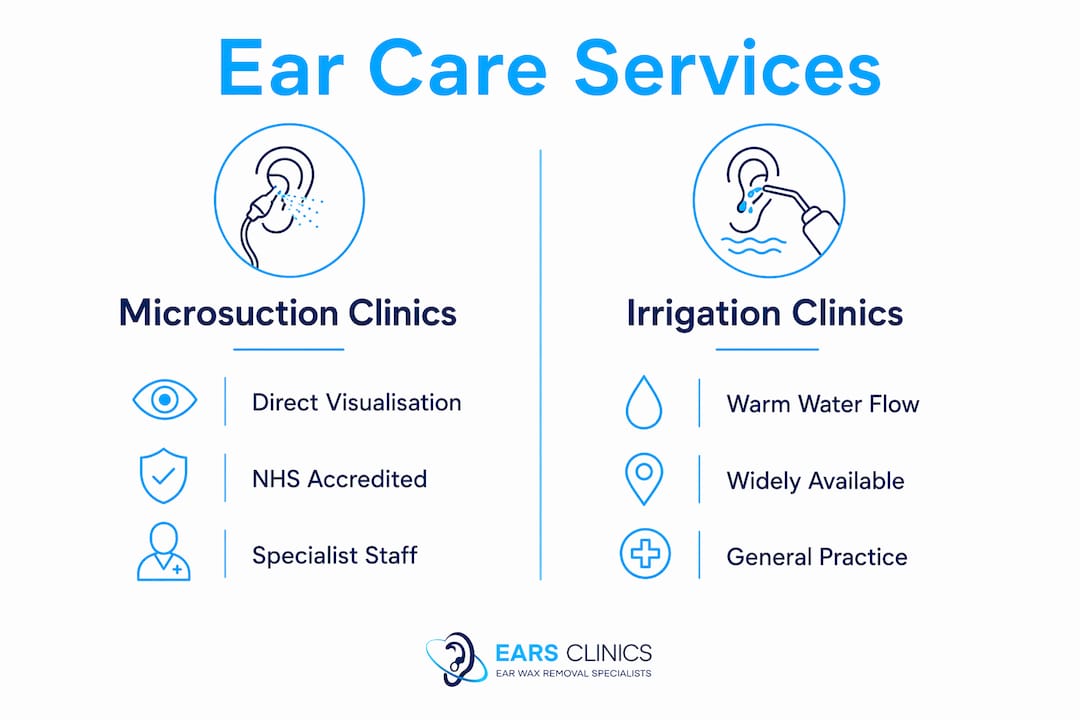
Microsuction
Microsuction uses a fine, low-pressure suction probe to remove wax under direct visualisation, typically with a microscope or loupe. Because no fluid is introduced into the canal, it is suitable for patients with perforations, grommets, or a history of ear surgery. Microsuction under microscopy is described by specialist clinics as the gold-standard approach for sensitive or complex ears, precisely because the clinician can see exactly what they are doing throughout the procedure.
Pros: Direct visualisation; no pressurised fluid; suitable for perforations and post-surgical ears; generally well tolerated. Cons: Can cause temporary tinnitus or dizziness in some patients; requires specialist equipment and training. Clinical suitability: Preferred by NICE for most presentations; particularly indicated where irrigation is contraindicated.
For a detailed explanation of what to expect during a microsuction appointment, the microsuction procedure guide on the EARS Clinics site is a useful reference.
Irrigation
Irrigation uses a controlled flow of warm water to soften and flush wax from the canal. Modern electronic irrigators are considerably safer than the older metal syringe method, but the technique is contraindicated where there is a known or suspected perforation, active infection, or a history of ear surgery.
Pros: Effective for soft or partially softened wax; widely available; generally comfortable. Cons: Contraindicated for perforations, grommets, or active infection; small risk of eardrum damage if pressure is poorly controlled. Clinical suitability: Appropriate for patients with no contraindications and where wax has been pre-softened with olive oil drops.
Manual instrumentation
Manual instrumentation involves the use of small instruments, such as a Jobson Horne probe or wax hook, to physically dislodge and remove wax under direct vision. It is typically used alongside microsuction or when suction alone is insufficient.
Pros: Precise; useful for hard or impacted wax; no fluid or suction required. Cons: Requires a high level of clinical skill; not suitable as a standalone method for all presentations. Clinical suitability: Used selectively by trained clinicians, often in combination with microsuction.
Aftercare note. After any ear wax removal procedure, mild discomfort, a sensation of fullness, or temporary altered hearing can occur and usually resolves within a few hours. Seek urgent care if you experience severe pain, significant hearing loss, discharge, or prolonged dizziness following treatment.
For guidance on microsuction versus irrigation for children, the EARS Clinics site covers method selection in a child-specific context.
Why do regulation and clinician credentials matter?
Choose providers regulated by CQC or HIS and staffed by ENT doctors or NHS-accredited Aural Care Specialists. Regulation is not a formality; it is the mechanism by which clinical standards, equipment safety, and patient safeguarding are independently verified.
The trust signals that matter most when evaluating an ear care provider are:
CQC or HIS registration — confirms the clinic meets independently assessed standards for safety and clinical governance.
ENT consultant or NHS-accredited clinician — indicates the practitioner has formal, assessed training in aural care, not just a short commercial course.
Microscope visualisation for microsuction — direct visualisation reduces the risk of canal or eardrum trauma and is the standard in well-equipped specialist clinics.
Before/after imaging — provides a clinical record and supports continuity of care if the patient is referred onwards.
GP or ENT correspondence — signals that the clinic operates as part of the wider clinical system, not in isolation.
Verifiable patient reviews — a consistent pattern of positive reviews across multiple platforms is a useful supporting signal, though it should never be the primary reason to choose a provider.
Pro Tip: To verify a clinic’s CQC registration in England, search the CQC register at cqc.org.uk. For Scotland, HIS registration can be confirmed via the Healthcare Improvement Scotland website. Any clinic that cannot provide its registration number on request should be treated with caution.
EARS Clinics demonstrate several of these signals simultaneously: HIS registration, NHS-accredited staff, formal microsuction training, before/after imaging, and clinical correspondence with GPs and ENT specialists. Auris Ear Care holds CQC registration and employs ENT-trained clinicians, making it a credible regulated option for London patients. Expert Ear Care’s ENT consultant leadership and membership of the British Society of Audiology are meaningful credentials in a field where practitioner qualifications can vary widely.
Formal training programmes for microsuction and irrigation are an additional indicator of a clinic’s commitment to clinical governance. Clinics that invest in ongoing clinician training and development are more likely to maintain consistent standards as techniques and guidelines evolve.
What should you budget for ear care in 2026?
Clinic-based ear wax removal typically costs between £60 and £120 for adults, with home visits and emergency appointments carrying additional charges. The table below shows sourced prices where available.
Provider | Adult (clinic) | Child | Home visit | Emergency / out-of-hours |
EARS Clinics | £60 | £75 | £180 | — |
Auris Ear Care | £175 | Not listed | £175 (standard mobile) | Surcharge applies |
Expert Ear Care | Not publicly listed | Not publicly listed | By arrangement | By arrangement |
CERA Ear Clinic | Not publicly listed | Not publicly listed | — | — |
High-street retailers | Varies by branch | Varies | Not typically offered | Not typically offered |
Timeline expectations:
A standard clinic appointment, including consultation and treatment, typically takes 30–45 minutes.
Same-day appointments are available at EARS Clinics and Auris Ear Care; routine bookings at other providers may require a wait of several days.
Home visits require the clinician to travel to you; factor in a travel window of 30–60 minutes beyond the appointment itself, particularly for mobile services in urban areas.
Pre-treatment softening with olive oil drops for 3–5 days before your appointment can improve outcomes and reduce appointment time, though it is not always a precondition at specialist clinics.
Before booking, confirm whether the quoted fee includes a consultation charge or whether this is billed separately. Also check the clinic’s policy on refunds if treatment cannot be completed, for example if wax is not present or the canal cannot be safely accessed.
Key takeaways
For most UK patients in 2025, choosing a regulated specialist clinic with NHS-accredited or ENT-trained clinicians and microsuction capability is the safest and most reliable route to effective ear wax removal.
Point | Details |
Regulation is non-negotiable | Only book with CQC (England) or HIS (Scotland) registered clinics to confirm independently verified safety standards. |
Microsuction is the preferred technique | NICE guidance favours microsuction for most presentations; it is the only method safe for perforations and post-surgical ears. |
Ask the right questions | Confirm clinician qualifications, method selection process, and whether a GP/ENT letter can be issued before you book. |
Budget realistically | Clinic appointments are priced transparently; home visits and emergency slots carry additional fees, so check the full cost upfront. |
EARS Clinics is the recommended option | HIS-registered, NHS-accredited, and offering microsuction, irrigation, and instrumentation with same-day and home-visit options in Glasgow and Edinburgh. |
Why regulated, microsuction-led care is the right standard
There is a tendency in online ear care content to treat all ear wax removal services as broadly equivalent, as though the only meaningful difference is price or convenience. That framing does a disservice to patients, particularly those with complex ear histories who may not realise that the wrong technique, performed by an inadequately trained clinician, carries real clinical risk.
Microsuction performed under direct visualisation is not simply a premium option for people who want the best. For patients with a perforated eardrum, grommets, or prior ear surgery, it is often the only method that should be used. Irrigation introduces pressurised fluid into a canal where the integrity of the eardrum may be compromised; the consequences of getting that wrong are not trivial. This is why the practitioner’s ability to take a proper clinical history, assess contraindications, and select the appropriate method is as important as the method itself.
The editorial preference for regulated, microsuction-capable clinics in this article is not a marketing position. It reflects the clinical reality that ear wax removal is a medical procedure, not a cosmetic treatment, and that the standards applied to it should match that reality. Convenience matters, and same-day or home-visit access genuinely improves outcomes for patients who would otherwise delay treatment. But convenience should never come at the cost of clinical oversight. A well-run mobile clinic, properly equipped and CQC-registered, can deliver the same standard of care as a fixed clinic. A poorly trained practitioner in a high-street setting cannot, regardless of how accessible the booking process is.
Book with EARS Clinics: regulated ear care in Glasgow and Edinburgh
EARS Clinics offer something genuinely difficult to find in private ear care: NHS-accredited Aural Care Specialists, HIS registration, and the full range of clinically appropriate methods, all available with same-day appointments and home visits, at transparent prices.
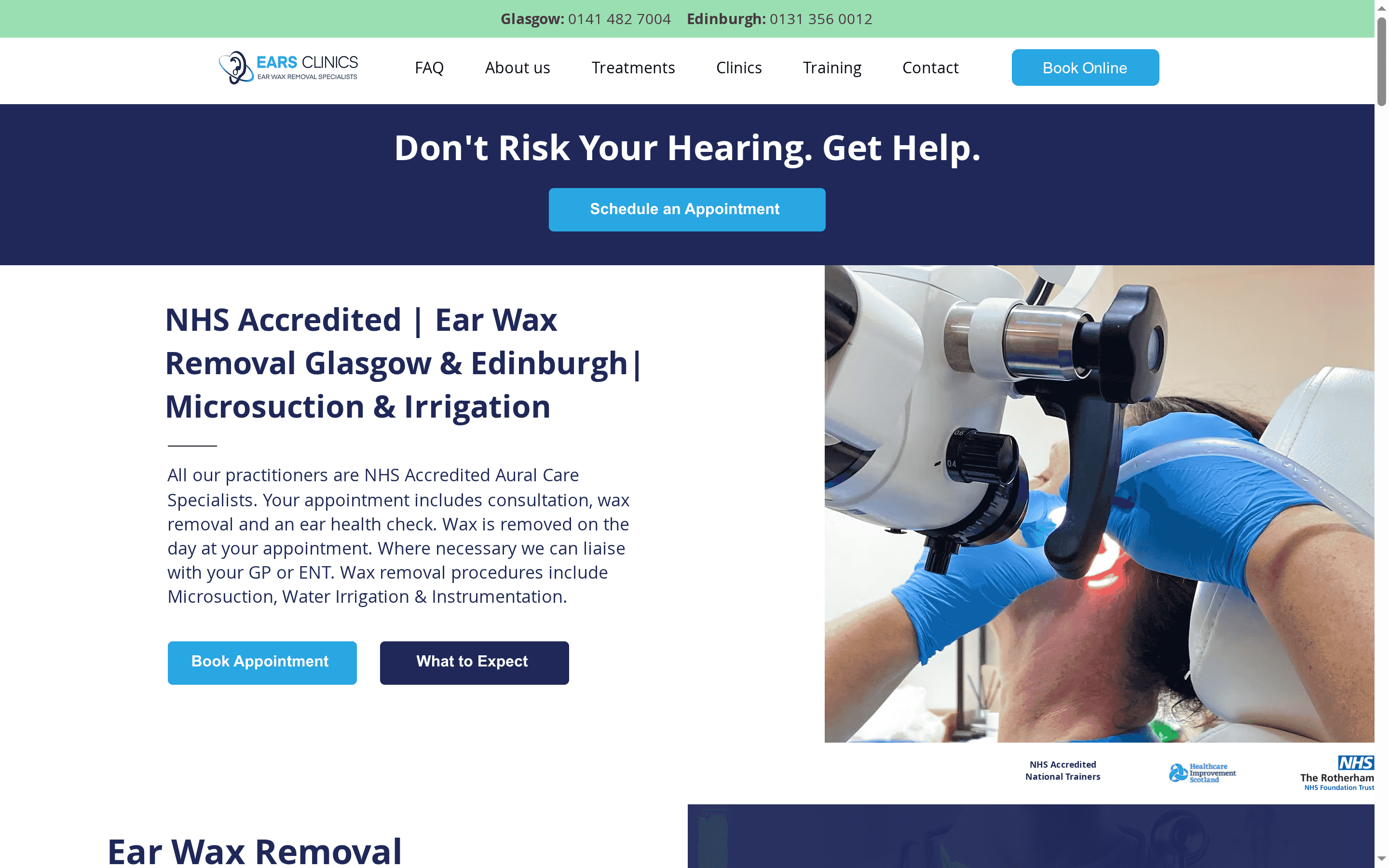
Every appointment includes a clinical assessment, method selection based on your individual history, before/after imaging, and a clinical letter to your GP or ENT specialist if required. Children are treated from age 2. Home visits are available for patients who cannot attend a clinic. Fees are £60 for adults, £75 for under-18s, and £180 for a home visit.
To understand the procedures available and what to expect, the ear wax removal procedures page covers microsuction, irrigation, and manual instrumentation in plain language. When you are ready to book, visit earhealthservice.co.uk to check availability and confirm an appointment in Glasgow or Edinburgh.
Useful sources and further reading
The following sources are worth consulting when researching ear care providers or verifying clinical claims:
EARS Clinics — ear wax removal procedures: Covers microsuction, irrigation, and manual instrumentation with NHS accreditation detail. High priority for patients ready to book.
EARS Clinics — what is microsuction?: Plain-language explainer on how microsuction works, its safety profile, and what to expect during an appointment.
EARS Clinics — home visits: Details on mobile ear wax removal services, coverage, and pricing for patients in Glasgow and Edinburgh.
Auris Ear Care: CQC-regulated mobile microsuction clinic in London; useful for London-based patients and for understanding what a regulated mobile service looks like.
Expert Ear Care: ENT consultant-led clinic in north-east England; a reference point for consultant-level credentials and before/after imaging standards.
CERA Ear Clinic: Specialist clinic emphasising microscopy-guided microsuction; useful for understanding the gold-standard approach for complex ears.
EARS Clinics — meet the team: Clinician profiles and credential information for EARS Clinics practitioners; consult before booking to verify qualifications.
Healthcare Improvement Scotland (HIS): The independent regulator for healthcare services in Scotland; use the HIS register to verify a Scottish clinic’s registration status.
Care Quality Commission (CQC): The independent regulator for health and social care in England; use the CQC register to verify an English clinic’s registration status before booking.
Recommended