
Ear canal blocked with wax: safe steps and when to act

TL;DR:
Earwax buildup is the most common cause of a blocked or muffled ear, often leading to hearing loss and discomfort. Softening drops and professional removal are safe options, but urgent symptoms like pain or bleeding require immediate medical attention. Using regulated clinics ensures safe, effective treatment and avoids risks from home remedies like cotton buds.
If your ear feels blocked, muffled, or full, earwax (cerumen) is the most likely cause. The NHS confirms that earwax build-up can cause hearing loss, earache, tinnitus, and dizziness. For most adults without red flags, the right first step is softening drops or olive oil, used for a few days, not a cotton bud.
Start here:
Try two to three drops of olive oil, almond oil, or an over-the-counter cerumenolytic (such as sodium bicarbonate drops) in the affected ear, once or twice daily for up to seven days.
Tilt your head so the treated ear faces upward, hold for a few minutes, then allow it to drain.
Do not insert anything into the ear canal.
If symptoms do not improve within seven days, speak to a pharmacist or book with a regulated ear clinic.
Stop self-care immediately and seek professional assessment if you have:
Ear pain or discharge
Bleeding from the ear
Sudden or severe hearing loss
Severe vertigo or loss of balance
A known or suspected eardrum perforation
Pro Tip: Warm the oil bottle in your hands for a minute before applying. Cold drops can trigger brief dizziness by stimulating the vestibular system.
What symptoms suggest your ear is blocked with wax?
Earwax blockage produces a recognisable cluster of symptoms. The most common are a feeling of fullness or pressure in the ear, muffled or reduced hearing, tinnitus (ringing or buzzing), mild earache, and itchiness inside the canal. Transient dizziness or mild nausea can also occur, particularly when wax presses against the eardrum.
Clinical note: Persistent or severe vertigo, sudden profound hearing loss, discharge, or pain are not typical of simple wax impaction. These symptoms suggest a different or more serious condition, such as a middle ear infection, eardrum perforation, or inner ear disorder, and require prompt clinical assessment rather than home treatment.
Symptoms that point away from wax and towards something requiring urgent review include discharge with an odour, visible blood, facial weakness, or hearing loss that developed very rapidly. If you are uncertain, a pharmacist can advise whether your symptoms fit a straightforward wax blockage or warrant a GP appointment.
Estimates suggest that between 700,000 and 2 million adults in England and Wales may have a build-up of earwax at any one time, making it one of the most common reasons for attending primary care.
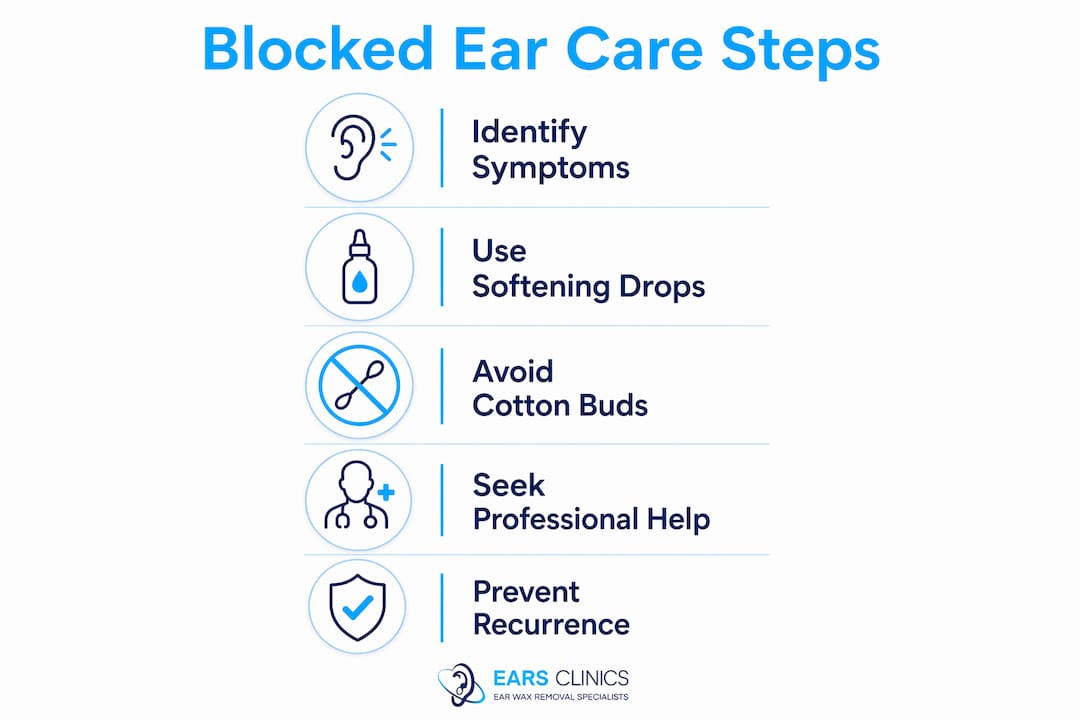
How to safely try to unblock an ear at home
Softening the wax is the recommended first approach for most adults who have no red flags. It is safe, inexpensive, and often effective on its own for mild to moderate build-up.
Choose your softening agent. Olive oil, almond oil, mineral oil, or a pharmacy cerumenolytic (such as sodium bicarbonate drops or carbamide peroxide) all work. There is no strong evidence that one is significantly better than another for most people.
Warm the drops slightly. Hold the bottle in your hands for one to two minutes. Body-temperature fluid is important: fluid that is too cold or too hot can trigger a caloric vestibular response and cause vertigo.
Apply the drops. Tilt your head so the affected ear faces the ceiling. Place two to three drops into the canal. Gently press the small flap of cartilage (the tragus) a few times to help the oil work down.
Hold the position. Stay still for three to five minutes, then tilt your head the other way to let the oil drain onto a tissue.
Repeat once or twice daily for up to seven days. Standard cerumenolytic regimens typically run for three to seven days before reassessment.
After softening, gentle irrigation may help. Using a bulb syringe filled with body-temperature water, gently flush the canal over a sink. Never use forceful pressure.
If the ear remains blocked after seven days, see a pharmacist or book a professional removal appointment.
Do not attempt home irrigation if you have:
Ear pain or discharge
A known or suspected eardrum perforation
Had ear surgery in the past
Received radiotherapy to the head or neck
Immunosuppression or are taking anticoagulants
These are contraindications to irrigation that require professional assessment instead.

When self-care is unsafe: red flags you should not ignore
Stop home treatment and seek clinical assessment if you experience ear pain, discharge, bleeding, sudden severe hearing loss, or severe vertigo. These are not signs of ordinary wax build-up.
Why this matters: DIY removal attempts are a leading cause of worsened impaction and injury. Cotton buds act as a ramrod, pushing wax deeper into the bony part of the canal where it cannot migrate out naturally. Repeated use can also stimulate the ear to produce more wax.
The NHS explicitly advises against inserting cotton buds or any other objects into the ear canal. Clinical guidance supports this: DIY removal attempts are among the primary causes of severe impaction and iatrogenic injury, including eardrum perforation.
For urgent situations, contact your GP practice on the same day or call NHS 111 for advice. Attend A&E if you experience sudden profound hearing loss, facial weakness, or severe unsteadiness. For non-emergency but persistent blockage that has not responded to softening drops, a regulated ear clinic such as EARS Clinics can often offer a same-day appointment without the waiting times associated with NHS referral pathways.
How a pharmacist or GP can help with a blocked ear
If softening drops have not cleared the blockage after a week, your next step is a pharmacist or GP, depending on your symptoms.
A pharmacist can:
Recommend the most appropriate over-the-counter cerumenolytic drops for your situation
Advise on correct application technique and duration
Assess whether your symptoms suggest a straightforward wax blockage or something that needs a GP
Signpost you to a regulated ear clinic if professional removal is needed
A GP can:
Examine the ear with an otoscope to confirm impaction and rule out other causes
Prescribe stronger cerumenolytic agents where appropriate
Perform simple removal in some practices, though this service varies considerably across the UK
Refer to an ENT specialist or regulated ear clinic when removal is beyond the scope of primary care
In practice, many GP practices no longer offer ear irrigation routinely, and waiting times for NHS ear care can be lengthy. If self-care has failed and your symptoms are affecting your hearing or daily life, a regulated private clinic is often the most direct route to prompt, safe removal.

What are the main professional earwax removal methods?
Three clinically recognised methods are used for professional earwax removal: microsuction, irrigation, and manual instrumentation. The choice between them depends on the patient’s clinical history, ear anatomy, and the practitioner’s assessment.
Method | How it works | Best suited to | Key considerations |
Microsuction | A fine suction probe removes wax under direct visualisation with a microscope or loupe | Most wax types; preferred where perforation risk exists or anatomy is complex | Dry procedure; precise; often preferred in NICE-aligned guidance |
Irrigation | Body-temperature water or saline flushes the canal via a controlled-pressure device | Soft or partially softened wax; intact eardrum confirmed | Contraindicated with perforation, discharge, recent surgery, or anticoagulation |
Manual instrumentation | A clinician uses a curette, probe, or forceps under direct vision | Harder wax; cases where irrigation is contraindicated | Requires skill and patient co-operation; very precise in trained hands |
Microsuction is frequently favoured for its precision and because it keeps the canal dry, reducing infection risk. NICE-aligned guidance references microsuction as the preferred approach where appropriate. That said, irrigation and manual instrumentation remain safe and clinically valid options; the practitioner selects the most suitable method based on the patient’s presentation and history, not a fixed protocol.
Clinical principle: No single method is universally superior. A regulated clinician, trained to NHS-accredited standards and working under HIS or CQC oversight, will assess each patient individually and choose the safest approach for that person’s anatomy and clinical picture.
Ear care should only be performed by trained, competent clinicians following best practice standards. Regulation by Healthcare Improvement Scotland (HIS) or the Care Quality Commission (CQC) provides the governance framework that protects patients.
How long does it take for a blocked ear to clear?
Softening drops typically need three to seven days to work. Professional removal, once carried out, usually resolves symptoms immediately or within 24–48 hours. Most patients notice a marked improvement in hearing straight after the procedure.
Stage | Typical timeframe |
Softening drops (self-care) | 3–7 days before reassessment |
Professional removal (symptom relief) | Immediate to 24–48 hours post-procedure |
Mild discomfort or altered hearing after removal | Usually settles within 24 hours |
Transient tinnitus or dizziness post-procedure | Typically resolves within a few hours |
Short-term aftereffects following professional removal are common and generally minor: a slight change in how sounds feel, brief discomfort, or a temporary increase in tinnitus. These settle quickly in most cases. Rare complications, including perforation, infection, or persistent hearing change, should prompt reassessment. Professional removal significantly improves quality of life for patients with symptomatic impaction; leaving hardened wax untreated tends to worsen symptoms over time.
How to prevent earwax building up again
Prevention is straightforward for most people, though some individuals are anatomically predisposed to recurrent impaction and need a different approach.
Avoid cotton buds entirely. They push wax deeper and can stimulate increased production.
Do not use ear candles. Research has found they are ineffective, and they carry a real risk of burns and eardrum damage.
Use a weekly maintenance oil. If you are prone to build-up, one to two drops of olive oil or mineral oil in each ear once a week can keep wax soft enough to migrate out naturally.
Hearing aid and earplug users should have their ears checked regularly, as devices that sit in the canal prevent natural wax migration. A routine check every six to twelve months is sensible.
If you have narrow canals, exostoses (bony growths), or recurrent impactions, anatomical factors mean sporadic home care is unlikely to be sufficient. Arrange regular professional maintenance rather than waiting for symptoms to return.
Older adults, hearing aid users, and those with certain skin conditions such as eczema are particularly prone to impaction and benefit most from a consistent prevention routine.
Why choose a regulated ear clinic for professional removal in the UK?
EARS Clinics are registered with Healthcare Improvement Scotland (HIS), making them one of the few regulated ear healthcare providers in Scotland. Their practitioners are NHS-accredited Aural Care Specialists, trained to the standards required for safe microsuction, irrigation, and manual instrumentation.
What regulation means for you: HIS registration means EARS Clinics operate under the same governance standards applied to NHS clinical services. Practitioners follow evidence-based protocols, use diagnostic otoscopy before every procedure, and select the method that is safest for your individual presentation, not the quickest or most convenient.
Patients can expect a thorough ear health assessment before any treatment, before-and-after imaging, and clinical correspondence with their GP or ENT specialist when needed. Same-day appointments are available at clinics in Glasgow and Edinburgh, and home visits are offered for patients who cannot attend in person. Fees are £60 for adults over 18, £75 for under-18s, and £180 for a home visit.
EARS Clinics are licensed to treat patients from two years of age and align their practice with NICE guidance on microsuction preference where appropriate. For patients who have tried softening drops without success, or who simply want fast, regulated care without NHS waiting times, EARS Clinics offer a clear and accessible pathway.
Key takeaways
A blocked ear canal caused by wax is common, treatable, and rarely dangerous, but the right sequence of steps, and knowing when to stop self-care, makes all the difference.
Point | Details |
Try softening drops first | Use olive oil or a cerumenolytic for 3–7 days before seeking professional help. |
Stop if red flags appear | Ear pain, discharge, bleeding, or severe vertigo require clinical assessment, not more home treatment. |
Professional removal works quickly | Symptoms typically resolve immediately or within 24–48 hours after professional removal. |
Avoid cotton buds and ear candles | Both worsen impaction or risk injury; NHS guidance advises against them explicitly. |
EARS Clinics offer regulated, same-day care | HIS-registered, NHS-accredited specialists in Glasgow and Edinburgh, with home visits available. |
A clinician’s note on safe ear care
The most common mistake we see is patients who have spent weeks trying to clear a blocked ear with cotton buds, only to arrive with wax pushed further into the bony canal than it would ever have migrated on its own. The ear is a self-cleaning structure for most people. When that process fails, the answer is softening, patience, and, when needed, skilled professional removal, not mechanical force.
Canal anatomy matters more than most patients realise. A narrow or curved canal, or the presence of exostoses, changes everything about how wax behaves and which removal method is appropriate. That is precisely why a diagnostic otoscopy before any procedure is non-negotiable, not a formality. Temperature control during irrigation is equally critical: fluid that deviates from body temperature can provoke a caloric vestibular response and leave a patient briefly but distressingly dizzy. In a regulated clinic, these variables are controlled. At home, they rarely are.
The choice between microsuction, irrigation, and manual instrumentation is a clinical decision, made in the room, based on what the clinician sees. Patients who ask for a specific method by name are welcome to express a preference, but the safest outcome comes from trusting a regulated practitioner to make that call based on your individual anatomy and history.
Clear your ears with EARS Clinics: fast, regulated, and NHS-accredited
If softening drops have not worked, or if you simply want the reassurance of regulated professional care without a long wait, EARS Clinics offer a straightforward solution. As one of the few HIS-registered ear healthcare providers in Scotland, their NHS-accredited Aural Care Specialists perform microsuction, irrigation, and instrumentation at clinics in Glasgow and Edinburgh, with same-day appointments available most days.

Appointments cost £60 for adults, £75 for under-18s, and £180 for a home visit. Every appointment includes a full ear health assessment with otoscopy, before-and-after imaging, and clinical correspondence with your GP or ENT if required. To book, visit earhealthservice.co.uk or call directly. Same-day and next-day slots are typically available, and no GP referral is needed.
Where this guidance comes from
The clinical information in this article draws on the following authoritative sources:
NHS (nhs.uk): Patient guidance on earwax build-up, symptoms, and safe self-care, including explicit advice against cotton buds and ear candles.
NIHR Health Technology Assessment (NCBI Bookshelf): Systematic review of the safety and effectiveness of earwax removal methods, including cerumenolytics, irrigation, and mechanical removal.
StatPearls, NCBI Bookshelf: Clinical reference on cerumen impaction, removal methods, contraindications, and epidemiology.
MedlinePlus Medical Encyclopedia: Guidance on irrigation temperature and vestibular caloric effects.
Merck Manual Professional: Contraindications for irrigation and indications for suction or manual removal.
MSD Manual (consumer edition): Anatomical predispositions to earwax impaction.
Otolaryngology, Head and Neck Surgery (SAGE Journals): Comparative clinical guidance on earwax removal methods, supporting microsuction preference in NICE-aligned practice.
On regulation and clinical standards: EARS Clinics operate under Healthcare Improvement Scotland (HIS) registration and follow evidence-based protocols aligned with NICE guidance. Their practitioners hold NHS-accredited Aural Care Specialist training, providing the governance and competence framework that underpins safe, effective ear care.
This article is general health information, not a substitute for professional medical advice. If you are unsure whether your symptoms are caused by earwax or something else, consult a pharmacist, your GP, or a regulated ear clinic for an individual assessment.
Recommended