
The role of NHS accreditation in ear health services

TL;DR:
NHS accreditation verifies that ear health services meet recognized standards of quality, safety, and clinical governance through independent assessment. It ensures practitioners are competent, procedures are monitored, and continuous improvement is maintained, benefiting patient safety and care consistency. Patients and professionals should verify specific accreditation schemes and governance transparency to make informed choices about ear care providers.
NHS accreditation is defined as an independent verification process that confirms a healthcare service meets nationally recognised standards of quality, safety, and clinical governance. Within ear health, the role of NHS accreditation is to provide patients and commissioners with objective assurance that practitioners performing procedures such as microsuction, irrigation, and manual instrumentation are operating within validated, regulated frameworks. Accrediting bodies including UKAS, JAG, and the Framework Accreditation Scheme each assess different dimensions of service delivery, from clinical competence to procurement governance. For patients seeking ear wax removal and for clinicians providing it, understanding what NHS ear care means in practice is the foundation of informed, safe decision-making.
What NHS accreditation programmes exist for ear and related health services?
Several nationally recognised accreditation schemes operate across NHS services, and their relevance to ear health extends beyond the obvious. Understanding which programmes apply, and how, helps both patients and professionals assess the credibility of any service they encounter.
UKAS ISO 15189 is the international standard applied to pathology and clinical laboratory services. All pathology laboratories at Oxford University Hospitals are annually inspected by UKAS against this standard to guarantee quality and competence. This distinction matters because UKAS-accredited tests have undergone external quality assurance, which separates them from tests that are in clinical use but have not yet completed external ratification cycles. In ear health, audiological and diagnostic testing services that feed into treatment decisions benefit directly from this level of scrutiny.
JAG accreditation applies primarily to endoscopy and gastrointestinal services, but its assessment model is instructive for any specialist clinical unit. Wirral University Hospital’s Endoscopy Unit retains JAG accreditation through a rigorous process that includes a full-day unit walkthrough, staff interviews, and review of clinical performance data. The programme evaluates clinical quality, patient experience, training standards, and operational performance simultaneously. This multi-dimensional approach reflects the gold standard for what specialist accreditation should look like.
The Framework Accreditation Scheme operates at the procurement level, governing how NHS organisations source services and supplies. NHS organisations must use framework agreements endorsed by Accredited Framework Hosts to reduce variation and uphold procurement quality. This scheme shapes which service providers can access NHS contracts, meaning it indirectly determines which ear health services patients can access through NHS-funded pathways.
GIRFT surgical hubs accreditation offers a voluntary but clinically meaningful recognition. Since 2023, 69 NHS surgical hubs have been accredited under a scheme supported by the Royal College of Surgeons and the Royal College of Anaesthetists. The scheme is designed to assure patients and improve operational flow, demonstrating that voluntary accreditation can carry significant clinical weight even without regulatory compulsion.
UKAS ISO 15189: external quality assurance for diagnostic and pathology services
JAG accreditation: multi-dimensional assessment for specialist clinical units
Framework Accreditation Scheme: procurement governance affecting service access
GIRFT surgical hubs: voluntary recognition of clinical and operational excellence
HIS registration: regulatory oversight specific to Scotland, applicable to providers like EARS Clinics
Pro Tip: When evaluating any ear health provider, ask specifically which accreditation scheme applies to their clinical services, not just their business registration. The type of accreditation tells you far more than the presence of a logo.
How does NHS accreditation improve quality, safety, and governance in ear health?
The importance of NHS accreditation in ear health is not abstract. It produces concrete, measurable improvements in how care is delivered, documented, and reviewed.

Accreditation adds an independent assurance layer beyond internal governance. UKAS accreditation confirms external review and ratification of quality assurance processes, distinguishing externally verified services from those relying solely on self-assessment. For patients undergoing microsuction or irrigation, this distinction means the practitioner’s competence and the clinic’s protocols have been reviewed by an external body, not just signed off internally.
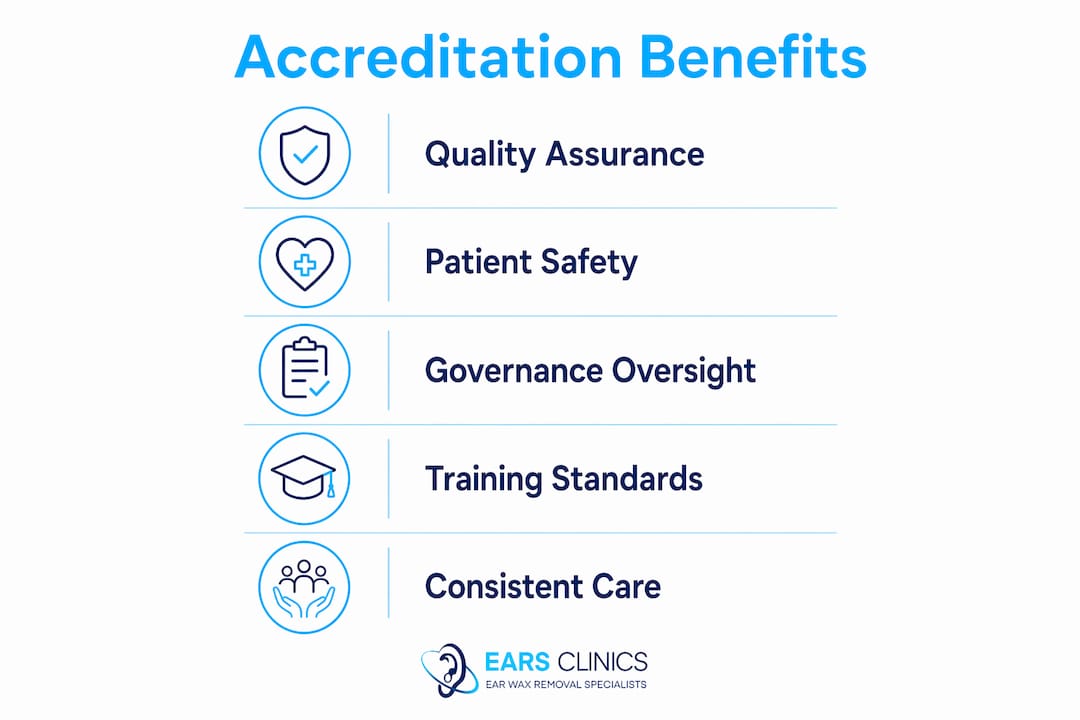
Clinical accreditations require documented evidence of audit, incident learning, and committee-level governance oversight. This means accredited ear health services must maintain audit cycles, record clinical incidents, and demonstrate that learning from those incidents has been embedded into practice. Patients benefit when clinicians understand accreditation expectations and maintain stringent documentation and training requirements. The result is a service that improves continuously rather than one that simply passes an initial inspection.
Structured training requirements are a non-negotiable component of most accreditation programmes. Practitioners performing microsuction, irrigation, and manual instrumentation must demonstrate not only initial competence but ongoing professional development. This protects patients from the risk of practitioners whose skills have stagnated, and it gives healthcare professionals a clear framework for career progression. Accreditation terminology varies by programme; some focus more on clinical competence while others emphasise operational and patient-flow improvements. Both dimensions matter in ear health, where a technically skilled practitioner working in a poorly organised clinic can still deliver a substandard patient experience.
Pro Tip: If you are a healthcare professional preparing for an accreditation assessment, start with your audit documentation. Gaps in audit cycles are among the most common reasons accreditation applications stall.
The benefits of NHS accreditation for patients extend to consistency of care. Accredited services follow validated protocols, which means a patient in Glasgow and a patient in Edinburgh should receive the same standard of assessment, the same safety checks, and the same post-procedure advice. You can read more about why regulated ear clinics deliver better outcomes for this reason specifically.
Mandatory vs voluntary NHS accreditation: what is the difference?
Not all NHS accreditation programmes carry the same weight in terms of regulatory obligation, and understanding this distinction is relevant for both patients choosing a provider and professionals seeking recognition.
Accreditation type | Example scheme | Obligation level | Impact on patients |
Mandatory (contract-linked) | ICB accreditation, Framework Accreditation Scheme | Required for NHS contract eligibility | Determines which providers patients can access via NHS pathways |
Voluntary (recognition-based) | GIRFT surgical hubs, HIS registration | Optional but clinically significant | Signals higher standards; builds patient confidence |
Regulatory (statutory) | HIS registration in Scotland, CQC in England | Legally required to operate | Baseline safety assurance for all regulated providers |
ICB accreditation for patient-choice eligible services involves multi-phase assessments culminating in contract establishment within six weeks. The process includes initial questionnaires, panel assessments, and service-specification confirmation before a contract is awarded. Providers who cannot complete this process are excluded from NHS-funded patient choice pathways, which directly limits patient access to those services.
Voluntary schemes like GIRFT surgical hub recognition carry no contractual obligation, yet they signal a provider’s commitment to standards that exceed the regulatory minimum. Accreditation can shape patient access indirectly by influencing procurement frameworks and supply paths within the NHS system. For patients, this means that a provider holding voluntary accreditation has chosen to be held to a higher standard, which is a meaningful indicator of quality.
For ear health service providers, the practical implication is clear. Mandatory accreditation determines market access. Voluntary accreditation builds reputation and patient trust. Regulatory registration, such as HIS registration in Scotland, is the non-negotiable baseline that permits a clinic to operate at all. EARS Clinics holds HIS registration and operates as one of the few fully regulated ear healthcare clinics in Scotland, which places it within the highest tier of assurance available to patients in Glasgow and Edinburgh.
How can patients and professionals use accreditation to choose ear health services?
Accreditation information is publicly available, but knowing how to interpret it requires a structured approach. The following steps help both patients and healthcare professionals make genuinely informed decisions.
Check regulatory registration first. In Scotland, confirm that a clinic is registered with Healthcare Improvement Scotland. In England, verify Care Quality Commission registration. These are the legal baseline requirements, and any provider without them should not be treating patients.
Identify the specific accreditation scheme. Ask whether the clinic holds UKAS accreditation for any diagnostic services, JAG accreditation for specialist procedures, or Framework Accreditation Scheme endorsement for NHS-funded pathways. A general claim of being “NHS-accredited” without specifying the scheme is not sufficient.
Confirm practitioner qualifications. Accreditation of a clinic does not automatically mean every practitioner within it is individually assessed. Ask whether the Aural Care Specialists performing microsuction, irrigation, or manual instrumentation hold recognised qualifications and participate in continuing professional development.
Review the clinic’s governance documentation. Accredited providers maintain audit records, incident logs, and clinical governance reports. Reputable clinics will be transparent about their governance processes, even if they do not publish every document publicly.
Understand what the accreditation covers. Some tests and procedures within an accredited service may not yet have completed their external ratification cycle. Tests marked as UKAS accredited have passed external oversight, but some tests in clinical use may be pending the next inspection cycle. Ask your provider which specific procedures are covered.
For patients in Scotland, NHS-accredited ear care is available through regulated private providers who meet the same standards as NHS services, often with shorter waiting times and no requirement for pre-treatment softening drops.
Key takeaways
NHS accreditation is the external verification mechanism that separates genuinely quality-assured ear health services from those relying solely on self-reported standards.
Point | Details |
Accreditation is external verification | Independent bodies like UKAS and JAG assess services against national standards, not just internal policies. |
Multiple schemes apply to ear health | UKAS, JAG, Framework Accreditation Scheme, and HIS registration each cover different aspects of service quality. |
Mandatory and voluntary schemes differ | Mandatory accreditation governs NHS contract access; voluntary schemes signal commitment beyond the regulatory minimum. |
Practitioners must meet training requirements | Accreditation requires documented competence and ongoing professional development for clinicians performing microsuction and irrigation. |
Patients can verify accreditation status | Checking HIS or CQC registration, asking about specific schemes, and reviewing governance transparency are practical steps for informed choice. |
Why accreditation in ear health deserves more scrutiny than it gets
At EARS Clinics, we have observed a pattern that concerns us. Many patients arrive having chosen a provider based on marketing language rather than verified accreditation status. The phrase “NHS-accredited” appears frequently in ear health advertising, but it is rarely accompanied by the specific scheme, the accrediting body, or the scope of what has actually been assessed. That ambiguity is not harmless. It erodes the very confidence that accreditation is designed to build.
What we have found in practice is that accreditation is most meaningful when it is treated as a continuous process rather than a one-time credential. The JAG model, which requires ongoing performance review and not just an initial assessment, reflects this well. Ear health services should adopt the same mindset. A clinic that passed an assessment three years ago and has not updated its governance documentation since then is not offering the same assurance as one that maintains active audit cycles and incident reviews.
We also believe that patient education on this topic is underinvested. Most patients do not know the difference between HIS registration and UKAS accreditation, and that is not their failure. It is the responsibility of providers and the wider healthcare system to communicate these distinctions clearly. When patients understand what accreditation actually means, they make better choices, and that drives the whole sector towards higher standards.
The future of accreditation in ear health will likely involve greater digital transparency, with accreditation status and audit summaries accessible to patients online. That shift cannot come soon enough.
— EARS
NHS-accredited ear wax removal with EARS Clinics
EARS Clinics provides NHS-accredited ear wax removal using microsuction, irrigation, and manual instrumentation, all performed by trained Aural Care Specialists. As a Healthcare Improvement Scotland registered provider, EARS Clinics is one of the few fully regulated ear health clinics in Scotland, serving patients in Glasgow and Edinburgh. Appointments are available in clinic, on the same day, or as home visits for those who cannot travel. Pricing starts at £60 for adults, £75 for under-18s, and £180 for home visits. For clinicians, accredited microsuction training is also available through EARS Clinics. Book your appointment at earhealthservice.co.uk.
FAQ
What is the role of NHS accreditation in ear health?
NHS accreditation independently verifies that ear health services meet nationally recognised standards of quality, safety, and clinical governance. It confirms that practitioners and clinics have been assessed by an external body, not just self-certified.
Which accreditation bodies are relevant to ear health services?
UKAS, JAG, and the Framework Accreditation Scheme each apply to different aspects of NHS service delivery. In Scotland, Healthcare Improvement Scotland registration is the statutory regulatory requirement for ear health clinics.
Is NHS accreditation mandatory for all ear health providers?
Regulatory registration with HIS in Scotland or CQC in England is legally required. Additional accreditation schemes such as GIRFT surgical hub recognition are voluntary, while Framework Accreditation Scheme endorsement is required for NHS contract eligibility.
How does accreditation protect patients during ear wax removal?
Accreditation requires practitioners to demonstrate documented competence, follow validated protocols, and maintain ongoing audit and governance records. This means procedures like microsuction and irrigation are performed within a framework of continuous quality assurance rather than individual discretion alone.
How can I verify that an ear health clinic is properly accredited?
Check for HIS registration in Scotland or CQC registration in England as a first step. Then ask the provider which specific accreditation scheme applies to their clinical services and which procedures are covered under that scheme.
Recommended