
NHS ear wax removal: what's changed and what to do now

TL;DR:
Access to free NHS ear wax removal now depends on local commissioning decisions, with many areas restricting or halting services since 2019. The NHS still recommends symptomatic wax removal in primary or community care, with microsuction as the preferred method where appropriate. Private clinics registered with regulators like CQC or HIS offer safe, accredited care when NHS services are unavailable.
Routine ear wax removal is no longer guaranteed on the NHS. Whether you can access free treatment now depends entirely on where you live, because Integrated Care Boards (ICBs) across England decide locally whether to commission the service. NICE quality standard QS185 still recommends that symptomatic ear wax should be removed in primary or community care, but many ICBs have withdrawn or restricted provision since 2019. If your GP surgery no longer offers removal, you are not alone.
What this means for you right now:
Try olive oil or sodium bicarbonate drops for at least one week as a first step (per NHS self-care guidance).
Contact your GP to describe your symptoms and ask specifically whether ear wax removal is commissioned in your area.
If NHS provision is unavailable locally, regulated private clinics such as EARS Clinics offer safe, accredited care.
Scale of the problem: BBC reporting on RNID findings estimates that almost 10 million people in England cannot access free NHS ear wax removal where local provision has been withdrawn.
Why the NHS no longer routinely offers ear wax removal in many areas
The change is not a clinical decision. NICE has never withdrawn its recommendation that symptomatic ear wax should be treated. What changed is commissioning: responsibility for funding ear wax removal sits with local ICBs, and many have chosen to reduce or remove it from their funded service list.
The shift accelerated from around 2019 onwards, as NHS England moved away from central commissioning and gave ICBs greater control over local spending. Ear wax removal, classified as a “low clinical priority” procedure by some commissioners, became an early casualty of budget pressures. RNID’s ‘Stop the Block’ report, which used Freedom of Information requests to survey ICBs across England, found that fewer than half commissioned a full ear wax removal service at one point, with subsequent FOIs showing some improvement but persistent gaps.
“The British Academy of Audiology calls for the return of NHS GP ear wax removal services for all, arguing that withdrawal has harmed access to safe and affordable care and pushed patients towards paid private treatment or unsafe DIY methods.” — British Academy of Audiology
Around 2.3 million people in the UK need ear wax treatment each year. The withdrawal of routine services has not reduced that clinical need; it has simply shifted the cost and risk onto patients. Some ICBs have introduced workarounds, including Any Qualified Provider contracts, community diagnostic centres, and buddy arrangements between GP practices, but coverage remains patchy and inconsistent across the country.
What NICE currently recommends: methods, eligibility and practitioner duties
NICE quality standard QS185 is unambiguous: ear wax that contributes to hearing loss, causes pain, or prevents examination of the ear should be removed in primary or community care. Three methods are clinically accepted.
Method | How it works | When it is preferred | Key contraindications |
Microsuction | Low-pressure suction removes wax under direct visual control | Preferred when irrigation is contraindicated; offers continuous view of the ear canal | Active infection, very narrow canal (relative) |
Irrigation | Controlled water flow loosens and flushes wax | First-line in many NHS pathways after drops have softened wax | Perforated eardrum, previous ear surgery, active infection |
Manual instrumentation | Wax removed using a probe or curette under direct vision | Used when other methods are unsuitable or as an adjunct | Requires skilled practitioner; not appropriate for all wax types |
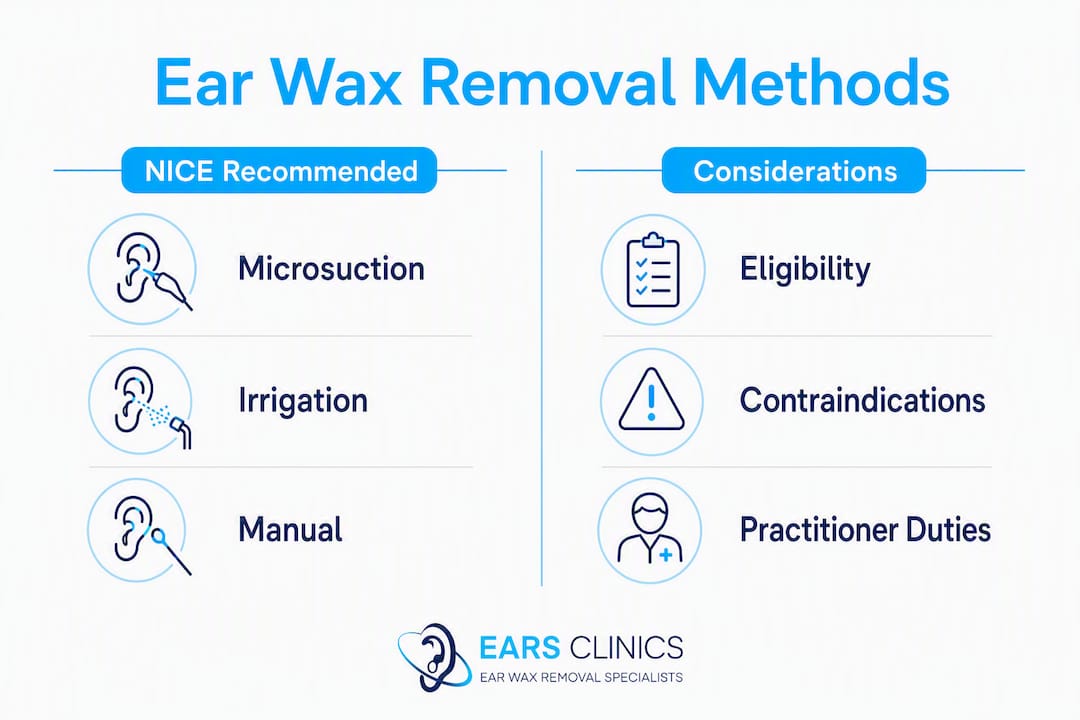
Microsuction is often preferred because the clinician can see the ear canal and tympanic membrane throughout the procedure, which reduces the risk compared with older high-pressure syringing techniques. Irrigation remains a safe and clinically valid first-line option in many cases, particularly after adequate softening with drops. Manual instrumentation is used when the other two methods are contraindicated or have not achieved full clearance.
Practitioners are expected to take a full clinical history before selecting a method, check for contraindications, use correct equipment, and follow local referral pathways. The choice of method is a clinical judgement, not a patient preference.
Clinically accepted methods under NICE QS185:
Microsuction: preferred where irrigation is contraindicated; continuous visual control throughout.
Irrigation: first-line in many NHS pathways; requires prior softening with drops.
Manual instrumentation: used as an adjunct or where the other methods are unsuitable.
Ear syringing (manual, high-pressure): no longer recommended and not supported by current NHS service specifications.
Pro Tip: Ask the clinician before your appointment which method they plan to use and why. A trained specialist should be able to explain their reasoning based on your medical history, any prior ear surgery, and whether you have used drops beforehand.
Who can still get ear wax removal on the NHS?
Eligibility is tied directly to NICE criteria and to what your local ICB has chosen to commission. In broad terms, you are more likely to qualify for NHS-funded removal if your ear wax is causing hearing loss, pain, or preventing a clinical examination or hearing aid impression. Wax that is present but symptom-free does not meet the threshold for treatment under most ICB policies.

The most common referral routes are as follows. Your GP may treat you directly if the practice is signed up to a locally commissioned service (LCS). Where no LCS exists, your GP can refer you to a community audiology service or, for complex cases, to ENT. Referral to ENT for simple wax removal is generally not considered appropriate use of specialist resources under NICE guidance, so most patients are directed to community pathways first.
Three scenarios illustrate how this plays out in practice. If your symptoms are mild and drops have not yet been tried, your GP will typically advise a one-week course of softening drops before any clinical intervention. If drops have failed and your ICB commissions a community service, you should be referred there. If your ICB does not commission removal and your symptoms are significant, you will usually be advised to seek private care. Hearing-aid users are at increased risk of wax impaction and should be assessed regularly; local ICB policies often include them as a priority group.
What to do when NHS care is not available locally
Private ear wax removal services have expanded significantly as NHS provision has contracted. The options available to you in the UK include private clinic appointments, home visits, and community providers operating under Any Qualified Provider arrangements with some ICBs. Not all private providers are equal, and the quality of care varies considerably.
Before you book anywhere, check the following:
Regulatory registration: the clinic should be registered with the Care Quality Commission (CQC) in England or Healthcare Improvement Scotland (HIS) in Scotland. Registration means the service is subject to inspection and must meet defined standards.
Practitioner training: ask whether the clinician holds accredited training in microsuction specifically. Many GP surgeries stopped offering removal partly because of training and indemnity concerns; a regulated private clinic should have no such gaps.
Methods offered: a reputable clinic will offer microsuction, irrigation, and manual instrumentation, and will select the appropriate method based on your history.
Before and after imaging: ear canal imaging before and after treatment confirms the procedure was completed safely and gives you a clinical record.
GP correspondence: the clinic should be willing to write to your GP or ENT if clinically relevant findings are made during the appointment.
Clear pricing: fees should be stated before you book, with no hidden charges.
Consent and record keeping: a proper clinical consent process and written records are non-negotiable.
Private fees for ear wax removal typically range up to £100 per procedure, according to RNID campaign reporting. For patients who require treatment multiple times a year, the annual out-of-pocket cost can be substantial. Keep receipts, as some private health insurance policies will reimburse the cost.
Step-by-step: what to do if you think you need ear wax removal
Acting in the right order matters. Starting with professional removal before trying drops is unnecessary in most cases, and attempting DIY methods before seeking advice can make things worse.
Try softening drops for one week. Use olive oil, almond oil, or sodium bicarbonate drops as directed. Drops alone clear wax in a proportion of patients, though evidence shows only a minority achieve full clearance without further intervention.
Check for red flags. Stop home treatment and seek same-day assessment if you experience severe ear pain, discharge from the ear, sudden or significant hearing loss in one or both ears, dizziness, or any sign of infection. These symptoms may indicate a perforated eardrum or active infection that requires urgent clinical attention.
Contact your GP. Phone or use an e-consult to describe your symptoms clearly. Ask specifically whether ear wax removal is commissioned in your area and, if so, how to access it. Ask your GP to record in your notes whether community removal is available locally.
Request a referral if appropriate. If your GP confirms that a community service exists and your symptoms meet the criteria, ask for a referral. If no NHS option is available, ask your GP to confirm this in writing so you have a record for insurance purposes.
Book regulated private care if NHS provision is unavailable. Use the checklist above to verify the clinic’s registration, practitioner training, and methods before you pay.
Red flag symptoms requiring urgent same-day assessment:
Sudden or unilateral hearing loss not explained by wax.
Ear discharge (fluid or blood).
Severe ear pain or a feeling of pressure that does not resolve.
Dizziness or balance problems alongside ear symptoms.
Any history of recent ear trauma.
If you are unsure whether your child’s ear pain needs urgent attention, online triage support can help you decide whether to seek same-day care.
Why DIY ear wax removal is unsafe
Cotton buds, ear candles, and improvised syringes are the three most common DIY approaches, and all three carry genuine clinical risk. Cotton buds do not remove wax; they push it deeper into the canal, compacting it against the eardrum and making professional removal harder. Ear candles have no clinical evidence of efficacy and carry a documented risk of burns to the ear canal and face, as well as candle wax deposits in the canal. Kitchen syringes used with tap water at uncontrolled pressure can perforate the eardrum.
The British Academy of Audiology and RNID have both warned that withdrawal of routine NHS services pushes patients towards these unsafe methods, increasing inequity and clinical risk. Complications from DIY attempts include outer-ear infections (otitis externa), perforated eardrums, permanent hearing loss, and delayed diagnosis of underlying ear conditions that were masked by the wax.
If you have already attempted DIY removal and now have pain, discharge, or reduced hearing, stop home treatment immediately and seek a clinical assessment. For guidance on safe self-care methods that carry lower risk, stick to approved softening drops only.
Typical costs, waiting times and seven questions to ask before you pay
Factor | NHS (where commissioned) | Private clinic |
Cost to patient | Free at point of care | Typically up to £100 per procedure |
Waiting time | Days to weeks depending on local service | Often same-day or within days |
Method offered | Irrigation (first-line); microsuction if irrigation fails or is contraindicated | Microsuction, irrigation, manual instrumentation |
Regulation | NHS commissioned service | CQC (England) or HIS (Scotland) registration required |
Practitioner qualification | Varies by ICB and LCS requirements | Should hold accredited microsuction training |
Annual NHS demand for ear wax treatment runs to around 2.3 million people per year. That volume, combined with the withdrawal of routine provision in many areas, means private waiting times are often shorter than NHS community pathways where they still exist.
Seven questions to ask a private clinic before you book:
Are you registered with the CQC (England) or HIS (Scotland)?
What training does the practitioner hold in microsuction specifically?
Which method will you use, and why is it appropriate for my situation?
What contraindications will you check for before proceeding?
Do you provide before and after imaging of the ear canal?
What aftercare do you offer, and what is your policy if the procedure is unsuccessful?
Will you write to my GP if you find anything clinically significant?
A clinic that cannot answer all seven questions clearly is worth approaching with caution.
Why you can trust this article
This article draws on primary clinical and campaign sources: NICE quality standard QS185, the RNID ‘Stop the Block’ report (2025), and the British Academy of Audiology’s public statement calling for restored GP provision. ICB policy documents from NHS Gloucestershire and NHS Somerset are cited to illustrate how national guidance is operationalised locally.
The clinical methods described throughout this article, microsuction, irrigation, and manual instrumentation, are those recognised by NICE QS185. Practitioners at EARS Clinics select the safest and most appropriate method based on each patient’s medical history and clinical presentation, in line with best practice standards. For further detail on the microsuction procedure and what to expect, the EARS Clinics website provides patient-facing clinical information.
Key takeaways
The NHS no longer routinely offers ear wax removal across England; whether you can access free treatment depends on your local ICB, not on NICE guidance, which still recommends community provision for symptomatic wax.
Point | Details |
NHS provision is now postcode-dependent | ICBs decide locally; many have withdrawn routine services despite NICE QS185 recommending community provision. |
NICE still recommends treatment for symptomatic wax | Wax causing hearing loss, pain, or preventing examination should be removed in primary or community care. |
Microsuction is the preferred method where appropriate | It offers continuous visual control; irrigation and manual instrumentation remain valid when clinically indicated. |
Check CQC or HIS registration before booking privately | Regulated clinics meet defined inspection standards; unregulated providers carry higher clinical risk. |
EARS Clinics offers regulated private care in Glasgow and Edinburgh | HIS-registered, NHS-accredited specialists; fees from £60 for adults, with same-day and home visit options. |
The real cost of a commissioning decision
The withdrawal of routine ear wax removal is one of those policy changes that looks minor on a spreadsheet and significant in a consulting room. For most patients, wax build-up is not a cosmetic inconvenience; it affects hearing, communication, and quality of life. When a GP can no longer treat it and the patient cannot afford private care, the problem does not go away. It compounds.
What concerns us most at EARS Clinics is not the existence of private options, but the absence of a safety net for people who cannot access them. Microsuction, performed by a trained clinician with the right equipment, is a low-risk, highly effective procedure. The risk is not the method; it is what happens when patients resort to cotton buds or ear candles because they have no other option. That is where real harm occurs.
The professional bodies are right to campaign for restored NHS provision. Until that happens, the most protective thing any patient can do is seek care from a regulated, accredited clinic rather than attempting removal at home. Regulation is not a marketing claim; it is a clinical safeguard. HIS and CQC registration means a clinic has been inspected, its practitioners have been assessed, and its processes meet defined standards. That matters when something goes wrong, and occasionally, even in the best hands, it does.
Safe, accredited ear wax removal when you need it most
When NHS provision is not available in your area, waiting is not always an option. Untreated wax impaction can worsen hearing loss, cause persistent discomfort, and prevent your GP from examining your ear canal properly. EARS Clinics offers a regulated, patient-centred alternative for people in Glasgow and Edinburgh who need prompt, professional care.
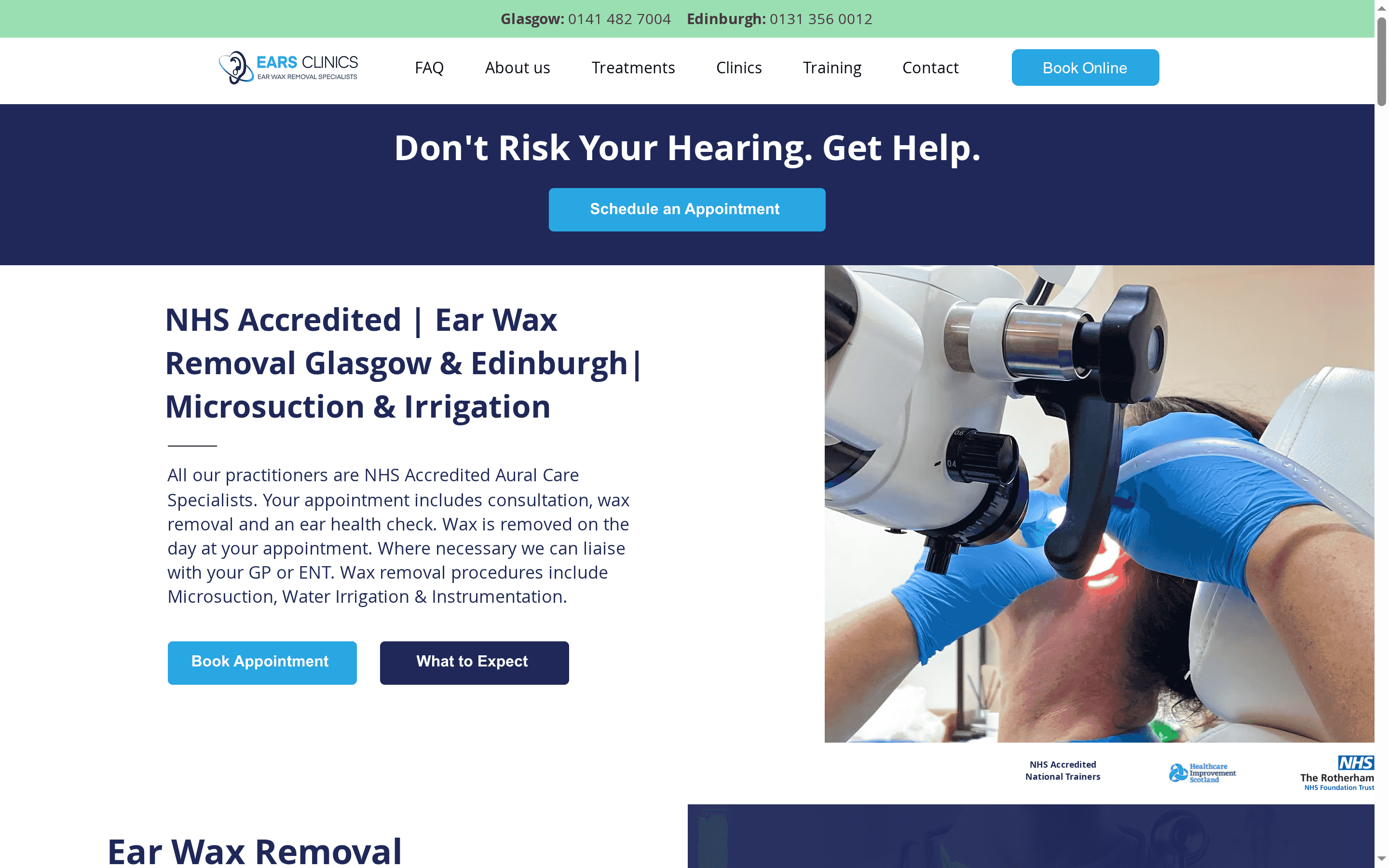
EARS Clinics is registered with Healthcare Improvement Scotland (HIS) and staffed by NHS-accredited Aural Care Specialists. Every appointment begins with a clinical assessment and ear canal imaging; the practitioner selects the most appropriate method, whether microsuction, irrigation, or manual instrumentation, based on your history and presentation. Same-day appointments are available, and home visits can be arranged for patients who cannot travel to the clinic. Fees are £60 for adults over 18, £75 for under-18s, and £180 for home visits. Clinical correspondence to your GP or ENT is provided where findings warrant it.
To see the full range of procedures offered and to book an appointment, visit the ear wax removal procedures page at earhealthservice.co.uk.
Useful sources
NICE quality standard QS185: Earwax removal — the authoritative clinical standard setting out when and how ear wax should be removed in primary and community care.
RNID ‘Stop the Block’ report (2025) — FOI-based analysis of ICB commissioning across England, with recommendations to NHS England and ICBs.
British Academy of Audiology: call for restored GP services — professional body statement on the clinical and equity impact of service withdrawal.
BBC News: Millions lose access to free NHS earwax removal — national media coverage summarising RNID findings and patient impact, including the estimate of almost 10 million people affected in England.
NHS Gloucestershire ICB: microsuction policy — example ICB policy document showing how local criteria for funded microsuction are applied in practice.
EARS Clinics: ear wax removal procedures — patient-facing service page describing microsuction, irrigation, and instrumentation available at EARS Clinics in Glasgow and Edinburgh.
EARS Clinics: what to expect at your appointment — guidance on appointment flow, clinical assessment, and aftercare for new patients.
Recommended