
Microsuction Often Safest on Blood Thinners Without Stopping Medication

Yes, ear wax removal is usually possible if you take blood thinners, but the procedure carries a higher risk of bruising or minor bleeding, and it needs a proper assessment first. Microsuction is often the preferred method because it involves no contact with the canal skin and no moisture, though irrigation and manual instrumentation remain valid options depending on your history. The one rule that overrides everything else: never stop or adjust your anticoagulant or antiplatelet medication before an appointment without written advice from the clinician who prescribed it.
TL;DR:
Microscopy is the preferred removal method for patients on blood thinners because it avoids contact with canal skin and moisture, reducing bleeding risk.
Proper assessment of medication, history of bleeding or ear conditions, and ear examination are essential before choosing the safest removal technique.
A clinician educated in aural care can adapt the method based on ear condition, with microsuction typically safest when dealing with anticoagulated patients.
Patients should not stop blood-thinning medication without medical advice and must inform the clinician about their current drugs and medical history.
Only trained, regulated practitioners using individualized risk assessments should perform ear wax removal on patients taking blood thinners.
What happens during your ear wax removal appointment
A clinician trained in aural care will not simply reach for a tool the moment you sit down. The appointment starts with questions, because the answers decide which method is safe.
Expect to be asked about:
Your full medication list, including the specific anticoagulant or antiplatelet drug and the reason it was prescribed
Any personal or family history of bleeding disorders or unusually heavy bruising
Previous ear surgery, grommets, or a known perforated eardrum
Recent ear infections or discharge
After the history, the clinician examines your ear canal and eardrum with an otoscope or a microscope. This step decides everything that follows: if the eardrum can’t be clearly seen, or if there’s any sign of infection or perforation, irrigation is usually ruled out and microsuction or manual instrumentation becomes the safer route.
During microsuction, you’ll hear a steady vacuum noise, similar to a dentist’s suction, but there’s no liquid and generally no discomfort beyond mild pressure. Most appointments run several minutes, though heavily impacted wax can take longer. The clinician will stop immediately if you feel pain, which is one of the built in safeguards for anyone on blood thinners.
How blood thinners actually change the bleeding risk
Anticoagulants and antiplatelet drugs work by slowing or interrupting the clotting cascade. In most areas of the body that’s the entire point of taking them, but in the ear canal it means the delicate skin lining is more prone to bruising, abrasion and bleeding if a probe, suction tip or irrigation jet makes contact with it. Clinical guidance flags this explicitly and asks practitioners to treat anticoagulant use as a factor that changes the risk profile of the procedure, not necessarily a reason to refuse treatment altogether, according to the Clinical Practice Guideline on Cerumen Impaction.
Medicines commonly named in this guidance include:
Warfarin (patients on warfarin should have a stable, recently checked INR)
Heparin
Clopidogrel
Dabigatran
Rivaroxaban
Apixaban
Statistic in context: the Clinical Practice Guideline (Update): Earwax lists these medications by name as risk modifiers for bleeding and bruising during cerumen removal, which is exactly why a proper pre-procedure history matters more here than for most patients.
Professional aural care guidance from the BSA is reassuring on one point: individual assessment, not a blanket rule, is what determines safety. Many patients on anticoagulants can still be treated. The decision simply has to be made case by case, not assumed either way.
Microsuction, irrigation and manual instrumentation compared
Three methods dominate professional ear wax removal, and each behaves differently when a patient is on blood thinners.
Microsuction is performed under direct visual magnification, using a fine suction tip to lift wax away without introducing any liquid. Because the clinician can see the canal clearly throughout and there’s no moisture involved, it’s often the method of choice for anticoagulated patients, and it’s the approach current NICE guidelines favour where the equipment and trained staff are available.
Irrigation uses a gentle, warmed stream of water to flush softened wax out. It works well for softer, less impacted wax, but it’s contraindicated if the eardrum can’t be fully visualised first, or if there’s a history of perforation, grommets, or recent ear surgery, according to guidance on manual cerumen removal and irrigation techniques.
Manual instrumentation, using fine curettes or forceps, is effective for hard, impacted wax that resists other methods. It demands more precision from the clinician and more stillness from the patient, since direct contact with the canal wall is the main source of bleeding risk in anyone on anticoagulants.
Across all three, clinicians reduce trauma the same way: working under magnification, keeping any irrigant at body temperature to avoid triggering dizziness, applying gentle suction pressure rather than force, and stopping the moment a patient reports pain. The choice between them isn’t about preference. It’s about what your ear canal and your microsuction procedure safety profile actually allow.
Pro Tip: If you’re nervous about which method suits you, ask the clinic beforehand whether they offer microsuction. It’s the option most patients on blood thinners find most comfortable, precisely because nothing touches the canal skin.
Preparing for your appointment: a short checklist
A little preparation makes the appointment faster and considerably safer.
Bring a full, current medication list, including the name of your anticoagulant or antiplatelet drug and why it was prescribed
Mention any bleeding disorder, recent ear surgery, grommets, current infection, or a past perforated eardrum
Do not stop or pause your blood-thinning medication on your own; if a clinic ever suggests it, confirm that instruction in writing with your prescriber first
Expect to sign a consent form once the clinician has explained the risk assessment for your specific case
Pro Tip: Keep a photo of your medication packaging on your phone. It’s a quick, reliable way to confirm exact drug names and doses if you’re asked during the pre-appointment workflow.
Softening ear wax at home safely, and what to avoid
Softening drops in the days before your appointment can make removal quicker and gentler, but they’re not right for everyone.
Olive oil, mineral oil, sodium bicarbonate or carbamide peroxide drops, used according to the product instructions for several days beforehand, are the NHS-recommended approach
Stop and seek advice if you suspect a perforated eardrum, have an active infection, or have recently had ear surgery
Never use cotton buds, ear candles, or any inserted object. These push wax deeper and risk injuring canal skin that’s already more vulnerable to bleeding on anticoagulants
Avoid unsupervised home irrigation kits if you’re on blood thinners. Professional assessment first is the safer route
Warning signs after treatment and what to do
Minor bruising or slight tenderness in the canal is common after removal and usually settles within a day or two. What isn’t normal, and needs prompt attention, is different.
Persistent or heavy bleeding that doesn’t ease with light pressure
Severe or worsening pain, rather than the mild discomfort expected immediately after treatment
Vertigo, dizziness, or a sudden change in hearing
Fluid discharge from the ear that wasn’t present before
If any of these occur, contact the clinic that treated you first, since they hold your history and can advise quickly. For heavy bleeding, severe pain, or vertigo that doesn’t settle, contact your GP or NHS 111, and treat sudden hearing loss as something to get checked promptly rather than waiting it out.
Routine aftercare is straightforward: keep the ear dry for 24 to 48 hours, take standard pain relief if needed, and attend any follow-up check the clinic recommends. The BSA’s aural care guidance notes that anticoagulant medicines increase the likelihood of minor abrasion, which is exactly why this aftercare window matters more for you than for a patient not on blood thinners.
Why regulation and training matter for anticoagulated patients
Ear wax removal on a patient taking blood thinners is not a task for an untrained hand. The margin between a routine appointment and a bleeding complication is narrow enough that practitioner skill, not just equipment, decides the outcome.
That’s why it matters who’s holding the suction tip or curette. Look for:
Practitioners with recognised, NHS-accredited aural care training
Clinics regulated by Healthcare Improvement Scotland (HIS) or the Care Quality Commission (CQC), rather than unregulated providers
A practice that documents your risk assessment and adapts its method to your medical history, instead of applying the same approach to every patient
Clinics that are HIS-registered often have microsuction, irrigation or manual instrumentation appointments carried out by NHS-accredited Aural Care Specialists. Appointments may be available in clinic, on a same-day basis, or as home visits, with correspondence to your GP or ENT where needed.
Our take: the caution around blood thinners is right, but the fear often isn’t
The instinct to treat blood thinners as a reason to delay ear wax removal is understandable, but it’s frequently the wrong call. Wax that’s left to build up because a patient or a clinic is nervous about anticoagulants tends to get harder, more impacted, and eventually more uncomfortable to shift, which can raise risk rather than lower it. The guidance is consistent on this point: individual assessment, not automatic refusal, is what current clinical practice supports.
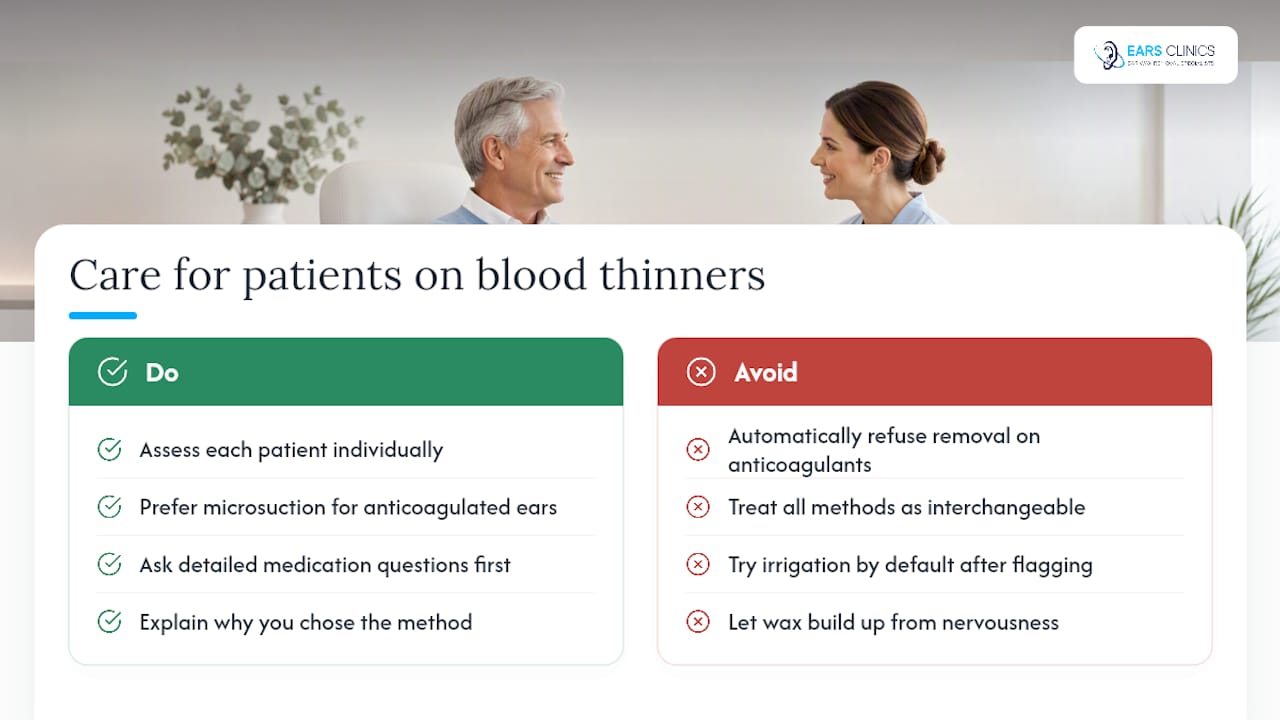
Where conventional advice falls short is in treating all three removal methods as interchangeable once a patient is flagged as “on blood thinners.” They’re not. Microsuction’s advantage for anticoagulated patients isn’t marginal. It removes the two biggest bleeding triggers, direct canal contact and introduced moisture, in one method. That should be the starting point of the conversation, not an afterthought after irrigation has already been tried and failed.
What we’d prioritise first: a clinician who asks detailed medication questions before touching an otoscope, and who explains why they’re choosing one method over another for your specific ear. If they can’t explain that reasoning, that’s worth noticing.
— EARS
Book a regulated ear wax removal appointment with EARS Clinics
If you’re on blood thinners and want ear wax removal handled by people trained to manage that risk properly, EARS Clinics is built for exactly this. As a Healthcare Improvement Scotland registered provider, every procedure is carried out by NHS-accredited Aural Care Specialists who assess your medication history and choose between microsuction, irrigation or manual instrumentation based on what’s actually safest for you, not a fixed script.
Appointments run in clinic in multiple locations, with same-day slots and home visits also available for patients who find travel difficult. Before you book, speak to your prescriber if you have any questions about your medication, and bring your current drug list to the appointment. You can check availability and book a microsuction appointment directly through EARS Clinics, and softening drops can be started beforehand if your clinician advises it.
Sources
This article draws on the Clinical Practice Guideline on Cerumen Impaction, NHS patient guidance on earwax, the NCBI clinical overview of cerumen impaction, and the BSA’s 2025 aural care and ear wax removal guidance.
This article is general information, not a substitute for advice from a qualified doctor. Consult a qualified healthcare professional about your own circumstances before acting on anything here.
FAQ
What pulls ear wax out safely?
Professional methods, microsuction, irrigation, and manual instrumentation, are the safest way to remove wax that hasn’t cleared on its own; softening drops such as olive oil can help beforehand but rarely clear a hard blockage alone.
Do the NHS still do ear wax removal?
NHS provision varies by area and often prioritises cases affecting hearing aid use or diagnosis; many patients on blood thinners choose a regulated private clinic like EARS Clinics for faster access to microsuction.
What not to do after ear wax removal?
Avoid getting the ear wet for 24 to 48 hours, don’t insert cotton buds or other objects into the canal, and don’t ignore persistent bleeding, severe pain or dizziness, contact the clinic or your GP instead.
How long can an ear wax blockage last?
Without treatment, impacted wax can persist for weeks or months and tends to worsen gradually rather than resolve on its own, which is why professional removal is usually recommended once symptoms appear.
Recommended