
After 2 Weeks of Drops, Book Microsuction for Impacted Ear Wax in the UK

Impacted ear wax means cerumen has built up and hardened enough to block the ear canal, causing fullness, muffled hearing or discomfort. Mild cases often respond to a short course of softening drops. If you have pain, discharge, fever or a marked drop in hearing, book a clinician rather than persisting with home treatment. Where professional removal is needed, microsuction is the method current NICE guidance favours.
TL;DR:
Professional removal methods like microsuction are preferred because they offer precise visualization and minimize risks compared to irrigation or manual tools.
Ear wax impaction is more common in older adults, hearing aid users, and those who frequently insert objects like cotton buds, which can worsen the blockage.
If home softening drops do not improve symptoms within two weeks, seeking professional assessment is recommended to avoid delays or complications.
Urgent medical attention is necessary if symptoms include severe pain, discharge, fever, or sudden hearing loss, indicating potential complications beyond simple wax buildup.
Clinics like EARS Clinics provide same-day appointments with NHS-accredited specialists, offering the safest and fastest options for persistent or complicated cases.
Symptoms of impacted ear wax
A blocked ear rarely announces itself with just one sign. Most people notice a cluster of symptoms that builds gradually rather than a sudden change.
A sensation of fullness or pressure in the ear
Muffled or reduced hearing, sometimes described as sound coming through “cotton wool”
Tinnitus, a ringing or buzzing noise with no external source
Itching or mild discomfort inside the canal
Earache, particularly if wax is pressing against the eardrum
Occasional dizziness or a feeling of being off balance
Impacted wax that goes untreated can prevent a clinician from properly examining the eardrum, which matters if there’s a separate concern like infection needing to be ruled out, according to NHS guidance on earwax build-up. Symptoms in one ear tend to be less urgent than sudden changes affecting both, though asymmetry can itself be a reason to get checked. Fever, continuous discharge, or a smell from the ear point to something beyond simple wax buildup and warrant a same-day assessment rather than a wait-and-see approach.
Causes and risk factors behind ear wax buildup
Cerumen is produced continuously by glands in the outer third of the ear canal, and normally it migrates outward on its own, carried by jaw movement from talking and chewing. Impaction happens when that self-clearing process fails, usually because wax hardens before it can travel, or because something is physically blocking its path.
Certain groups face a higher chance of this happening:
Older adults, whose wax tends to be drier and slower to migrate
Regular hearing aid or earplug wearers, whose devices interrupt natural clearance
People with naturally narrow or curved ear canals
Those with skin conditions affecting the canal, such as eczema
Anyone who frequently uses cotton buds or similar objects inside the ear
That last point deserves particular attention. Inserting a cotton bud rarely removes wax. It usually pushes it further down against the eardrum while also irritating the canal skin, which can stimulate even more wax production. Cerumen impaction is common across all age groups but is more frequent in children, older adults and people with cognitive impairment, a pattern that explains why routine ear checks matter most for these groups and for anyone using hearing devices.
How impacted ear wax is diagnosed
Diagnosis starts with a straightforward visual check, but what a clinician looks for goes beyond simply confirming wax is present.
Otoscopy or microscopy. A trained clinician examines the canal with an otoscope or microscope to confirm the wax’s extent, consistency and exact position against the eardrum.
Assessment of hearing changes. If hearing loss seems disproportionate to the visible wax, or persists after removal, a formal hearing test may be arranged to rule out an unrelated cause.
Checking the eardrum’s condition. Before any irrigation is considered, the clinician confirms there’s no perforation, active infection or recent ear surgery, since these change which removal method is safe.
Referral where needed. Unusual findings, recurrent impaction despite good ear hygiene, or signs of a structural problem may prompt referral to an ENT specialist for further investigation.
This step-by-step check is why self-diagnosis from symptoms alone has real limits. A muffled ear that feels like simple wax could occasionally be something else entirely, and only direct visualisation settles the question.
Treatment options: from home softening to professional removal
The right first step for uncomplicated impaction is usually a softening agent used at home for a short, defined period. Most cases of wax blockage respond to over-the-counter drops, but if symptoms haven’t improved after a short course, typically up to two weeks, it’s time to get professional advice rather than continuing indefinitely.
Softening agents (cerumenolytics) fall into two broad categories: oil-based options like olive oil or mineral oil, and water-based or peroxide-based drops. Oil-based drops are gentler and suit most people; peroxide-based products can be more effective on very hardened wax but may cause temporary fizzing or mild irritation. Neither should be used if there’s a known or suspected perforation.
Pharmacists are often the sensible first port of call. They can advise on which drops suit your situation, check whether your symptoms sound consistent with simple wax buildup, and flag when it’s time to see a GP or book directly with an ear health clinic instead of continuing to self-treat.
Professional removal becomes the right route when drops haven’t worked or symptoms are more pronounced:
Microsuction uses gentle suction under direct visualisation and is the method current NICE guidance favours, largely because it avoids introducing moisture into the canal and gives the clinician precise visual control throughout.
Irrigation uses a controlled flow of water to flush wax out, and remains a safe, clinically valid option when appropriate, though it’s avoided if the eardrum is perforated, ear surgery is recent, or infection is active.
Manual instrumentation uses fine tools to physically remove wax and works well for stubborn or superficial deposits, though it demands considerable skill and patient cooperation.
Ultimately, practitioners choose the method based on your history and what the examination shows, not on a fixed protocol.
Pro Tip: Avoid ear candling or vacuum devices sold for home use. Clinicians advise against them because there’s no credible evidence they work, and they carry a real risk of burns or eardrum injury.
What happens during a professional ear wax removal appointment
Knowing the sequence in advance takes the uncertainty out of booking. A typical appointment runs through a consistent structure regardless of which method ends up being used.
History and examination first. The clinician asks about your symptoms and any relevant medical history, then examines the ear canal and eardrum before deciding on an approach.
Confirming the eardrum is intact. This check happens before irrigation is offered, since a perforation rules that method out.
The procedure itself usually takes between 15 and 30 minutes, depending on how hardened the wax is and which method is used. Microsuction can feel like a faint tickling or noise; irrigation involves a warm water sensation; instrumentation may involve brief, mild pressure.
Immediately afterwards, some people notice hearing feels oddly muffled for a short while as the ear canal adjusts, before clearing.
Rare complications, such as minor discomfort or slight dizziness, are minimised by choosing the safest method for your specific case and stopping if you’re uncomfortable.
Follow-up correspondence with your GP or ENT is arranged where relevant, particularly if the appointment revealed something beyond simple wax buildup.
Prevention and aftercare for ear wax buildup
Reducing the odds of impacted drainage recurring comes down to a few consistent habits rather than any single fix.
Clean only the outer ear. Wash the visible part with a flannel and leave the canal itself alone; nothing narrower than your elbow belongs inside it.
Consider maintenance drops if you’re prone to buildup. A brief, occasional course of softening drops can keep recurrent impaction from becoming a repeated appointment cycle.
Check hearing aids and earplugs regularly. Anyone who wears these daily should have their ears checked every three to six months, since the devices interrupt the canal’s natural clearance.
Remove hearing aids overnight where possible, giving the canal skin a chance to breathe and migrate wax naturally.
After a removal procedure, most people can resume swimming within a day or two, though your clinician will advise based on what was done. Watch for any new pain, discharge or hearing change in the days that follow.
Pro Tip: If you wear hearing aids, book a wax check alongside your routine audiology review rather than waiting for symptoms to appear. Impaction often builds quietly behind a device long before it’s noticeable.
Red flags: when to seek urgent care
Certain signs mean you should stop any home treatment immediately and get seen the same day.
Severe or worsening ear pain
Fever alongside ear symptoms
Pus, blood or continuous discharge from the ear
Sudden, significant hearing loss
Recent ear surgery or trauma to the ear or head
For mild concerns, a pharmacist is a sensible starting point. For persistent but non-urgent symptoms, contact your GP or a specialist ear clinic. For anything on the red flag list above, particularly fever or sudden hearing loss, treat it as an emergency and seek same-day medical assessment rather than waiting.
EARS Clinics: a regulated option for professional removal
EARS Clinics operate as a Healthcare Improvement Scotland registered service, with procedures carried out by NHS-accredited aural care specialists rather than generalist staff. That registration matters: ear care should only ever be performed by trained, competent clinicians working to recognised standards, whether regulated by Healthcare Improvement Scotland or, elsewhere in the UK, the Care Quality Commission.
The clinic offers all three clinically valid removal methods, chosen by the practitioner according to your history and what the ear examination shows:
Microsuction, irrigation and manual instrumentation, available at in-clinic appointments
Same-day appointments for people who need prompt attention
Home visits for those who can’t easily travel to a clinic
Correspondence with GPs or ENT specialists when a case needs wider clinical input
Fees are provided to patients before booking to inform them of the cost.
Our take: what most advice on ear wax gets wrong
Most consumer guidance on ear wax treats every method as roughly interchangeable, when in practice the choice matters more than people assume. Irrigation has been the default for decades largely because it’s cheap and quick, not because it’s universally the safest option. Microsuction earns its NICE preference through precision: the clinician sees exactly what they’re removing and never introduces water into a canal that might have a hidden perforation.
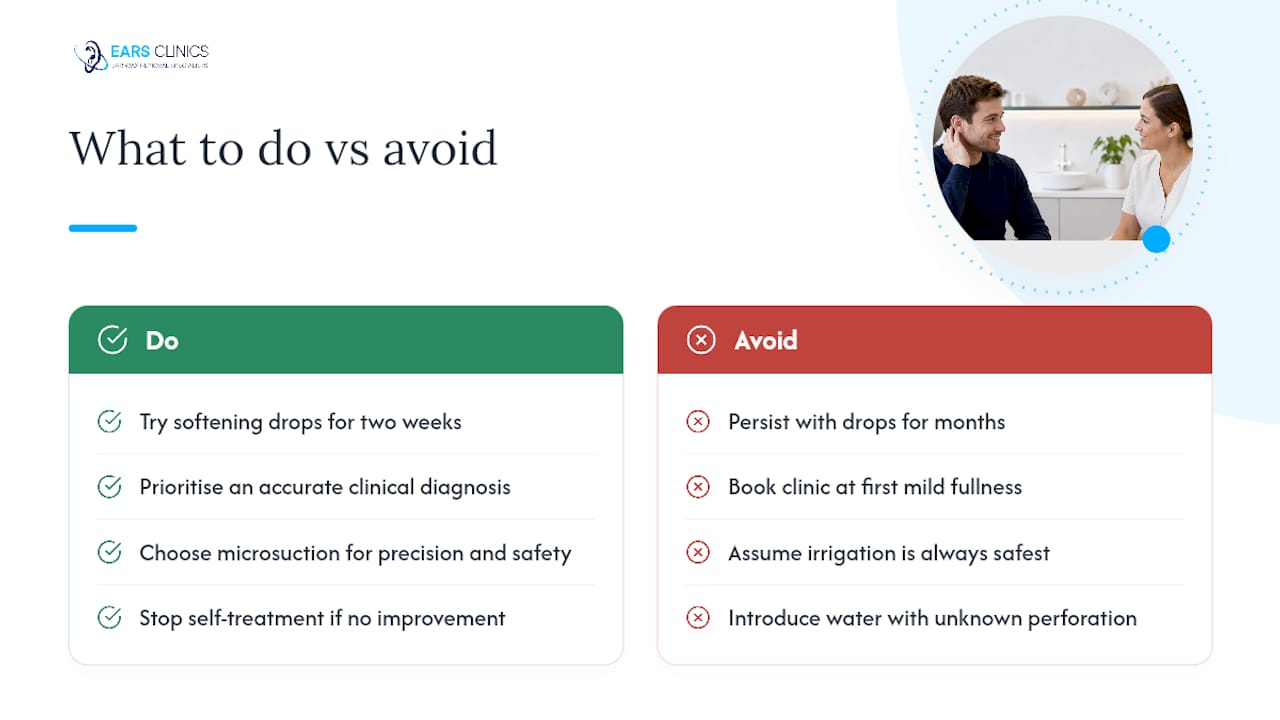
Where conventional advice falls shortest is timing. Too many people either persist with drops for months past the point of usefulness, or reach for a clinic appointment the moment they feel any fullness at all. Two weeks of appropriate softening drops is a reasonable trial. Beyond that, without improvement, self-treatment stops being cautious and starts being a delay.
Prioritise getting an accurate diagnosis before choosing a treatment path. A muffled ear has more than one possible cause, and only a proper examination tells you which one you’re actually dealing with.
— EARS
Book professional ear wax removal with Earhealthservice
Persisting with drops for weeks when they clearly aren’t working costs you more time than booking a same-day appointment would. Professional clinics like EARS Clinics may offer faster routes to ear care than NHS waiting lists, often without requiring referrals or pre-treatment conditions.

EARS Clinics suit anyone with persistent fullness, hearing loss or discomfort who wants a same-day answer rather than an open-ended wait. Appointments cover microsuction, irrigation and manual instrumentation, with the method chosen after your practitioner examines your ear and reviews your history. Home visits are available for anyone who can’t easily get to a clinic, and correspondence with your GP or ENT is arranged where relevant. If you recognise the symptoms described above, book an appointment with EARS Clinics and get your ears properly checked rather than guessing at drops indefinitely.
This article is general information, not a substitute for advice from a qualified doctor. Consult a qualified healthcare professional about your own circumstances before acting on anything here.
Sources
Recommended