
What is complex ear care? A guide to safe wax removal

Most people assume ear wax removal is straightforward, but certain medical conditions require specialised approaches that standard methods cannot safely address. Complex ear care involves tailored techniques for patients with perforated eardrums, narrow ear canals, hearing aids, or previous ear surgery. Without proper assessment and expert treatment, you risk serious complications including infection, perforation, and permanent hearing damage. This guide explains the specialised methods, safety protocols, and clinical pathways that protect vulnerable patients whilst effectively resolving ear wax buildup.
Key Takeaways
Point | Details |
Microsuction gold standard | Microsuction, performed under magnified visualisation, is the preferred safe method for removing wax in complex ear care. |
Irrigation risks and contraindications | Irrigation is contraindicated in perforations, previous ear surgery, active infection or presence of grommets, as pressure can push infection into the middle ear. |
Risks of DIY methods | Cotton buds and ear candles are unsafe for complex ears and can push wax deeper or cause trauma. |
Patient centred assessment essential | A professional assessment with video otoscopy and tympanometry guides personalised treatment and protects vulnerable ear structures. |
What is complex ear care? Understanding the scope and need
Complex ear care addresses situations where standard ear wax removal methods pose unacceptable risks or prove ineffective. Patients with perforated eardrums, hearing aids, or previous surgery require gentle techniques that protect vulnerable ear structures whilst clearing blockages. This specialised approach differs fundamentally from routine ear care available through general practice.

Several patient groups need complex ear care rather than standard treatment. You fall into this category if you have a perforated eardrum, grommets, mastoid cavity surgery, or chronically narrow ear canals. Hearing aid users often develop impacted wax requiring expert removal to prevent device damage. Children under five years need specialised assessment due to developing ear anatomy. Patients with recurrent ear infections, eczema affecting the ear canal, or immune system conditions also require tailored approaches.
Standard methods like irrigation involve forcing water into the ear canal at pressure. This technique risks pushing infection through perforations into the middle ear, potentially causing serious complications. Cotton buds and ear candles pose even greater dangers, with cotton buds pushing wax deeper and causing trauma whilst ear candles provide no clinical benefit and risk burns. These DIY approaches lack the precision needed for complex cases.
Professional assessment identifies your specific needs before treatment begins. Video-otoscopy allows specialists to visualise your ear canal and eardrum, detecting perforations, inflammation, or anatomical variations. This examination determines which removal method suits your condition. Tympanometry measures eardrum movement, revealing middle ear problems that contraindicate certain procedures. Without this personalised evaluation, treatment could worsen your condition rather than resolve it.
Techniques and methods used in complex ear care
Microsuction represents the gold standard for complex ear care, using gentle suction under microscopic visualisation to remove wax without touching ear structures. This method achieves over 90% success rates with 50% fewer risks than irrigation, making it ideal for vulnerable patients. The procedure involves inserting a fine suction tube whilst viewing through a microscope or endoscope, allowing precise control. You remain still whilst the specialist carefully extracts wax particles without applying pressure or introducing fluids.
Three primary methods exist for ear wax removal, each suited to different clinical situations:
Method | Best For | Risks | Success Rate |
Microsuction | Complex cases, perforations, hearing aids, narrow canals | Under 1% complication rate; minimal discomfort | Over 90% |
Irrigation | Simple blockages in healthy ears only | 1-3% complications including otitis externa, perforation | 70-85% |
Manual instrumentation | Hard wax, partial blockages, when suction insufficient | Requires high skill; risk of canal trauma if rushed | 75-90% |
Microsuction advantages include direct visualisation throughout the procedure, no water introduction that could cause infection, and suitability for patients with perforations or grommets. The technique proves particularly effective for hearing aid users whose devices create hard, compacted wax. You can undergo microsuction even with active ear infections, unlike irrigation which spreads bacteria.
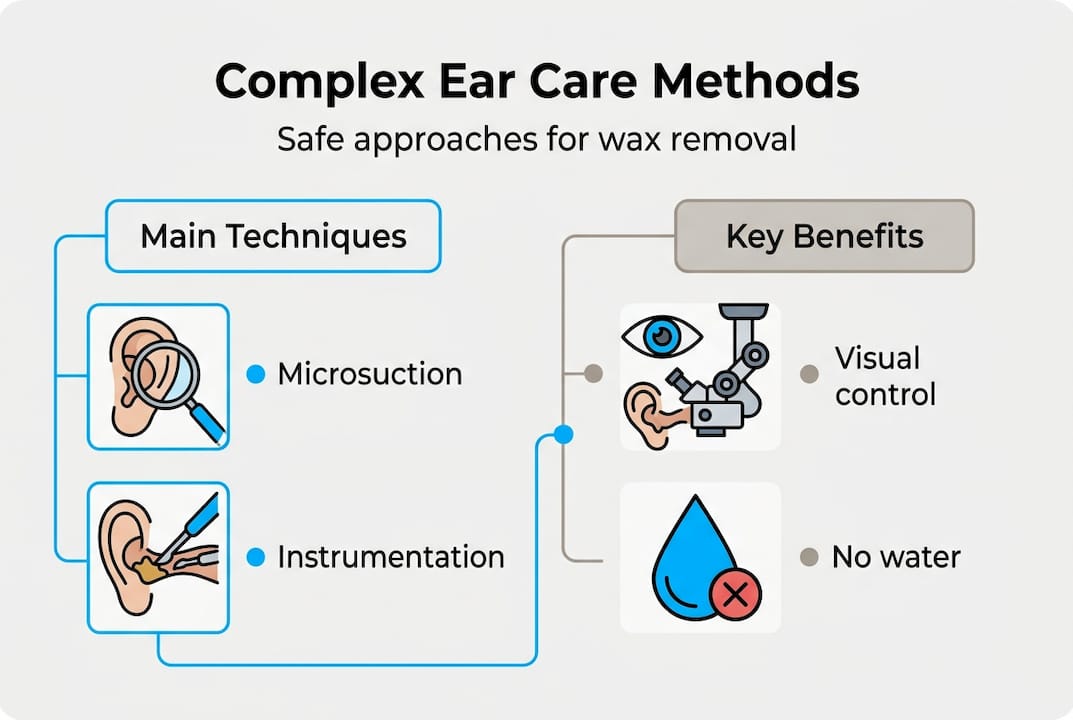
Irrigation involves flushing warm water through the ear canal to dislodge wax. NHS guidelines contraindicate this method for patients with perforations, grommets, previous ear surgery, acute infections, or mucus discharge. The pressurised water can force infection into the middle ear through damaged eardrums, causing serious complications. Irrigation also fails with hard, impacted wax that resists water pressure.
Manual instrumentation uses specialised tools to physically remove wax under direct vision. Specialists employ this technique when wax proves too hard for suction or when treating partial blockages. The method requires exceptional skill and patience, as rushing increases trauma risk. Microsuction for sensitive ears often combines with gentle instrumentation for optimal results.
Pre-treatment preparation significantly improves outcomes and reduces complications. Applying olive oil or medical-grade ear drops for 3-5 days before your appointment softens wax, making removal easier and faster. This preparation proves especially important for hard, impacted blockages. However, avoid oil if you suspect eardrum perforation, as introducing liquid through damaged tissue risks infection.
Pro Tip: Choose clinics staffed by NHS-accredited Aural Care Specialists rather than general practitioners offering ear care. Specialists complete rigorous training in complex cases and maintain higher safety standards through regular clinical governance reviews.
Assessments, contraindications, and expert care pathways
Specialist assessment forms the foundation of safe complex ear care, identifying conditions that contraindicate certain procedures. Video-otoscopy provides magnified visualisation of your ear canal and eardrum, revealing perforations, inflammation, foreign bodies, or anatomical abnormalities. The specialist captures images during examination, creating a baseline record for future comparison. This technology proves essential for detecting subtle perforations that standard otoscopy might miss.
Tympanometry measures how your eardrum responds to air pressure changes, indicating middle ear function. Abnormal results suggest fluid accumulation, Eustachian tube dysfunction, or eardrum perforation. This objective test helps specialists determine whether your symptoms stem from wax buildup or underlying middle ear pathology requiring different treatment. You experience brief pressure sensations during the test, but the procedure causes no discomfort.
Several absolute contraindications prevent certain ear wax removal methods:
Active ear infections with discharge require antibiotic treatment before wax removal
Recent ear surgery within 6-8 weeks risks disrupting healing tissues
Grommets in place contraindicate irrigation but permit microsuction
Known or suspected eardrum perforation rules out water-based methods
Severe eczema or psoriasis affecting the ear canal needs dermatological management first
NHS versus private clinic approaches differ significantly in Scotland. NHS wait times range from 6 to 16 weeks, with the service prioritising conservative management through oil drops and self-care advice. You receive referral for professional removal only after these measures fail. This pathway suits non-urgent cases but proves problematic when wax causes significant hearing loss affecting work or daily activities.
Private clinics offer same-day appointments without requiring prior oil treatment, though pre-softening still improves outcomes. You access immediate care when symptoms interfere with your quality of life. Healthcare Improvement Scotland regulates private ear care clinics, ensuring they meet strict safety standards. This regulation provides assurance that private treatment matches NHS clinical quality whilst offering faster access.
The clinical care pathway for complex ear wax removal follows these steps:
Initial consultation includes medical history review, current symptoms assessment, and medication documentation
Video-otoscopy examination visualises ear canal and eardrum condition, identifying contraindications
Tympanometry testing measures middle ear function and eardrum integrity when indicated
Treatment planning selects appropriate removal method based on findings and patient factors
Procedure performed with continuous monitoring and patient communication throughout
Post-treatment examination confirms complete wax removal and checks for complications
Aftercare instructions provided with follow-up arranged if needed
Pro Tip: If you experience sudden hearing loss, severe pain, or discharge alongside wax buildup, request urgent private assessment rather than waiting weeks for NHS appointments. Prompt treatment prevents complications and restores hearing faster, justifying the private fee for complex cases.
Managing risks and ensuring patient safety in complex ear care
Ear wax removal carries inherent risks that increase significantly with improper technique or unsuitable method selection. Otitis externa, an outer ear canal infection, develops in 1-3% of irrigation cases when water remains trapped after treatment. You experience pain, itching, and discharge requiring antibiotic ear drops. Microsuction reduces this risk to under 1% by avoiding water introduction entirely.
Eardrum perforation represents the most serious complication, occurring when excessive pressure or instrument trauma damages the thin membrane. Irrigation causes perforation in approximately 1 in 1,000 procedures, whilst microsuction carries even lower risk at 1 in 10,000 when performed by trained specialists. Perforations cause sudden sharp pain, hearing loss, and potential middle ear infection. Most heal naturally within 6-8 weeks, but some require surgical repair.
Statistical safety data demonstrates clear method superiority:
Clinical Safety Comparison: Microsuction achieves complication rates under 1% across all patient groups, including those with complex conditions. Irrigation complications occur in 1-3% of cases, rising to 5-8% in patients with narrow canals or hard wax. Manual instrumentation carries 2-4% complication rates depending on practitioner experience and wax consistency.
Post-procedure care significantly reduces infection risk and promotes healing. Keep your ears completely dry for 48 hours following treatment, avoiding swimming and using cotton wool coated with petroleum jelly when showering. This protection prevents water entry that could introduce bacteria into the vulnerable ear canal. Resume normal activities immediately, but avoid inserting anything into your ears including cotton buds or hearing aids until advised.
Proper aftercare reduces post-treatment infections by 40% compared to patients who neglect these precautions. Apply prescribed antibiotic or anti-inflammatory drops if your specialist recommends them, particularly after treating infected or inflamed ears. Report increasing pain, discharge, or hearing loss promptly, as these symptoms indicate complications requiring assessment.
DIY ear cleaning methods cause more harm than the wax they attempt to remove. Cotton buds push wax deeper into the canal, creating impaction against the eardrum. This practice also risks eardrum perforation and removes protective wax that prevents infection. Ear candles provide no clinical benefit whilst posing burn risks from hot wax dripping into the ear. Prompt professional ear care prevents the complications these dangerous methods cause.
Your ear canal produces wax as a natural protective mechanism that traps debris and repels water. Normal wax migrates outward naturally, requiring no intervention. You need professional removal only when wax causes symptoms including hearing loss, fullness sensation, tinnitus, or pain. Regular cotton bud use disrupts this natural process, causing the very problems you attempt to prevent.
Discover expert complex ear care at EARS Clinics
When complex ear conditions require specialised attention, EARS Clinics provides NHS-accredited care tailored to your specific needs. Our Healthcare Improvement Scotland registered facilities in Glasgow and Edinburgh offer immediate access to expert microsuction and assessment services without lengthy NHS waiting periods.
Our trained Aural Care Specialists understand the nuances of different ear wax removal procedures, selecting the safest method for your individual circumstances. We treat patients from age two upwards, including those with perforations, hearing aids, and previous surgery that standard services cannot safely manage. Same-day appointments mean you regain hearing comfort quickly rather than enduring weeks of impairment. During your visit, you will understand what to expect from comprehensive ear health checks that identify issues before they escalate. Meet our team of NHS-trained specialists who bring hospital-grade expertise to convenient clinic and home visit settings across Scotland.
Frequently asked questions
What are the symptoms that indicate you need complex ear care?
Persistent ear blockage despite using olive oil drops for a week suggests impacted wax requiring professional removal. Hearing loss affecting conversation, tinnitus, ear pain, or discharge indicate you need specialist assessment rather than continued self-treatment. Hearing aid users experiencing feedback or reduced amplification likely have wax buildup needing expert care. Previous ear surgery, known perforations, or recurrent infections automatically classify you as needing complex rather than routine ear care approaches.
Is microsuction safe for children and people with hearing aids?
Microsuction proves especially suitable for children and hearing aid wearers due to its gentle, precise nature. Regulated clinics treat children from age two upwards using child-friendly techniques and communication. The procedure avoids water that could damage hearing aids or cause infection in young ears. Specialists adjust suction pressure and work speed according to patient comfort, making microsuction the preferred method for sensitive or anxious individuals across all age groups.
Why does the NHS have long waits for ear wax removal?
The NHS prioritises conservative self-management through olive oil drops and observation before offering professional removal. This approach reserves specialist appointments for cases where self-care fails after several weeks. Microsuction availability remains limited within NHS services, with many areas offering only irrigation despite its contraindications for complex cases. Resource constraints and clinical prioritisation systems create 6-16 week waiting periods that private clinics eliminate through dedicated ear care focus and immediate appointment availability.
How much does private complex ear care cost in Scotland?
Private ear wax removal costs £60 for adults over 18 and £75 for children and teenagers under 18 at regulated clinics. Home visits for patients unable to travel cost £180, providing expert care in your own environment. These fees include full assessment, treatment, and aftercare advice from NHS-accredited specialists. The investment proves worthwhile when considering immediate symptom relief, avoided complications from delayed treatment, and restored hearing quality affecting work and daily activities.
Can I use olive oil if I suspect an eardrum perforation?
Never introduce olive oil or any liquid into your ear if you suspect perforation. Signs suggesting perforation include previous trauma, sudden hearing loss with pain, or visible discharge. Oil entering the middle ear through damaged tissue risks infection and delays healing. Book urgent specialist assessment instead, as video-otoscopy quickly confirms or rules out perforation. If examination shows an intact eardrum, your specialist will advise whether pre-treatment oil softening suits your specific situation before proceeding with appropriate wax removal.
Recommended