
NHS microsuction waiting times: what to expect in 2026
NHS microsuction waiting times vary so much across the UK that a single national figure is meaningless. Depending on where you live, you might get an appointment within days, wait many months, or find your GP surgery does not offer the service at all. This is the postcode lottery RNID’s FOI analysis exposed: of 40 health bodies that responded, only 18 commissioned a full earwax removal service, 15 restricted eligibility or offered patchy access, and 7 provided no treatment whatsoever. NICE guidance NG98 supports microsuction as a preferred method, but that does not mean your local NHS board funds it.
Here is what to do while you find out where you stand:
Check your GP practice’s website for an earwax or ear care policy before you book.
Ask your GP specifically whether you’re being referred to community ear care, audiology, or ENT, as each has a different waiting list.
If speed matters, look into private microsuction, including through EARS Clinics, as a same-day or short-wait alternative.
Pro Tip: When you speak to your GP or the practice nurse, describe your symptoms precisely, including how long you’ve had a blocked ear, whether there’s any discharge, and whether you’ve had ear surgery before. This detail helps avoid a wasted irrigation attempt or an unnecessary extra assessment step that can add weeks to your wait.
Key Takeaways
NHS microsuction waiting times depend entirely on local commissioning decisions, meaning your postcode, not your symptoms, often determines whether you wait days or many months.
Point | Details |
Postcode lottery is real | Only 18 of 40 health bodies RNID surveyed commission a full earwax removal service. |
NICE allows multiple methods | NG98 supports microsuction, irrigation, or manual removal depending on training and equipment. |
Ask about referral destination | Community ear care, audiology, and ENT waits differ, so confirm which list you’re joining. |
Prerequisites can add delay | Failed irrigation after drops is often required before microsuction is funded. |
EARS Clinics offers a faster regulated route | Same-day and short-wait microsuction, irrigation, and manual instrumentation in Glasgow and Edinburgh via HIS-registered specialists. |
Where to check the facts yourself
NICE NG98 for the clinical guidance behind method choice.
RNID’s FOI campaign findings for commissioning variation data.
NHS earwax build-up guidance for patient pathway basics.
Your local ICB or health board website for area-specific policy and eligibility criteria.
Why NHS microsuction waiting times differ so much by area
The variation comes down to commissioning, not clinical demand. Each integrated care board (ICB) in England, and each health board in Scotland, Wales, and Northern Ireland, decides independently whether to fund community earwax removal and which method to use. NICE NG98 states that microsuction, electronic irrigation, or manual removal are all acceptable options in primary or community ear care, provided the practitioner is trained, understands the contraindications, and has the right equipment. That single caveat, trained staff and suitable equipment, is exactly where local provision breaks down. Training clinicians in microsuction costs money and time, and not every practice or ICB has prioritised it.
Local policies also often gate access behind prerequisite steps. Many areas require patients to try softening ear drops first, and some insist on a failed irrigation attempt before microsuction is even considered. That sequencing can quietly add several weeks to your overall wait before the actual procedure happens.
Four factors mainly drive the differences you’ll encounter:
Funding decisions by the local ICB or health board.
Workforce and training levels, since microsuction requires a trained, competent operator.
Local policy choices on which conditions qualify for NHS-funded treatment.
Clinical criteria, such as whether irrigation has already been tried and failed.
Who qualifies for NHS microsuction and how referral works
Eligibility for funded microsuction usually hinges on clinical need rather than personal preference. Local ICB policies, such as the Gloucestershire framework, typically prioritise patients who have one or more of these factors:
A perforated eardrum or history of ear surgery, which makes irrigation unsafe.
A recent ear infection or discharge.
Only one hearing ear, where any complication carries higher risk.
Failed irrigation after a proper course of softening drops.
The referral pathway generally follows a set order. Your GP practice assesses you first, sometimes referring you to a community ear care service, an audiology-linked earwax clinic, or, less commonly, directly to ENT. Each destination has its own waiting list, which is why two people with blocked ears in the same town can face very different timeframes.
A short checklist helps you move through this smoothly:
Book a GP appointment and mention the duration and severity of your symptoms clearly.
Ask which service you’re being referred to, community ear care, audiology, or ENT, so you know which wait applies.
Confirm whether you need to try drops or irrigation first before microsuction becomes an option.
Ask for a rough timeframe and how to check your position on the list.
Pro Tip: Mention explicitly if you have single-sided hearing, a history of grommets, or a perforated eardrum at your very first appointment. Leaving this out is one of the most common reasons for mis-triage and a repeated assessment cycle.
What the waiting time data actually shows
There is no published national league table for NHS microsuction waiting times, largely because it rarely gets tracked as its own metric. It usually sits behind broader audiology or community ear care waiting lists, which makes direct comparison difficult.
That said, the fragments of data available paint a stark picture. BBC reporting on RNID’s findings suggested that many people in England may no longer have local NHS access to earwax removal at all, a scale of service withdrawal that has pushed many towards private care or, worryingly, unsafe DIY methods using cotton buds or ear candles.
Local examples show just how wide the gap can be:
Some mid-Nottinghamshire GP practices are commissioned specifically for community microsuction, giving residents in that catchment reasonably direct access.
Other practice pages, such as one in Wembley, quote NHS microsuction waits of several months where local provision is limited.
Audiology waiting-time FOIs from NHS Lothian show average waits for new adult audiology appointments that can run into hundreds of days, illustrating how a microsuction referral folded into an audiology pathway can drag on regardless of the procedure’s own simplicity.
These figures come with real limitations. FOI responses vary in how they define “wait,” some measure from referral, others from triage, and sample sizes from individual practices rarely reflect a whole region. Treat any single number as an illustration of the range, not a guarantee of what you’ll experience.
How to check your local NHS wait and what to do next
You don’t need to guess. A few direct checks will tell you where you actually stand.
Search your GP practice’s website for an earwax removal or ear care policy page.
Call and ask the receptionist or GP directly whether they offer community ear care or refer out for microsuction.
Look up your ICB’s website for a remedy or ear-care policy, or search for published FOI responses covering your area.
If you’re already referred, ask how to track your position on the waiting list or get an estimated date.
When you speak to the practice, keep your description short and factual: “I’ve had a blocked, muffled ear for three weeks, no discharge, no previous ear surgery.” That kind of clarity moves things along faster than a vague complaint of “ear problems.”
Know when to push for more. If you’re told to “just use drops and see,” but symptoms persist beyond a couple of weeks, ask explicitly for a referral rather than accepting an open-ended wait.

Pro Tip: Many ICBs publish their ear care commissioning policy as a PDF, often buried under “clinical policies” rather than patient information. A quick search for your ICB’s name plus “ear wax removal policy” often surfaces the exact eligibility criteria your GP is working from.
Private microsuction: speed, cost, and what to check first
If NHS timelines don’t fit your situation, whether that’s a hearing aid that won’t sit properly, discomfort, or a looming holiday with flights to catch, private microsuction is a realistic option. Most private clinics offer same-day to one-week appointments, a sharp contrast to the months some NHS pathways involve. Reported costs run up to around £100 per procedure in some parts of the UK, though prices vary by clinic and region.
Before booking anywhere, ask these questions:
Is the clinic registered with Healthcare Improvement Scotland (HIS) or the Care Quality Commission (CQC)?
Are the practitioners NHS-accredited or specifically trained in aural care?
What equipment do they use, and do they follow a documented safety protocol?
Do they offer clinical correspondence back to your GP if needed?
What’s their policy for treating children or patients with complex ear conditions?
Watch for red flags: no visible regulatory registration, no clear scope of practice, or staff who can’t explain their training. Regulated clinics should be transparent about all of this without you having to dig.
EARS Clinics: regulated, NHS-accredited ear care in Scotland
EARS Clinics provides microsuction, irrigation, and manual instrumentation across Glasgow and Edinburgh, with in-clinic appointments, same-day slots, and home visits for those who can’t easily travel. Every procedure is carried out by a trained, NHS-accredited Aural Care Specialist who selects the safest method for your specific ear health history rather than defaulting to one technique for everyone.
A few trust markers worth knowing:
EARS Clinics is registered with Healthcare Improvement Scotland (HIS), one of a small number of regulated ear healthcare providers in Scotland.
Clinicians are licensed to treat patients from age 2 upwards, including children with more sensitive presentations.
Clinical correspondence can be provided back to your GP or ENT where continuity of care matters.
If you want to check current availability, the team page sets out clinician credentials in full.
Weighing up waiting versus paying
Choosing between waiting for the NHS and paying privately isn’t really about speed alone. If your symptoms suggest a perforation, discharge, or recent surgery, safety should guide the decision, and a properly trained clinician will assess that regardless of which route you take. Affordability matters too, so it’s worth running through the eligibility checklist earlier in this piece before deciding your ear genuinely needs private, faster treatment.
Same-day microsuction when you can’t wait months
Waiting nine to twelve months for a blocked ear isn’t reasonable when hearing loss is affecting your daily life, and EARS Clinics exists precisely for that gap between NHS commissioning gaps and what patients actually need now. Same-day and short-wait appointments are available across Glasgow and Edinburgh, in-clinic or via home visit, carried out by NHS-accredited Aural Care Specialists who choose between microsuction, irrigation, and manual instrumentation based on your ear health, not a one-size-fits-all script.
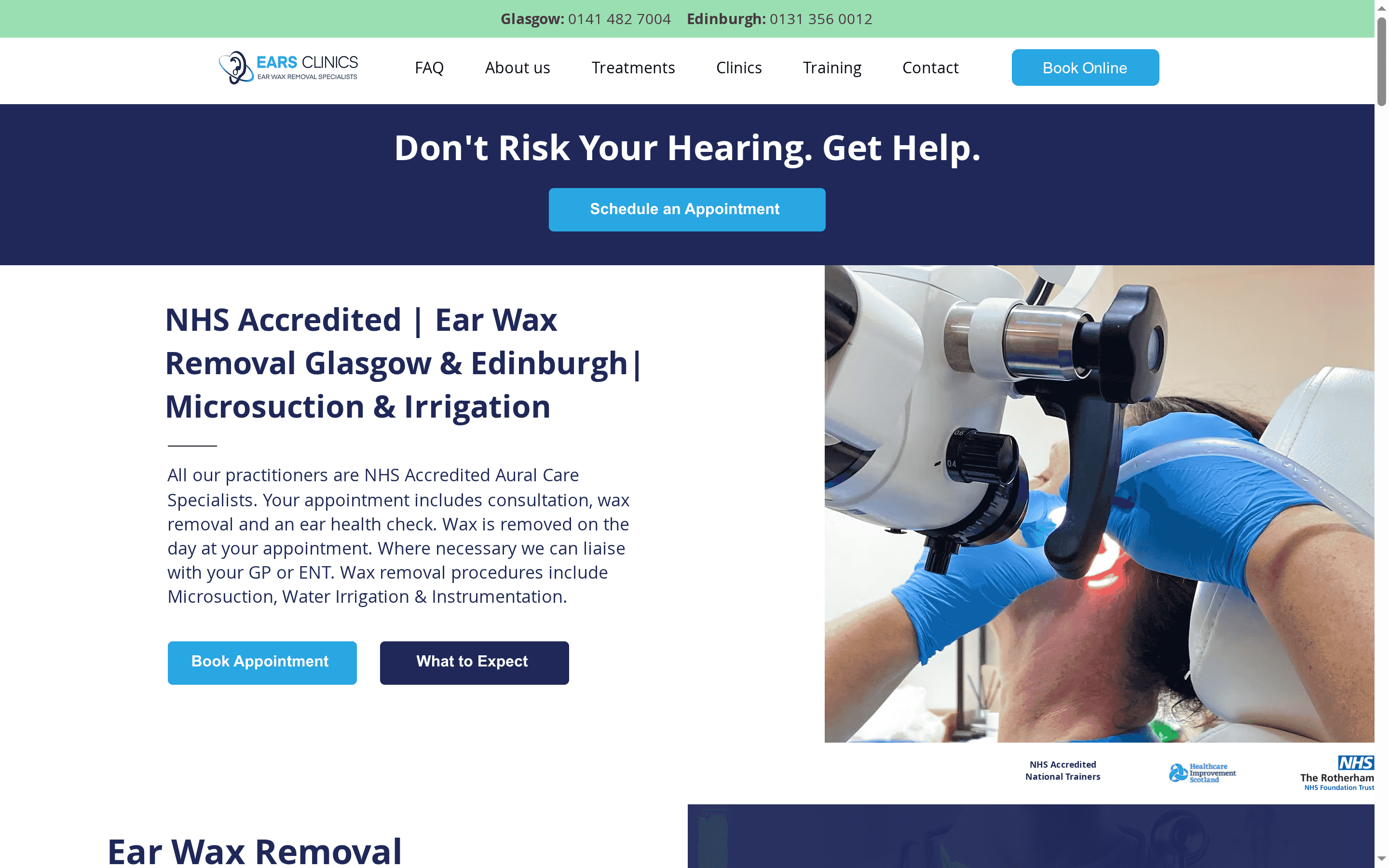
If your GP practice has confirmed a long wait, or doesn’t offer earwax removal at all, you can check what to expect from an ear health check appointment and book a slot that fits your schedule. Clinical letters can be provided to your GP where needed, so you stay within joined-up care even when you’ve chosen to go private. If NHS treatment is clinically appropriate and available in reasonable time, that route remains perfectly valid, EARS Clinics simply gives you a faster, regulated option when timing matters. Book your appointment through the microsuction booking page to see current availability near you.
Frequently asked questions
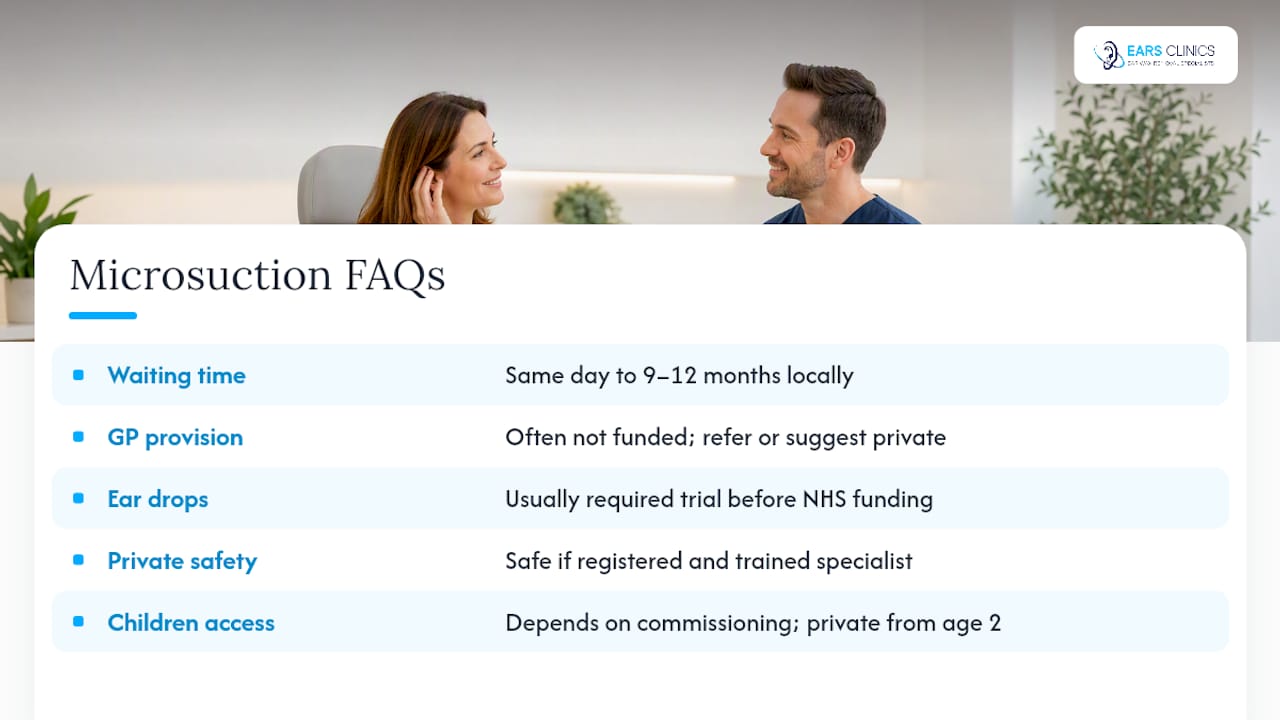
How long is the NHS microsuction waiting time in the UK? It ranges from same-day access in well-commissioned areas to nine to twelve months where local provision is limited, as some GP practice pages confirm. There’s no single national figure because commissioning is decided locally.
Why doesn’t my GP offer ear wax removal? Many practices no longer provide it because it isn’t centrally funded everywhere; NHS patient guidance confirms some surgeries refer patients elsewhere or advise private care instead.
Do I need to try ear drops before microsuction? Often yes. Many local policies require a trial of softening drops, and sometimes a failed irrigation attempt, before microsuction is approved for NHS funding.
Is private microsuction safe? It can be, provided the clinic is registered with Healthcare Improvement Scotland or the Care Quality Commission and the procedure is performed by a trained, NHS-accredited specialist, such as those at EARS Clinics.
Can children get microsuction on the NHS? Availability for children depends on local commissioning and clinical assessment. Private clinics like EARS Clinics are licensed to treat patients from age 2, which can be a useful option where NHS paediatric provision is limited.
This article is general information, not a substitute for advice from a qualified doctor. Consult a qualified healthcare professional about your own circumstances before acting on anything here.
Sources
Recommended