
Microsuction for Hard Wax: What to Expect and How It Works

Yes, microsuction can remove hard wax. A trained clinician views the ear canal under magnification and uses a fine suction tube, with small instruments where the wax is compacted. Sometimes very hard wax needs softening first, and occasionally a second visit. This guide explains how that works, what it feels like, and how to prepare.
TL;DR
Microsuction is suitable for hard and impacted wax. The clinician may add small instruments, such as wax hooks or forceps, when the wax is firm.
Very hard or dry wax can make the procedure uncomfortable, so softening drops are sometimes advised beforehand, but only on a clinician’s advice.
Expect about 15 to 20 minutes for both ears, with noise and perhaps brief dizziness. You can ask to stop at any time.
Microsuction is the method ENT UK describes as the method of choice, and it uses no water, which matters for people who cannot have irrigation.
You can book ear wax removal with EARS Clinics in Glasgow or Edinburgh from £60 for adults.
Can microsuction remove hard wax?
It can. Microsuction is carried out under direct vision, usually with a microscope, so the clinician can see exactly how the wax sits in the canal and what it is made of. Royal Devon University Healthcare NHS Foundation Trust explains that instruments may also be used to remove more solid material, such as foreign bodies or hard wax.
That combination is the reason microsuction suits stubborn wax. Suction alone works well on soft or flaky wax. When wax is hard and compacted, the clinician can loosen it with a hook or lift it with forceps, then clear it with suction. ENT UK’s clinical guidance notes that microsuction may be used alongside wax hooks or crocodile forceps.
Why some wax is harder than other wax
Earwax is a normal, protective substance, and some people simply make drier, harder wax. NHS Tayside’s ear care leaflet lists several factors that raise the chance of build-up:
naturally hard or dry earwax
narrow or hairy ear canals
older age, as wax becomes drier
bony growths in the outer ear canal
regularly using cotton buds, ear plugs or hearing aids
If you wear hearing aids or earplugs, or you have a narrow canal, hard wax can return more often. Regular checks can then be sensible.
What happens if the wax is too hard or impacted?
Most hard wax can be cleared in one appointment. Occasionally it cannot. ENT UK’s patient page on ear microsuction says you may need more than one session if the wax cannot be removed because it is too painful, and the clinician may ask you to use softeners before booking another appointment.
This is a safety decision, not a failure. Very hard wax pressing on the canal wall can make removal uncomfortable, and the Royal Devon leaflet notes that trauma to the canal or eardrum can result from very hard wax or from movement during the procedure. A competent clinician stops, softens, and returns rather than forcing it.
Should you use drops beforehand?
Only if you have been advised to. ENT UK’s patient page says people with hard, dry wax, or who have had problems with microsuction before, can use wax softening drops for 5 days before the appointment to make removal easier. By contrast, York Teaching Hospitals’ guidance says not to use olive oil or softeners unless a clinician has told you to, because wax can become too wet to remove and fungal infections can follow.
The sensible route is to tell the clinic about your wax when you book. We will tell you whether drops are right for you. If you have a perforated eardrum, a history of ear surgery, or ear discharge, do not put anything in your ear before speaking to a clinician. Our guide to safe home methods for loosening ear wax covers what is generally appropriate for adults.

What the procedure involves
You sit or lie down while the clinician looks into the ear with magnification. A fine suction tube then draws out the wax. According to the ENT UK guidance, it can take anything from a few seconds to 20 minutes, depending on the amount of blockage, the consistency of the wax, the shape of the canal and the clinician’s experience.
University College London Hospitals gives 15 to 20 minutes for both ears as the usual time, and says the procedure can be stopped at any time.
What it feels like
The suction is loud, because the tube sits close to the eardrum. Some people feel discomfort, particularly when wax is pressing on the eardrum or is hard and compacted, as UCLH notes. Dizziness and coughing can occur. Dizziness usually passes within a few minutes.
Tell the clinician straight away if anything hurts. Pausing is normal and does not spoil the appointment. For a step-by-step view, see our microsuction procedure guide and the procedure workflow.
Microsuction or irrigation for hard wax?
ENT UK’s guidance states that most ENT doctors regard microsuction as the safest way to clear wax compared with irrigation or manual clearance, and that it should be the method of choice. York Hospitals describes it as the safest way to remove wax without water or pressure, with a clear view of the ear and eardrum throughout.
Irrigation and manual instrumentation remain clinically valid in the right patient. The clinician chooses the safest method for you based on your medical history and what they see in the ear. Hard wax is one reason to favour microsuction with instruments, since water can be unsuitable in several situations.
Situation | Why it matters |
Previous problem with irrigation | A listed reason not to irrigate |
Perforated eardrum or grommets | Water should not be used |
Past ear surgery | Specialist-led approach needed |
Ear discharge in the past 12 months | Irrigation not suitable |
Middle ear infection in the past 6 weeks | Irrigation not suitable |
Only one hearing ear (the one being treated) | Irrigation not suitable |
These contraindications come from the BOB ICB and Frimley ICB policy statement. For more on the trade-offs, read our pages on irrigation risks and microsuction versus irrigation for children.
Is microsuction safe?
It is described as a safe procedure when performed by adequately trained clinicians. ENT UK’s guidance also sets out the possible risks so you can make an informed choice. They include:
trauma to the ear canal skin (about 1 in 20)
ear canal infection after trauma (1 in 500)
severe vertigo (1 in 200)
temporary tinnitus (1 in 100); permanent tinnitus (1 in 5,000)
temporary hearing loss (up to 1 in 100); permanent hearing loss (fewer than 1 in 10,000)
eardrum trauma (fewer than 1 in 10,000)
The same guidance says people with ear canal or eardrum conditions, or previous ear surgery, should be treated by clinicians with extensive experience and ready access to ENT services. If that is you, say so when you book. We are registered with Healthcare Improvement Scotland, and ear care should only ever be done by trained, regulated clinicians, whether regulated by HIS in Scotland or the Care Quality Commission in England. Our ear safety best practice guide explains what to look for.
See your GP or an urgent care service if you have severe pain, discharge or a suspected infection. If you have acute outer ear infection, wax removal may need to wait, as we explain in our page on otitis externa and ear wax removal.
Signs that hard wax may be blocking your ear
NHS Tayside lists earache, hearing loss, tinnitus, itchiness, vertigo and ear infections as problems that usually improve once excess wax is removed. Hard wax that cannot clear by itself can also cause ringing, mild earache and muffled hearing. Hearing aid wearers may notice whistling.
Do not poke at it. The Humber NHS guidance warns that cotton buds, matchsticks and hairpins can push wax deeper, damage the canal or perforate the eardrum, and that ear candles have no benefit and may cause serious injury.
Can you get hard wax removed on the NHS?

Sometimes, but it varies. The NHS says not all GP surgeries remove earwax, and those that do may use irrigation, microsuction or a small scraping device. Where local policy applies, such as the BOB ICB and Frimley ICB statement, removal may require you to have tried self-care first and to have hearing loss, pain, an obscured eardrum, or hearing aid problems.
If you would rather not wait or go through those steps, private care is an option. We offer appointments without pre-treatment requirements, including same-day slots.
Hard wax is where clinical judgement matters most. We would rather you came in and let a specialist look than try to solve it with cotton buds or unsupervised drops. At EARS Clinics, our NHS-accredited Aural Care Specialists choose the safest method for each patient after looking at their history and at the ear itself. Microsuction is the method recommended by current guidance, and we use irrigation or manual instrumentation when they are clinically appropriate. Our approach is designed so that hard wax is dealt with carefully, with before and after imaging and correspondence with your GP or ENT where needed. We are registered with Healthcare Improvement Scotland and licensed to treat patients from 2 years of age. EARS
Our view on hard wax
Book ear wax removal with EARS Clinics
We provide microsuction, irrigation and manual instrumentation in Glasgow and Edinburgh, delivered by NHS-accredited specialists. Prices as published on our booking page:
Ear wax removal, 18+: £60
Ear wax removal, under 18: £75
Home visit within 20 miles of Glasgow: £180
Foreign body removal: £80
Out of hours: £90
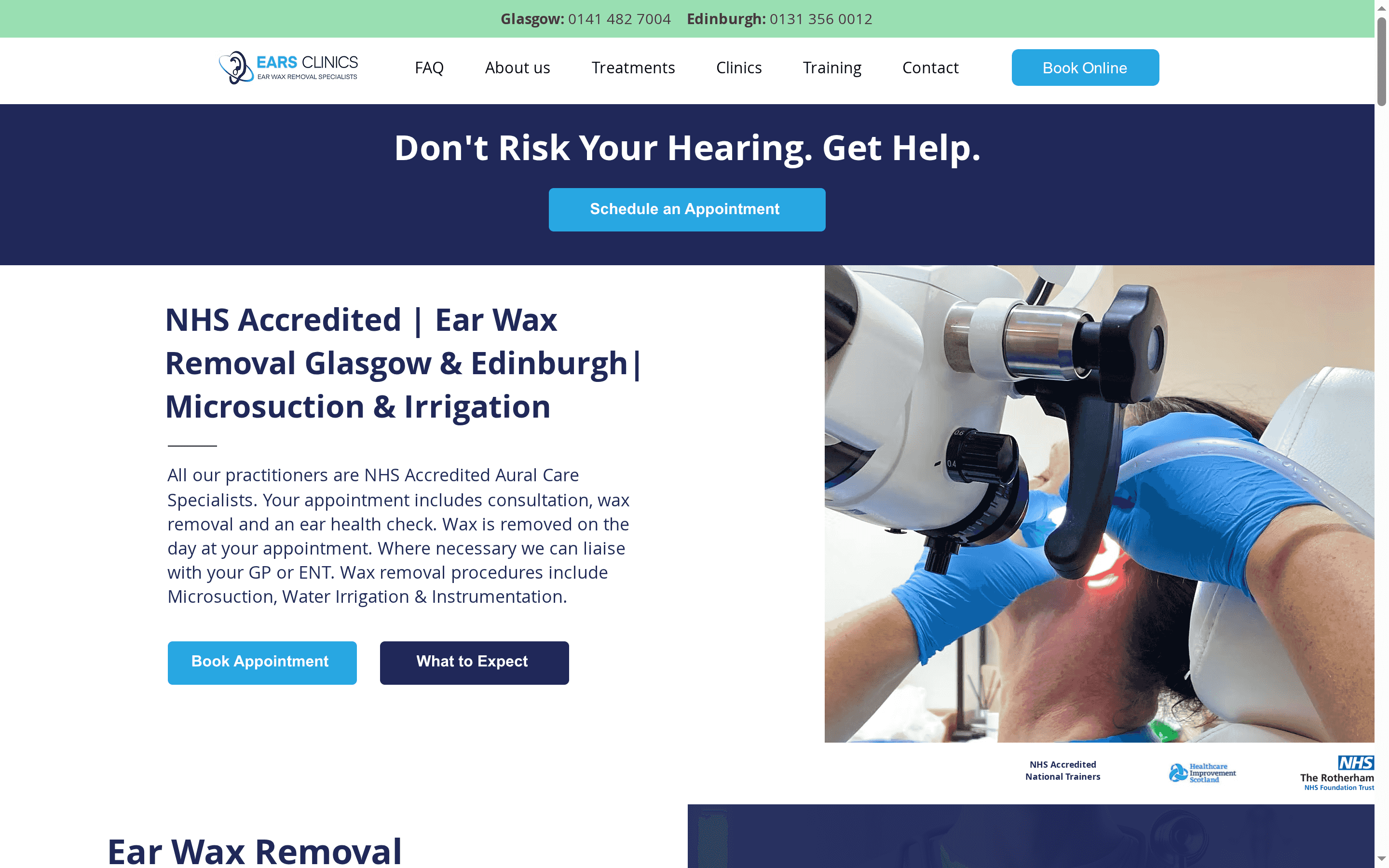
You can book ear wax removal online, or look at our same-day appointments if the blockage is urgent. If travelling is hard, we also offer home visits.
FAQ
Is microsuction painful for hard wax?
Most people find it noisy rather than painful, but hard, compacted wax or wax pressing on the eardrum can cause discomfort. You can ask the clinician to stop at any time. If it is too uncomfortable, they may advise softening and a return visit.
How long does microsuction take?
It can take from a few seconds to 20 minutes depending on the wax and the shape of your ear canal. UCLH quotes 15 to 20 minutes for both ears as typical.
Can microsuction remove impacted wax in one visit?
Often, yes. If the wax is too hard or removal is too uncomfortable, the clinician may suggest softeners and another appointment rather than forcing it.
Is microsuction safer than ear syringing?
ENT UK states most ENT doctors regard microsuction as the safest method and the method of choice. Irrigation can be unsuitable for people with perforations, grommets, previous ear surgery or recent infection.
Sources
Recommended