
Which doctor can safely clean your ear wax?

A GP, practice nurse, audiologist, ENT specialist, or regulated private ear clinic can all remove earwax safely. For most adults in the UK, the fastest and most reliable route is a regulated private clinic offering same-day microsuction, the method currently preferred in NICE guidance for its direct visualisation and tolerability.
Your immediate next steps:
Try safe softening first (unless red flags are present): a few drops of olive oil or mineral oil several times daily for a few days.
Contact your GP surgery to ask whether earwax removal is offered on the NHS at your practice, or whether a referral is available.
Book a regulated private clinic such as EARS Clinics for same-day care, no referral required, with NHS-accredited specialists.
Seek urgent care immediately if you have sudden hearing loss, severe pain, discharge, fever, or a history of perforated eardrum or recent ear surgery.
Pro Tip: Microsuction is performed under magnification, which allows the clinician to see exactly what they are doing at every stage. It is generally preferred for fragile ears, children, and anyone who has had previous ear surgery.
Key takeaways
Seeing a regulated, trained clinician is the safest and most effective route to earwax removal, with microsuction the preferred method in current UK guidance where available.
Point | Details |
Try safe softening first | Use 2–3 drops of olive or mineral oil, 3–4 times daily for up to 5 days, unless red flags are present. |
Stop and seek help for red flags | Sudden hearing loss, severe pain, discharge, or a history of perforated eardrum requires same-day clinical assessment. |
NHS access is variable | Not all GP surgeries offer removal; referral to community audiology can take weeks in many areas. |
Microsuction is the preferred method | Current UK guidance favours microsuction for its direct visualisation and tolerability across most patient groups. |
EARS Clinics offers regulated same-day care | HIS-registered, NHS-accredited specialists in Glasgow and Edinburgh; adults from £60, no referral required. |
What symptoms mean you should see a clinician about earwax?
NHS guidance identifies the following as signs that earwax has built up enough to warrant professional assessment:
Hearing loss or muffled sound in one or both ears
A persistent blocked or full feeling in the ear canal
Earache or discomfort without an obvious cause
Tinnitus (ringing, buzzing, or humming sounds)
Vertigo or a sense of dizziness
Discharge from the ear canal
Fever alongside any of the above
Most of these symptoms respond well to softening drops followed by professional removal. The NHS recommends trying oil drops for 3–5 days before seeking help, provided no red flags are present.
Red flags requiring same-day care: sudden or severe hearing loss, sharp pain, blood or pus from the ear, a history of perforated eardrum or tympanostomy tubes, or symptoms following recent ear surgery. Do not attempt any home treatment in these situations.
Symptoms that persist after several days of safe self-care should prompt a clinical appointment. Hearing aids and earplugs increase the risk of wax impaction, so regular users may need periodic professional cleaning rather than repeated home treatment.
What can you safely try at home before seeing a doctor?
Self-care is appropriate for most adults with mild symptoms and no red flags. The goal is to soften the wax so it can migrate out naturally or be removed more easily by a clinician.
Safe softening agents:
Olive oil, almond oil (avoid if you have a nut allergy), or mineral oil
Over-the-counter cerumenolytics (wax-softening drops) available from pharmacies
Use a few drops, warmed to body temperature, several times daily for a few days
Pro Tip: Lie on your side with the affected ear facing upward for a few minutes after applying drops. This allows the oil to coat the wax rather than simply running back out.
Harvard Health notes that earwax is protective: it moisturises the ear canal, repels bacteria, and traps debris. Removal is only necessary when a build-up causes symptoms. For people with recurrent blockages, a weekly drop of mineral oil can help prevent accumulation.
Do not use:
Cotton buds or cotton swabs, which push wax deeper and risk canal injury
Ear candles, which carry a burn risk and have no clinical evidence of benefit
Sharp objects, hairpins, or any implement not designed for ear use
MedlinePlus is clear that inserting objects into the ear canal is unsafe regardless of the object used. Stop self-care and book a clinical appointment if symptoms worsen, if there is any pain or discharge, or if 5 days of drops have produced no improvement. A step-by-step overview of safe home and clinic ear care can help you understand what to expect at each stage.
Which clinicians remove earwax in the UK?
Several types of healthcare professional can remove earwax, but availability varies considerably across the NHS.
GP (General Practitioner): Can assess earwax and, in some practices, perform basic removal. Many GP surgeries, however, no longer offer this routinely.
Practice nurse: Often the first clinical contact for earwax removal within a GP surgery where the service is still provided.
Audiologist: Trained in ear assessment and removal, particularly relevant for patients with hearing aids or hearing loss.
ENT (Ear, Nose and Throat) specialist: Handles complex or recurrent cases, typically via GP referral. WebMD confirms that ENT referral is appropriate when home treatment fails or complications are suspected.
Regulated private ear clinic: Offers direct-access appointments without a GP referral, often with same-day availability and a wider choice of removal methods.
NHS availability varies significantly. NHS guidance acknowledges that not all GP surgeries provide earwax removal, and local referral pathways differ across regions. Some patients are directed to community audiology services; others are advised to seek private care. Waiting times for NHS referral can extend to several weeks.
For patients who cannot access NHS removal promptly, or who prefer not to wait, a regulated private clinic is a practical and safe alternative. EARS Clinics, for example, is registered with Healthcare Improvement Scotland (HIS) and staffed by NHS-accredited Aural Care Specialists, making it one of the few fully regulated ear health providers in Scotland.
How do clinicians remove earwax? Methods explained
Clinicians select the most appropriate method based on the patient’s medical history, the consistency and position of the wax, and the condition of the ear canal. Mayo Clinic describes the three main approaches used in clinical practice.
Method | How it works | Typical suitability | Contraindications |
Microsuction | A fine suction probe removes wax under direct magnification using a microscope or loupe | Fragile ears, children, post-surgical ears, dry or hard wax | Active infection with discharge (relative); perforated eardrum (specialist assessment required) |
Irrigation | Warmed water or saline is gently pulsed into the canal to dislodge and flush out wax | Soft or moderate wax in cooperative adults with intact eardrums | Suspected or confirmed perforation, tympanostomy tubes, recent ear surgery, otitis externa |
Manual instrumentation | A curette or forceps removes wax under direct vision | Hard, adherent wax; cases where irrigation is contraindicated | Uncooperative patients; very narrow canals; active infection |
Key clinical points:
Microsuction is the preferred method in current UK guidance where available, because it allows continuous visualisation and is generally well tolerated. Full details on the microsuction procedure explain what patients can expect.
Irrigation water must be at body temperature. MedlinePlus notes that water that is too cold or too warm can trigger brief but severe vertigo during the procedure.
The Merck Manual recommends pre-procedure cerumenolytics to soften wax before irrigation or manual removal, and advises against irrigation whenever tympanic membrane integrity is uncertain.
Manual instrumentation can be faster for large, hardened accumulations but requires a skilled, experienced clinician.
The practitioner’s choice of method is always guided by clinical judgement. No single technique suits every patient, which is why a thorough assessment precedes any procedure. An overview of all types of ear wax removal procedures is available for patients who want to understand their options before booking.
When is earwax removal unsafe, and what does aftercare involve?
Some patients should not undergo certain removal methods, or should only receive treatment from a specialist with appropriate equipment.
Contraindications to be aware of:
Suspected or confirmed tympanic membrane perforation
Recent ear surgery (within the past 6–8 weeks, or as directed by the operating surgeon)
Active otitis externa (outer ear infection) with discharge
Tympanostomy (grommets) in place
Severe pain or fever alongside earwax symptoms
Immune suppression or conditions affecting wound healing
MedlinePlus is explicit that home irrigation or cerumenolytic drops are unsafe when tympanic membrane integrity is uncertain. The Merck Manual reinforces this, recommending that clinicians avoid irrigation entirely in these cases and use manual techniques under direct vision instead.
Clinicians mitigate procedural risks through microscope-assisted visualisation, temperature-controlled irrigation equipment, and thorough pre-procedure history-taking. Experienced operators recognise early signs of discomfort and adjust their approach accordingly.
Aftercare following professional removal:
Keep the ear canal dry for 24–48 hours after the procedure
Avoid inserting any objects, including cotton buds, into the ear
Watch for signs of infection: increasing pain, discharge, swelling, or fever
Contact the clinic or your GP if symptoms return or worsen within a few days
Pro Tip: If you wear hearing aids, ask your clinician about a regular maintenance schedule. Hearing aid users are at higher risk of recurrent wax build-up, and a 6–12 monthly check can prevent the cycle of blockage and removal.
What happens at a professional earwax removal appointment?
A typical appointment at a regulated clinic or GP surgery follows a consistent pattern, though the exact steps vary slightly by setting and method.
Assessment phase: The clinician takes a brief history, asking about symptoms, duration, any previous ear surgery, allergies, and current medications. They then examine both ears using an otoscope or, in specialist clinics, a microscope or video otoscope. This assessment determines which removal method is appropriate.
Procedure phase: Most appointments take 20–45 minutes in total. The removal itself is usually 5–15 minutes per ear. Microsuction produces a low hissing sound and mild suction sensation; irrigation feels like a gentle warm flush; manual instrumentation involves light pressure. None of these should be painful. If you experience sharp pain at any point, tell the clinician immediately.

After the procedure: Many clinics provide before-and-after imaging so you can see the result. Written aftercare instructions are standard at regulated clinics. You can usually return to normal activities straight away.
NHS vs private: access and costs
Pathway | Typical access | Approximate cost | Waiting time |
NHS GP surgery | Referral or direct (where available) | No charge to patient | Days to several weeks |
NHS community audiology | GP referral required | No charge to patient | Weeks to months |
Private ear clinic (adults) | Direct booking, no referral | £60 per appointment | Same day to a few days |
Private ear clinic (under-18s) | Direct booking | £75 per appointment | Same day to a few days |
Private home visit | Direct booking | £180 per visit | Usually within days |
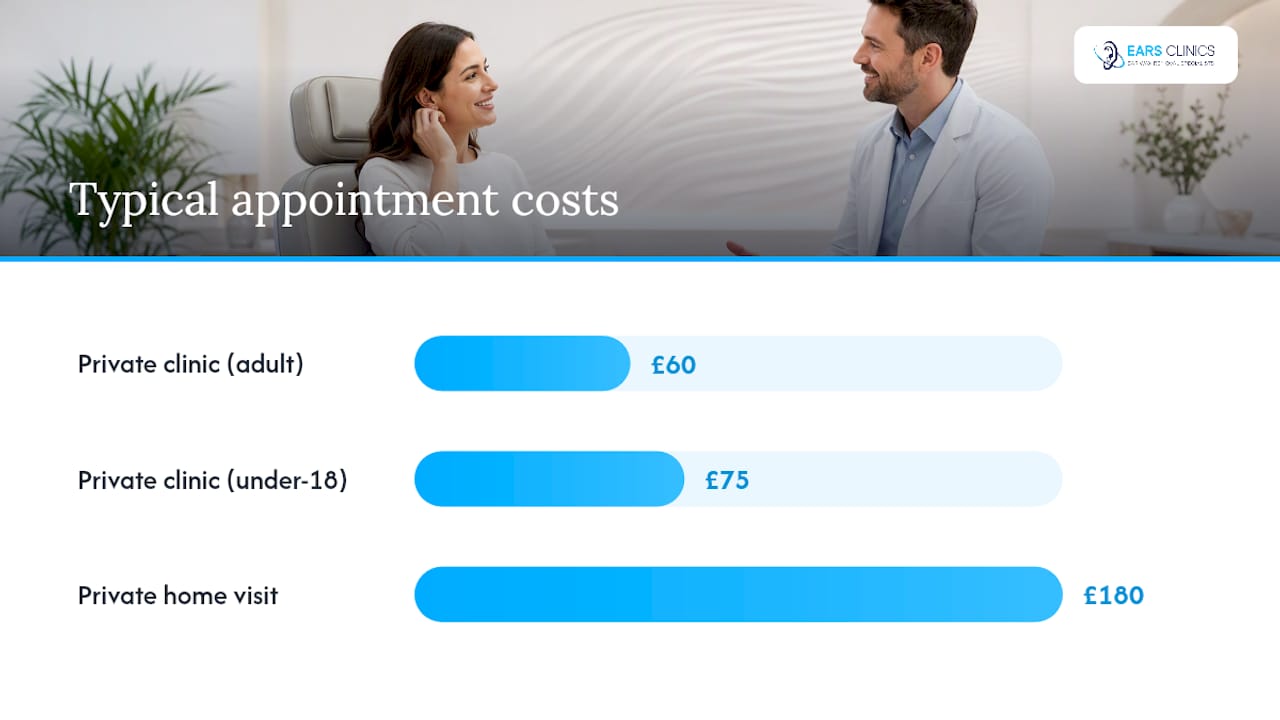
Costs above are indicative ranges for the UK private market. EARS Clinics charges £60 for adults, £75 for under-18s, and £180 for home visits. A full overview of what your appointment includes is available on the EARS Clinics website.
How do you choose a safe, trustworthy ear clinic or doctor?
Not every provider offering earwax removal in the UK operates to the same clinical standard. These questions and criteria will help you identify a regulated, competent service.
Checklist before you book:
Is the clinic registered with the Care Quality Commission (CQC) in England, or Healthcare Improvement Scotland (HIS) in Scotland?
Are practitioners NHS-accredited or trained to a recognised clinical standard in aural care?
Does the clinic use a microscope or video otoscope for assessment and during microsuction?
Is microsuction available, or is only irrigation offered?
Does the clinic provide written aftercare instructions?
Is there a clear infection control policy and clinical indemnity in place?
Can the clinic provide clinical correspondence to your GP or ENT if required?
Is the clinic licensed to treat children, if relevant?
Questions to ask when booking:
What qualifications does the practitioner hold, and are they NHS-accredited?
Which removal methods are available, and how will the clinician decide which to use?
What is included in the appointment fee?
Is a pre-assessment carried out before any procedure begins?
What is the process if a complication arises?
When to choose NHS vs private:
The NHS route is appropriate when your GP surgery offers removal, when you are not in a hurry, and when your case is straightforward. Private care is worth considering when NHS access is limited in your area, when you need same-day treatment, or when you have a complex ear history that benefits from specialist equipment. A practical guide to choosing an ear clinic covers these criteria in more detail.
Why EARS Clinics meets the standard for regulated ear care
EARS Clinics is registered with Healthcare Improvement Scotland (HIS), making it one of a small number of fully regulated ear health providers in Scotland. All practitioners are NHS-accredited Aural Care Specialists, trained to the same clinical standards applied in NHS settings.
Services available at EARS Clinics:
Microsuction (preferred method, performed under magnification)
Irrigation using temperature-controlled equipment
Manual instrumentation for complex or hardened wax
Same-day appointments at clinics in Glasgow and Edinburgh
Home visits for patients who cannot attend in person
Ear health checks with before-and-after imaging
Clinical correspondence with GPs and ENT specialists
Specialist care for children from 2 years of age
The clinic operates without requiring a GP referral, which means patients can access care directly when they need it. Practitioners select the safest and most suitable procedure based on each patient’s medical history and the findings of the clinical assessment, rather than applying a one-size-fits-all approach.
For patients with hearing aids, recurrent wax problems, or complex ear histories, the clinic’s combination of specialist equipment, NHS-accredited staff, and flexible booking options provides a level of care that is difficult to access through standard NHS routes.
A professional perspective on safe ear care
The single most common mistake patients make is reaching for a cotton bud. It feels intuitive, but it reliably pushes wax further into the canal and can cause abrasions or, in the worst cases, a perforated eardrum. The second most common mistake is waiting too long. Wax that has been impacted for months is harder to remove, more likely to require multiple methods, and more likely to have caused secondary problems such as mild infection or skin irritation.
The right approach is straightforward: soften first with oil drops if there are no red flags, then seek a trained clinician if symptoms persist. Microsuction is preferred when it is available, because the clinician can see exactly what they are doing throughout the procedure. But the method matters less than the clinician’s training and the quality of the assessment. A well-performed irrigation by an experienced practitioner is far safer than a poorly performed microsuction. Regulation through CQC or HIS is the clearest signal that a clinic operates to a defined clinical standard, and it is the first thing worth checking before booking anywhere.
Book safe, same-day ear wax removal with EARS Clinics
If you have been waiting weeks for an NHS appointment, or your GP surgery no longer offers earwax removal, EARS Clinics offers a direct, regulated alternative in Glasgow and Edinburgh. Appointments are available the same day in many cases, with no referral needed and no requirement to pre-treat with drops beforehand.
A standard adult appointment costs £60 and includes a full clinical assessment, otoscopy, the removal procedure itself, before-and-after imaging, and written aftercare. Under-18s are seen for £75, and home visits are available at £180 for patients who cannot travel to the clinic. All procedures are carried out by NHS-accredited Aural Care Specialists using clinical-grade equipment, and the clinic is HIS-registered.
Book your appointment online at EARS Clinics and get your hearing back to its best.
Sources
These authoritative resources provide further clinical detail on earwax, removal methods, and when to seek professional help.
This article is general information, not a substitute for advice from a qualified doctor. Consult a qualified healthcare professional about your own circumstances before acting on anything here.
Recommended