
Blocked ear after a flight: causes, fixes and when to see someone

A blocked ear after a flight is usually ear barotrauma, also called airplane ear, caused by pressure changes your Eustachian tube couldn’t equalise quickly enough during ascent or descent. In most cases, it clears within minutes to a few hours using simple techniques.
Try these three things first, in order:
Swallow or yawn repeatedly. This activates the muscles that open your Eustachian tube.
Chew gum or sip water. The repeated swallowing motion works the same muscles without effort.
Try a gentle Valsalva manoeuvre. Pinch your nose, close your mouth, and blow gently until you feel a pop. Stop immediately if it causes pain.
Most blocked ears settle within a few hours of landing. If fullness, muffled hearing or discomfort lasts beyond 48 hours, or you notice pain, bleeding or dizziness, it’s time to get it checked rather than wait it out.
Key Takeaways
Most blocked ears after flying resolve within hours through swallowing, chewing or gentle pressure-equalising manoeuvres, but persistent, painful or worsening symptoms need clinical assessment rather than repeated self-treatment.
Point | Details |
Try simple measures first | Swallow, yawn, chew gum or attempt a gentle Valsalva or Toynbee manoeuvre before anything else. |
Know the timeline | Most cases clear within minutes to a few hours; persistent symptoms require medical review. |
Watch for red flags | Severe pain, bleeding, sudden hearing loss, vertigo or fever mean urgent assessment, not waiting. |
Understand the risk factors | Colds, sinusitis, allergies, earwax and sleeping through descent all raise the odds of blockage. |
Book regulated clinical care | Earhealthservice offers microsuction, irrigation and manual instrumentation from NHS-accredited, HIS-regulated specialists when self-care isn’t enough. |
Why ears block after flying and what the symptoms mean
Your middle ear sits behind the eardrum as a small air pocket, connected to the back of your nose by the Eustachian tube. That tube’s job is to let air in and out so pressure on both sides of your eardrum stays equal. When a plane climbs or descends, cabin pressure changes faster than your tube can respond, especially on the way down, and the eardrum gets pulled or pushed out of shape. That’s the fullness and muffling you feel.
Several things make this more likely. A cold, sinusitis, hay fever or other allergies all cause swelling around the Eustachian tube’s opening, narrowing the passage air needs to travel through. A build-up of earwax adds another barrier. Falling asleep during descent is a common, avoidable trigger, since you stop swallowing altogether at the point pressure is changing fastest.
Most symptoms are mild and short-lived: pressure, muffled hearing, a mild ache, or a faint ringing (tinnitus). Treat these differently from the warning signs below:
Severe or worsening pain rather than pressure
Blood or fluid draining from the ear
Sudden hearing loss
Vertigo or a spinning sensation that doesn’t settle
How to unblock your ears after flying, step by step
Start with the basics before trying anything more deliberate. Yawning stretches the muscles around the Eustachian tube open; swallowing does something similar through a different muscle group; chewing keeps both moving continuously, which is why cabin crew hand out sweets on descent. None of these carry any risk, so they’re always worth doing first.
If those don’t shift it, move through these manoeuvres in order:
Valsalva manoeuvre. Pinch your nostrils shut, close your mouth, and blow gently through your nose as if clearing it. You should feel a soft pop. Never blow hard. Stop if you feel pain, pressure building without release, or dizziness.
Toynbee manoeuvre. Pinch your nose and swallow with your mouth closed. Some people find this gentler and more reliable than Valsalva.
Frenzel manoeuvre. Close your mouth and throat as if straining, then push the back of your tongue upward while pinching your nose. This one takes practice but avoids the pressure spikes Valsalva can produce.
Stop any of these immediately if you feel sharp pain, hear a whistling sound, or notice bleeding. Forcing it against resistance can damage the eardrum.
Adjuncts can help alongside these techniques. A warm compress held against the outer ear for ten minutes eases discomfort and may loosen thickened wax. Paracetamol or ibuprofen at standard doses manage pain. Decongestant nasal sprays reduce swelling around the Eustachian tube opening and can help, but limit use to three or four days. Longer use causes rebound congestion that makes the underlying problem worse.

Pro Tip: Do the Toynbee manoeuvre little and often during descent rather than one big effort once you land. It’s gentler on the eardrum and tends to work better than a single forceful attempt.
Avoid forcing any of these techniques if you have severe pain or suspect an ear infection. Forceful equalising against an already inflamed or infected middle ear risks pushing infection further in or damaging the eardrum.
How long a blocked ear lasts and when to get it checked
Most airplane ear resolves within minutes to a few hours once you’re back on the ground and swallowing normally again. A day of mild fullness or muffled hearing is common and nothing to worry about.
**Symptoms that persist beyond 48 hours warrant a proper assessment, particularly if they’re not improving at all. Watch for these red flags and act accordingly:
Severe or worsening ear pain that isn’t easing with paracetamol or ibuprofen: contact your GP or book an urgent assessment
Blood or discharge from the ear canal: seek same-day medical review
Sudden or significant hearing loss: get assessed urgently, ideally same day
Severe dizziness, vertigo or loss of balance: seek urgent care
Fever alongside ear pain, which suggests infection rather than simple barotrauma: contact your GP promptly
None of these signs are common after a routine flight, but they change the picture from “wait it out” to “get it looked at” quite quickly. If you’re ever unsure, treat persistent pain or hearing change as reason enough to book an assessment rather than waiting to see if it settles on its own.
What happens at a clinic: microsuction, irrigation and manual instrumentation
When self-care doesn’t clear things, particularly where earwax build-up or ongoing Eustachian tube dysfunction is the underlying issue, professional ear care offers safe, regulated options. Three methods dominate clinical practice, and each suits different situations.
Microsuction uses gentle suction under microscope or magnified vision to lift wax or debris away without introducing any liquid. Current guidance and clinical practice favour microsuction where appropriate, largely because it’s dry, precise and generally well tolerated. Irrigation uses warm water to gently wash out the ear canal and remains valid and safe for many patients. Manual instrumentation uses fine specialist tools to remove wax directly and suits particular presentations a clinician identifies on examination.
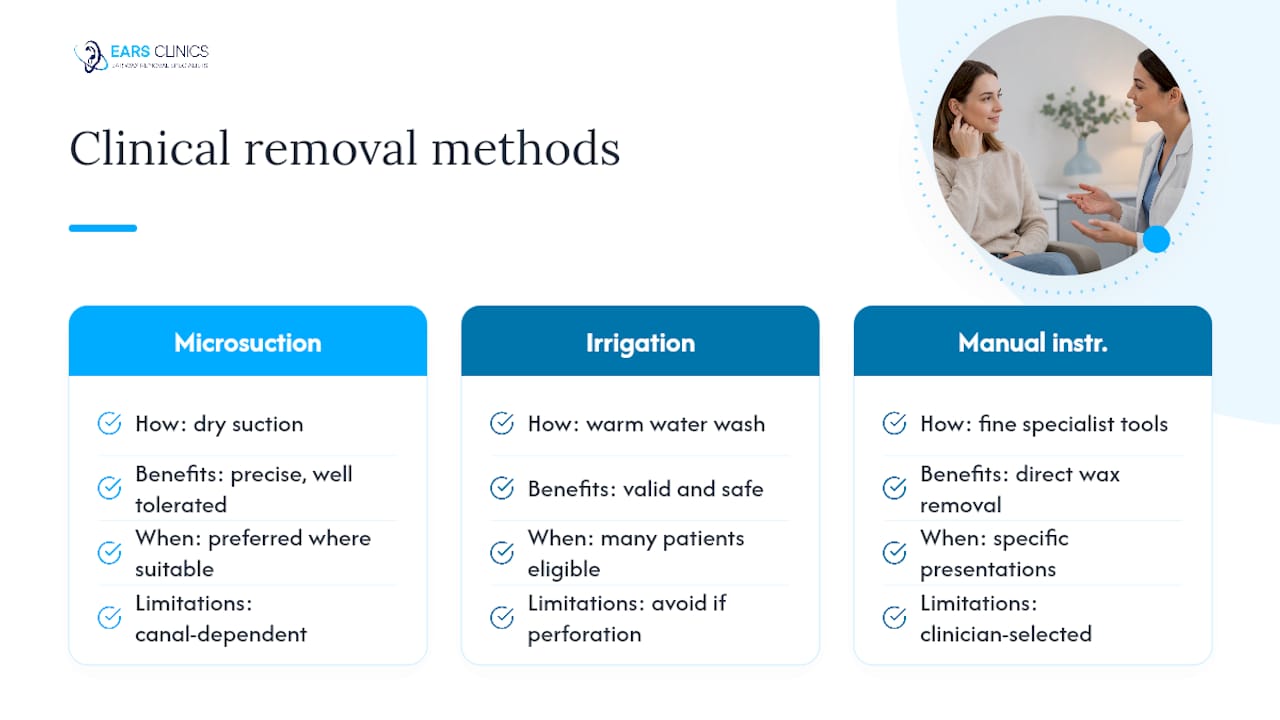
Which method gets used isn’t fixed. Your practitioner decides based on your ear canal’s shape, whether you have a perforated eardrum, wax consistency, and your wider medical history. Surgical intervention such as myringotomy is rarely needed for flight-related barotrauma; the overwhelming majority of patients respond to conservative or clinic-based non-surgical care.
Before booking anywhere, ask two questions: is the clinic regulated by the Care Quality Commission or Healthcare Improvement Scotland and are the practitioners NHS-accredited? A proper appointment starts with an otoscopic examination, a discussion of your history, and a clear explanation of which method suits your ears before anything happens.
Pro Tip: If you’ve flown with an existing cold and the blockage hasn’t settled after a couple of days, book an ear health check rather than repeating Valsalva attempts. Persistent pressure against an already inflamed Eustachian tube rarely responds to more forcing.
Preventing blocked ears on your next flight
A little preparation before you fly matters more than anything you do once you’re already uncomfortable mid-descent.
If you’re flying with a heavy cold or blocked sinuses, consider rescheduling where you can. It’s the single biggest risk factor you have control over.
Use a decongestant nasal spray or oral decongestant 30 to 60 minutes before descent if your GP or pharmacist confirms it’s suitable for you.
Chew gum, suck a sweet, or drink water continuously during descent rather than waiting until your ears feel full.
Stay awake for landing. Sleeping through descent is one of the most common, entirely avoidable causes of a blocked ear.
Pressure-regulating earplugs slow the rate of pressure change reaching your eardrum and help many frequent flyers.
If blocked ears happen on nearly every flight, that’s a pattern worth treating rather than repeatedly managing. Getting allergies or sinus problems properly controlled, and seeing an ENT specialist for recurrent Eustachian tube dysfunction, addresses the underlying cause rather than just the symptom each time you travel.
Why self-care first is the right advice, and where it stops being enough
Most guidance on blocked ears after flying gets the emphasis right: try the simple things first, because they work for the overwhelming majority of people. Where a lot of advice falls short is in defining the point at which self-care stops being appropriate. Too many articles list the same three manoeuvres and leave readers to guess when repeating them becomes pointless, or worse, harmful.
The honest answer is that forcing a Valsalva manoeuvre against genuine resistance, over and over, past the point of mild discomfort, isn’t persistence. It’s a sign the underlying blockage, whether wax, inflammation or fluid, needs a clinician’s eyes rather than more effort from you. That’s not a failure of self-care. It’s simply outside its scope.
What the reader should prioritise first is honest self-assessment at the 48-hour mark: is this improving, plateauing, or getting worse? A plateau or decline after two days is the signal to book an assessment with a regulated practitioner rather than trying yet another manoeuvre variation. Getting that timing right matters more than which technique you try first.
Book a regulated ear assessment with Earhealthservice
If your ears are still blocked days after a flight, Earhealthservice gives you same-day access to a regulated clinical assessment, without the waiting list that often comes with a GP referral for something this straightforward. Every appointment is carried out by an NHS-accredited Aural Care Specialist, and the clinic chooses between microsuction, irrigation or manual instrumentation based on what your ear canal and history actually need, not a one-size-fits-all default.
Earhealthservice is registered with Healthcare Improvement Scotland, so you’re seeing a clinician working to the same regulatory standard you’d expect from any NHS-accredited setting, with the shorter waiting time private care allows. Home visits are available for anyone who can’t easily get to clinic, and clinics operate across Glasgow and Edinburgh with same-day slots when your symptoms need prompt attention.
If your blocked ear has lasted more than a couple of days, book a same-day appointment and get it properly assessed rather than waiting it out any longer.
Frequently asked questions
Why is my ear blocked after a flight if I don’t have a cold? Pressure changes alone can overwhelm your Eustachian tube’s ability to equalise, particularly during rapid descent, even without congestion. Sleeping through descent or simply not swallowing enough during the pressure change is often the whole explanation.
My ear won’t pop after a flight. What should I do? Keep trying gentle swallowing, yawning or a Toynbee manoeuvre rather than forcing a hard Valsalva attempt. If it hasn’t resolved within 48 hours, book an assessment rather than continuing to force it.
Can a blocked ear after a cold make flying worse? Yes. Congestion from a cold narrows the Eustachian tube before you even board, so flying with a heavy cold significantly raises your risk of painful barotrauma. Rescheduling, where possible, avoids the problem entirely.
Is it safe to fly with a blocked ear before the flight? It’s generally safer to address congestion before you fly than to fly and hope pressure changes clear it. A decongestant taken in advance, following pharmacist or GP advice, reduces the risk considerably.
When does a blocked ear become an emergency? Severe pain, blood or discharge, sudden hearing loss, or significant vertigo are urgent signs. These warrant same-day medical attention rather than home management.
This article is general information, not a substitute for advice from a qualified doctor. Consult a qualified healthcare professional about your own circumstances before acting on anything here.
Sources
For deeper background on the mechanics and management of airplane ear, these sources informed this guide:
For booking or procedure detail, see Earhealthservice’s emergency appointment page or what to expect at an ear health check.
Recommended