
Best way to clean ear wax out: safe methods for 2026

TL;DR:
The ear canal naturally cleans itself through epithelial migration, making additional cleaning unnecessary for most adults.
Unsafe methods like cotton swabs, ear candling, and water devices can cause injury or worsen wax impaction, while professional removal methods are safer when needed.
Earwax, known clinically as cerumen, is a natural protective substance, and the best way to clean ear wax out is to work with the ear’s own biology rather than against it. The ear canal is self-cleaning by design, and most adults never need to intervene at all. When wax does build up and causes symptoms, safe options range from cerumenolytic drops at home to professional procedures such as microsuction, irrigation, and manual instrumentation performed by trained clinicians. Medical authorities including NICE and Healthcare Improvement Scotland (HIS) are clear: nothing should be inserted into the ear canal without clinical justification.
Why are ears self-cleaning and what goes wrong?
The ear canal cleans itself through a process called epithelial migration. Skin cells in the canal move outward naturally, carrying wax and debris with them toward the outer ear. This means, for most people, cerumen exits the canal on its own without any assistance.
Earwax is not dirt. Cerumen contains antimicrobial properties that protect the canal from bacteria, fungi, and foreign bodies. Removing it too aggressively strips the canal of this protection and can trigger more wax production as a compensatory response.
Problems arise when wax accumulates faster than it migrates out. This is more common in people who use hearing aids or earplugs regularly, have naturally narrow ear canals, or produce drier wax that does not migrate as easily. Cotton swabs are the most common cause of wax impaction. Inserting objects like cotton swabs pushes wax deeper into the canal rather than removing it, and risks perforating the eardrum or causing infection.
The key distinction is this: only the outer ear should be cleaned physically. The ear canal itself should be left alone unless a trained clinician is involved.
Pro Tip: Wipe the outer ear with a damp cloth after a shower. That is the only physical cleaning the ear needs under normal circumstances.
Common unsafe practices to avoid:
Cotton swabs and cotton buds: Push wax deeper and risk eardrum injury.
Bobby pins, keys, or any rigid object: Can lacerate the delicate canal skin.
Ear candling: Burns debris from the candle itself, not wax from the ear. Experts strongly advise against ear candling due to burn risks and a complete absence of clinical evidence for efficacy.
High-pressure water devices: Water flossers and shower jets can perforate the eardrum.
Safe home remedies for ear wax buildup
Home treatment is appropriate for mild wax buildup in adults with no history of ear surgery, perforated eardrums, or active ear infections. The goal is to soften the wax so the ear can expel it naturally.
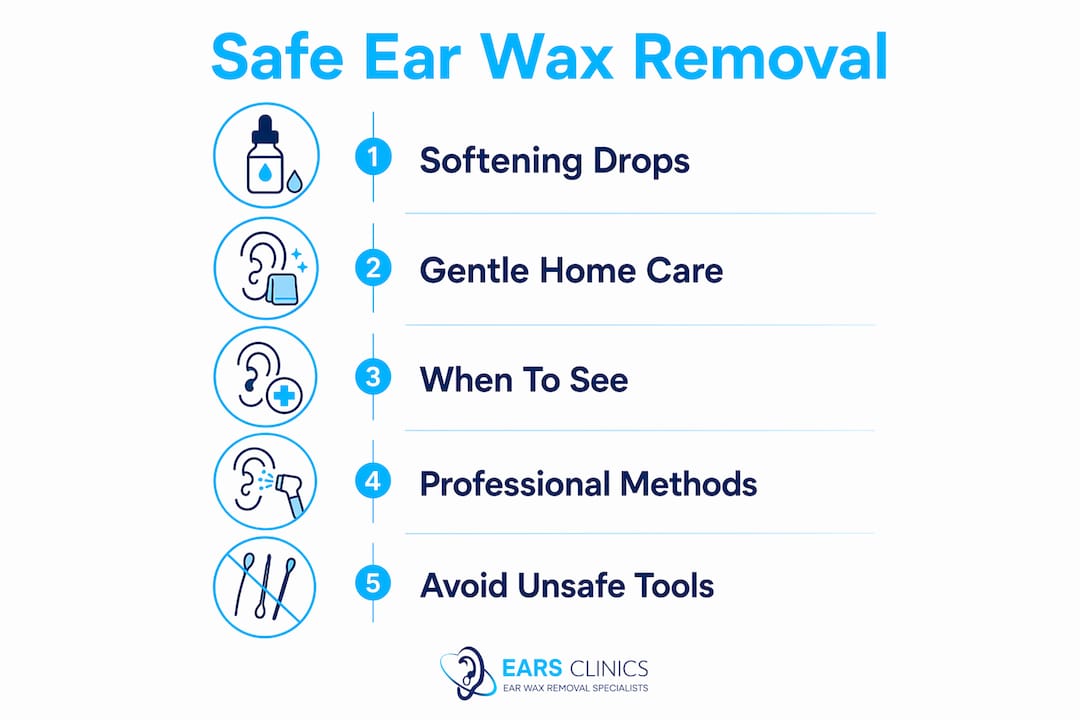
The most effective home remedies for ear wax use cerumenolytic agents, which are drops that soften or dissolve cerumen. Options include mineral oil, glycerin, and commercially available ear drops. A few drops placed in the affected ear, with the head tilted for several minutes, can soften wax significantly over several days. For a full step-by-step home guide, Earhealthservice provides clinically reviewed instructions.
Follow this sequence for safe home treatment:
Confirm there are no contraindications. Do not attempt home irrigation if you have had ear surgery, a perforated eardrum, diabetes, or an active ear infection. A baseline medical examination before home treatment can prevent serious complications.
Apply cerumenolytic drops. Use mineral oil, glycerin, or a commercial ear drop product. Tilt your head to the side, apply the drops, and remain still for 3–5 minutes. Repeat twice daily for 3–5 days.
Irrigate gently with body-temperature water. Use a rubber bulb syringe. Irrigation water must be at 37°C to avoid triggering vertigo and nausea. Cold or hot water stimulates the vestibular system and causes dizziness.
Tilt your head to drain. After irrigation, tilt the treated ear downward and allow water and softened wax to drain out naturally.
Dry the outer ear gently. Use a clean towel or a hairdryer on the lowest setting held at arm’s length.
Pro Tip: Never use a high-pressure device for home irrigation. Rubber bulb syringes are the only safe option for home use. Excessive pressure risks eardrum perforation.
If symptoms persist after five days of home treatment, or if you experience pain, hearing loss, or discharge, stop home treatment and seek professional assessment.
What are the professional ear wax removal methods?
Professional ear wax removal is the safest and most reliable option for impacted wax, high-risk patients, and anyone whose symptoms do not resolve with home treatment. Clinicians select the most appropriate method based on each patient’s medical history and clinical presentation.
Microsuction is considered the safest method by current NICE guidelines. It uses a fine suction device under microscopic or loupe guidance to remove wax without introducing water into the canal. This makes it suitable for patients with perforated eardrums, previous ear surgery, or active infections where irrigation would be contraindicated.
Irrigation involves flushing the canal with body-temperature water using a controlled-pressure device. It is effective for soft or partially softened wax and is widely used in clinical settings. Clinical protocols favour microsuction for high-risk groups, including diabetics and immunocompromised patients, where infection risk must be minimised.
Manual instrumentation uses curettes or loops to physically remove wax. This method requires clinical expertise to avoid trauma to the canal wall or eardrum, and is often selected when irrigation is contraindicated and microsuction is not available.
Method | How it works | Best suited for |
Microsuction | Gentle suction under microscopic guidance | Impacted wax, perforated eardrums, post-surgery patients |
Irrigation | Controlled water flush at body temperature | Soft or partially softened wax in low-risk patients |
Manual instrumentation | Curette or loop extraction by a clinician | Cases where water-based methods are contraindicated |
Earhealthservice is registered with Healthcare Improvement Scotland (HIS) and is one of the few regulated ear healthcare clinics in Scotland. All procedures are performed by NHS-accredited Aural Care Specialists. Patients can be seen from 2 years of age.
What are the risks of unsafe ear wax removal methods?
Several popular methods are not only ineffective but actively dangerous. Understanding why they fail protects you from avoidable harm.
Ear candling: The debris found in a used ear candle is residue from the burning candle itself, not wax drawn from the ear. Ear candling is unsafe and ineffective, carrying real risks of burns to the face, canal, and eardrum.
Home ear endoscope devices: These camera-tipped tools are marketed for self-removal, but the delicate ear canal anatomy requires skilled manual extraction even when a camera is present. Without clinical training, the risk of injury is significant.
Water flossers and shower jets: These generate pressure far above what the eardrum can safely tolerate. A single use can cause perforation.
Frequent DIY attempts: Repeated attempts to remove wax at home, even with relatively safe tools, cause micro-abrasions in the canal. These abrasions increase infection risk and stimulate the glands to produce more wax, worsening the original problem.
The pattern seen in clinical practice is consistent. Patients who arrive with impacted wax have often spent weeks attempting home removal with cotton buds or other objects, compacting the wax further with each attempt. Professional removal at the first sign of blockage is far less invasive than treating the consequences of repeated DIY efforts.
How can you prevent ear wax buildup long term?
Prevention reduces the frequency of professional treatment and protects the ear canal from chronic irritation. These steps are grounded in current clinical guidance.
Never insert objects into the ear canal. This includes cotton buds, fingers, and any device not prescribed by a clinician. The outer ear is the only area that benefits from physical cleaning.
Limit ear-insert device use. Hearing aids and earplugs block the natural outward migration of wax. Limiting use to 8 hours daily reduces wax impaction risk for regular users.
Use mineral oil drops weekly if prone to buildup. A single drop of mineral oil in each ear once a week lubricates the canal and keeps wax soft enough to migrate naturally. This is particularly useful for patients with dry cerumen.
Schedule routine professional cleaning every 6–12 months. Routine professional ear cleaning every 6–12 months is the most effective management strategy for patients who experience frequent buildup. It removes accumulated wax before it becomes impacted.
Recognise the warning signs. Muffled hearing, a feeling of fullness in the ear, tinnitus, or mild earache are all signs that wax has built up enough to warrant professional assessment. Acting early prevents impaction.
For guidance on preventing ear wax buildup through lifestyle changes and routine care, Earhealthservice publishes clinically reviewed resources.
Key takeaways
The safest and most effective approach to ear wax removal is to use cerumenolytic drops for mild buildup and seek professional microsuction, irrigation, or manual instrumentation for impacted or symptomatic wax.
Point | Details |
Ears are self-cleaning | Most adults need no intervention; wax migrates out of the canal naturally. |
Home treatment has limits | Cerumenolytic drops and gentle irrigation at 37°C are safe for mild buildup in low-risk adults. |
Professional removal is safest | Microsuction, irrigation, and manual instrumentation are performed by trained clinicians based on patient history. |
Common methods cause harm | Ear candling, cotton buds, and home endoscopes are unsafe and can worsen impaction or cause injury. |
Prevention reduces recurrence | Weekly mineral oil drops and professional cleaning every 6–12 months manage chronic buildup effectively. |
What we see in practice at EARS Clinics
The most common mistake we encounter is patients who have been using cotton buds for years, convinced they are keeping their ears clean. What they are actually doing is compacting wax against the eardrum and stripping the canal of its natural protective coating. By the time they come to us, what could have been a straightforward microsuction appointment has become a more involved procedure.
The second most common issue is patients who have tried ear candling after seeing it recommended online. We have seen canal burns and wax pushed further in as a result. There is no clinical evidence that ear candling removes cerumen. None. The debris in the candle is from the candle itself.
What I would encourage every adult to do is have a baseline ear examination before attempting any home treatment. Hidden conditions such as a small perforation or a narrow canal change the risk profile entirely. A five-minute assessment by a trained Aural Care Specialist tells you exactly what you are dealing with and which approach is appropriate. Skipping that step is where most complications begin.
The 2026 NICE guidelines continue to position microsuction as the preferred first-line professional method, and that reflects what we see in practice. It is dry, controlled, and does not introduce water into a canal that may already be compromised. For patients who are suitable for irrigation, it remains a clinically valid and effective option. The key is that the decision is made by a trained clinician, not by a patient with a cotton bud.
— EARS
Professional ear wax removal at EARS Clinics
Earhealthservice provides NHS-accredited ear wax removal at clinics in Glasgow and Edinburgh, with home visits available across the region.

All procedures, including microsuction, irrigation, and manual instrumentation, are carried out by trained Aural Care Specialists registered with Healthcare Improvement Scotland (HIS). Appointments are available the same day, with no requirement for pre-treatment softening drops before attending. Pricing is £60 for adults, £75 for under-18s, and £180 for home visits. Earhealthservice treats patients from 2 years of age and tailors every procedure to the individual’s medical history and clinical presentation.
FAQ
What is the safest way to remove ear wax at home?
The safest home method is applying cerumenolytic drops such as mineral oil or glycerin to soften wax, followed by gentle irrigation with a rubber bulb syringe using water at 37°C. Avoid cotton buds, high-pressure devices, and ear candling entirely.
When should I see a professional for ear wax removal?
Seek professional assessment if you experience muffled hearing, ear fullness, tinnitus, pain, or discharge that does not resolve after five days of home treatment. Patients with diabetes, a history of ear surgery, or a perforated eardrum should always see a clinician rather than attempting home removal.
Is microsuction better than irrigation?
Microsuction is the method preferred by current NICE guidelines because it does not introduce water into the canal, making it suitable for a wider range of patients including those with perforated eardrums or post-surgical ears. Irrigation is equally effective for low-risk patients with soft wax and remains a clinically valid option.
How often should I have my ears professionally cleaned?
Adults prone to wax buildup benefit from professional cleaning every 6–12 months. Regular users of hearing aids or earplugs may need more frequent appointments because these devices interfere with the ear’s natural wax migration.
Does ear candling actually work?
Ear candling does not remove earwax. The debris found inside a used candle comes from the candle itself, not from the ear canal. Clinical experts advise strongly against it due to the risk of burns and the absence of any evidence of efficacy.
Recommended